
Introduction
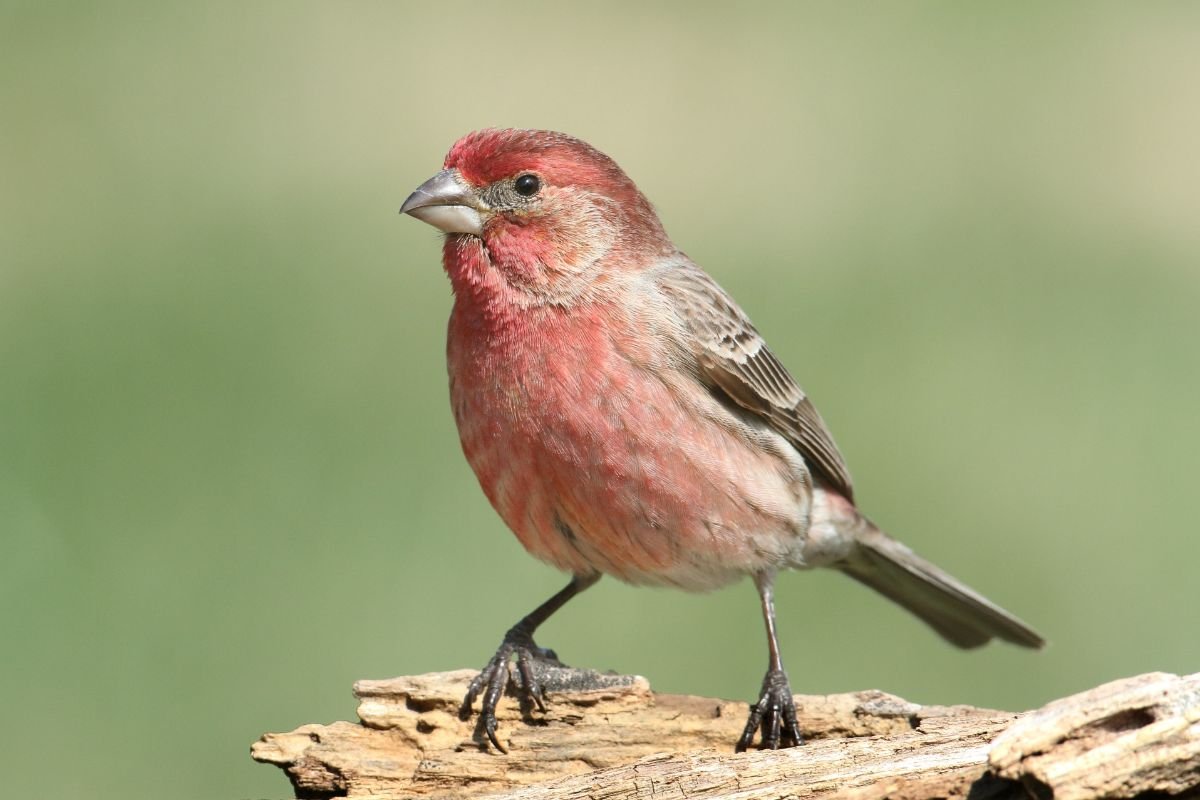
In the United States, the male House Finch is the bird most often described as having a red head and red chest. Its red color usually covers the forehead, face, throat, and upper breast, while the back and belly remain brown and streaked.
Other U.S. birds can also show red on the head and chest, including the Purple Finch, Northern Cardinal, Cassin’s Finch, Pine Grosbeak, Vermilion Flycatcher, Summer Tanager, and Scarlet Tanager. The bird’s size, bill shape, wing color, habitat, and location can help you tell them apart.

The Most Likely Answer: Male House Finch
The male House Finch (Haemorhous mexicanus) is the most common answer to “what bird has a red head and chest?” It is widespread across the United States and often visits backyard feeders, gardens, parks, and city streets.
A male House Finch has:
- A red forehead and crown
- A red face and throat
- Red coloring across the upper chest
- Brown wings and back
- Heavy brown streaks on the belly and flanks
- A short, thick, cone-shaped bill
- A long, slightly notched tail
The red color can range from bright cherry red to orange-red or reddish pink. It may look strongest around the face and throat, then fade into the chest. Some males show more red than others because diet affects the color of their feathers during molt.
Female House Finches do not have red feathers. They are mostly gray-brown with strong streaks and may look similar to female Purple Finches.
Where House Finches live
House Finches occur across much of the United States. They are especially common in:
- Residential neighborhoods
- Suburban yards
- Open woodland
- Farm edges
- City parks
- Areas with bird feeders
They often feed on sunflower seeds, millet, and other small seeds. You may see them in small groups, perched on wires, shrubs, fences, or feeder poles.
The House Finch is a strong candidate when the bird is small, brown-streaked, and seen near homes or feeders.

Birds That Also Have a Red Head and Chest
A red-headed, red-chested bird is not always a House Finch. Use the features below to narrow down the identification.
| Bird | Red pattern | Body size and shape | Best clues |
|---|---|---|---|
| House Finch | Red forehead, face, throat, and upper chest | Small and slim | Brown streaks on belly; common at feeders |
| Purple Finch | Raspberry-red head, throat, and breast | Small but fuller than a House Finch | Softer streaking and more blended red color |
| Cassin’s Finch | Red crown, throat, and breast | Medium-sized finch | Mostly found in the western United States; long-bodied |
| Northern Cardinal | Entire head, body, and crest are red | Larger and long-tailed | Red crest, black face mask, orange-red bill |
| Pine Grosbeak | Red head and much of the underparts | Large, heavy finch | Thick bill; often found in northern forests |
| Vermilion Flycatcher | Bright red head, throat, and chest | Small and slender | Dark wings; often perches in open areas |
| Summer Tanager | Red head and body | Medium-sized songbird | Plain red body with no black wings |
| Scarlet Tanager | Red body and head | Medium-sized songbird | Black wings and black tail on the male |
Purple Finch
The male Purple Finch (Haemorhous purpureus) has a raspberry or wine-red wash over the crown, face, throat, chest, and sometimes the back. The color often looks softer and more blended than the red of a House Finch.
Purple Finches have:
- A rounded head
- A thick finch bill
- A pale eyebrow line in some views
- Less obvious belly streaking than House Finches
- A fuller, more compact body
They occur across the northern United States and in parts of the West. In winter, they may move into backyards and visit seed feeders.
Cassin’s Finch
The male Cassin’s Finch (Haemorhinus cassinii) has a red crown, pink-red face, red throat, and rosy breast. It is most common in the western United States, especially in mountain forests and high-elevation habitats.
Compared with a House Finch, Cassin’s Finch often looks:
- Larger and longer-bodied
- Less heavily streaked below
- More peaked or crested around the crown
- More likely to be found near conifers
Geography matters. A red-headed finch in a Rocky Mountain or Pacific Northwest forest may be a Cassin’s Finch rather than a House Finch.
Northern Cardinal
The male Northern Cardinal (Cardinalis cardinalis) is easy to recognize because the red covers nearly the entire body. It also has a tall red crest, a black mask around the face, and a large orange-red bill.
A Northern Cardinal is usually:
- Larger than a House Finch
- Longer-tailed
- More richly red from head to tail
- Seen in shrubs, woodland edges, and backyards
If the bird has a clear crest and black around its eyes and bill, it is probably a Northern Cardinal.
Pine Grosbeak
The male Pine Grosbeak (Pinicola enucleator) can have a bright red head, throat, chest, and belly. It is much larger and heavier than a House Finch.
Look for:
- A thick, powerful bill
- A rounded body
- Gray wings with white wing bars
- A long tail
- Northern or high-elevation habitat
Pine Grosbeaks are not typical birds of warm urban neighborhoods. They are more often associated with boreal forests, mountain forests, and northern regions.
Vermilion Flycatcher
The male Vermilion Flycatcher (Pyrocephalus rubinus) has a striking scarlet head, throat, and underparts. Its wings and back are dark brown or blackish.
Unlike a finch, it has:
- A narrow flycatcher bill
- A slim body
- Longer-looking wings
- A habit of sitting on exposed branches, posts, or fences
- A preference for open country
In the United States, it is most strongly associated with the Southwest and parts of Texas.

How to Identify the Bird in Your Yard
Start with the bird’s overall shape, not just its color. Red feathers can appear on several unrelated bird species, so color alone is not enough.
1. Check the size
- Very small: House Finch, Purple Finch, or Vermilion Flycatcher
- Medium-sized: Summer Tanager, Scarlet Tanager, or Cassin’s Finch
- Large and heavy: Pine Grosbeak
- Large with a crest: Northern Cardinal
2. Look at the red pattern
Ask how much of the body is red.
- Red only on the head, throat, and upper chest: Often a House Finch or Purple Finch
- Red across the entire body: Usually a Northern Cardinal or Summer Tanager
- Red body with black wings: Scarlet Tanager
- Bright red front with dark wings: Vermilion Flycatcher
- Red head and breast with a large body: Pine Grosbeak
3. Examine the belly
A streaked belly strongly supports House Finch. The male often has brown streaks below the red chest.
A Purple Finch may also show streaking, but the pattern is usually less bold and the red color often spreads more evenly over the head and breast.
4. Study the bill
Finches have short, thick bills designed for cracking seeds. Flycatchers have narrower bills suited to catching insects.
A large, orange-red bill and a red crest point toward a Northern Cardinal. A stout bill with a very large body may indicate a Pine Grosbeak.
5. Consider the location
Location can remove several possibilities:
- Urban and suburban areas nationwide: House Finch
- Northern forests and winter feeders: Purple Finch
- Western mountain forests: Cassin’s Finch
- Woodland edges across the eastern and central United States: Northern Cardinal
- Southwestern open country: Vermilion Flycatcher
- Northern forests or high elevations: Pine Grosbeak
- Open woodland and warm regions: Summer Tanager
- Mature forest: Scarlet Tanager
6. Note the behavior
House Finches often feed in groups and spend time near seed feeders. Cardinals usually move between shrubs, low branches, and the ground. Flycatchers often sit alone on an exposed perch before darting out to catch insects.
Behavior is not proof by itself, but it can support the visual clues.

Male and Female Birds Can Look Very Different
Many red birds are red only when they are adult males. Females and young birds may look brown, gray, yellow, or streaked.
This is especially important for:
- House Finches
- Purple Finches
- Cassin’s Finches
- Northern Cardinals
- Tanagers
- Vermilion Flycatchers
A female House Finch has a plain brown, streaked appearance. A female Northern Cardinal is mostly warm brown with red highlights on the wings, crest, and tail. A female Vermilion Flycatcher is gray-brown and may show a pale peach or salmon-colored belly.
Young birds can be even harder to identify because they may not have their adult feathers. If a bird has a partial red pattern, it may be molting or developing adult plumage.
Feather color can also vary with age, diet, wear, and lighting. A bird seen in shade may look duller than the same species in direct sunlight.

Red-Headed Birds That Are Often Confused With This Description
Red-headed Woodpecker
The Red-headed Woodpecker (Melanerpes erythrocephalus) has a completely red head, but its chest and belly are white. It also has bold black-and-white wings and a short tail.
If the bird has a red head but a white body, it is likely a Red-headed Woodpecker, not a red-chested finch.
Red-bellied Woodpecker
Despite its name, the Red-bellied Woodpecker does not usually have a red belly that is easy to see. It has a red crown and nape, a pale body, and black-and-white barred wings.
The name refers to a faint reddish area on the belly, not to a bright red chest.
American Robin
An American Robin has an orange-red breast, but its head is dark gray or black. It is larger than a finch and has a longer body and tail.
Cedar Waxwing
A Cedar Waxwing has a smooth brown head and a pale yellow belly. It does not have a red head or chest, although red wax-like tips can appear on some wing feathers.
Rose-breasted Grosbeak
The male Rose-breasted Grosbeak has a bright red or rose-colored triangle on the chest, but its head is black. Its belly is white, and its bill is large and pale.
This bird may match the “red chest” part of the description but not the “red head” part.

How to Attract and Watch Red Birds Safely
If you want to see House Finches, Purple Finches, or cardinals, offer suitable native cover and clean feeding areas.
Useful steps include:
- Provide black-oil sunflower seed. Many finches and cardinals eat it.
- Use several feeder types. Tube feeders suit finches, while platform or hopper feeders can suit cardinals.
- Add native shrubs and trees. Dense plants give birds places to rest and hide.
- Offer clean water. A shallow birdbath can attract birds that do not visit seed feeders.
- Clean feeders often. Discard wet or moldy seed and scrub feeders on a regular schedule.
- Place feeders near cover but away from immediate hiding spots. Birds need shelter, but dense shrubs close to feeders can also give cats a place to ambush them.
- Reduce window strikes. Put feeders either very close to windows or well away from them, and use visible window markers where needed.
- Keep cats indoors. Free-ranging cats are a major risk to wild birds.
Do not use dyed foods or bread as a regular bird food. Also avoid placing a feeder where you cannot keep it dry and clean. If sick birds gather around a feeder, pause feeding and clean the area before putting the feeder back.

Quick Identification Guide
Use this short decision guide:
- Small bird, red face and chest, brown streaked belly: Male House Finch
- Small bird, raspberry-red head and breast, softer streaks: Purple Finch
- Small-to-medium western finch with red crown and breast: Cassin’s Finch
- Large red bird with a crest and black face: Northern Cardinal
- Large, heavy red finch in northern or mountain forest: Pine Grosbeak
- Small bright-red bird with dark wings in open country: Vermilion Flycatcher
- Plain red songbird with no black wings: Summer Tanager
- Red songbird with black wings: Scarlet Tanager
- Red head with a white body and black wings: Red-headed Woodpecker
A clear photo from the side is often enough to confirm the species. Include the bill, tail, wings, belly, and habitat in the frame if possible.

Frequently Asked Questions
What is the most common bird with a red head and red chest?
The male House Finch is the most common match in many U.S. backyards. It has red on the forehead, face, throat, and upper chest, with a brown, streaked body.
Is a Purple Finch the same as a House Finch?
No. They are different species, although both belong to the finch family and can visit feeders. Purple Finches often have a softer raspberry color and less obvious belly streaking. House Finches are usually more strongly streaked below.
Do female House Finches have red heads?
No. Female House Finches are mainly brown and streaked. Young birds also lack the bright red plumage seen in adult males.
What bird has a red head, red breast, and black wings?
A male Scarlet Tanager has a red body and black wings. A Vermilion Flycatcher also has a red head and underparts with dark wings, but it is smaller and has a different body shape and behavior.
What bird has a red head but a white chest?
The Red-headed Woodpecker has a completely red head, a white chest and belly, and black-and-white wings. It is not a finch.
Why does a male House Finch’s red color vary?
The amount and brightness of red can vary with age, feather condition, and nutrition during feather growth. Lighting can also make the color look more orange, pink, or deep red.
How can I identify a red bird without a clear photo?
Record its location, size, bill shape, body pattern, wing color, tail length, call, and feeding behavior. These details are often more useful than color alone.
Final Answer
The bird most likely to have a red head and chest in the United States is a male House Finch. Look for a small brown-streaked bird with red on the forehead, face, throat, and upper breast.
If the bird has a crest and black mask, check for a Northern Cardinal. If it has a raspberry wash and softer streaks, consider a Purple Finch. In the western United States, a Cassin’s Finch or Vermilion Flycatcher may fit better.
For further verification, compare your sighting with species accounts from Cornell Lab of Ornithology’s All About Birds, the National Audubon Society, and the U.S. Fish & Wildlife Service.