
For readers in the United States, the female twelve-wired bird-of-paradise is a wild bird of New Guinea, not a common cage bird or a species found in North America. Its scientific name is Seleucidis melanoleucus. Unlike the glossy black male, the female has soft brown and olive colors that help her blend into forest plants.
The female is smaller and less showy than the male. She does not have the male’s famous yellow crown, black plumage, or twelve long wire-like flank feathers. Her plain look serves a useful purpose: camouflage while she feeds, nests, and raises young.

What Is the Female Twelve-Wired Bird-of-Paradise?
The female twelve-wired bird-of-paradise is the female form of Seleucidis melanoleucus, a bird-of-paradise native to lowland forests and wetlands on the island of New Guinea.
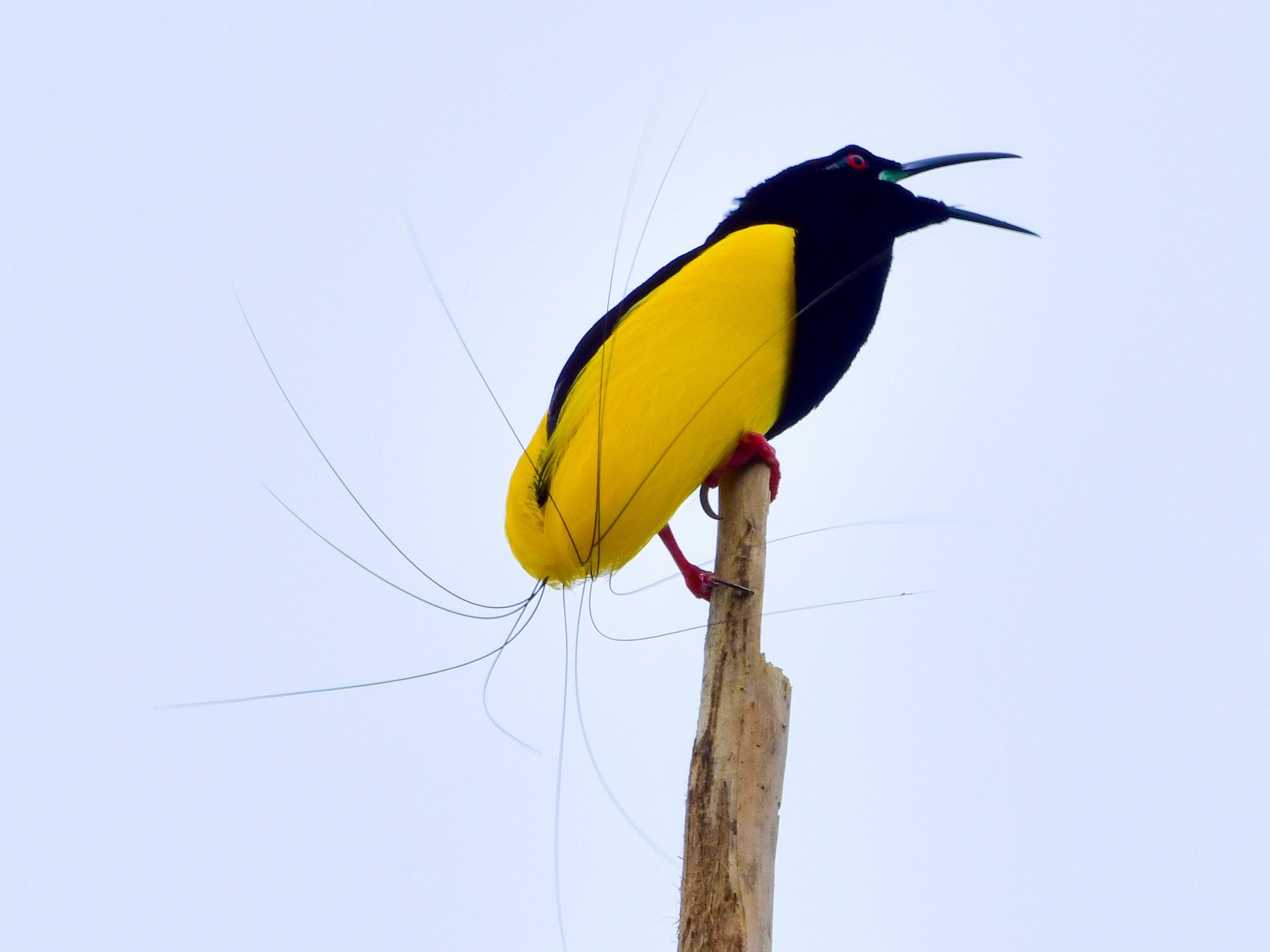
The name “twelve-wired” refers to the male’s twelve thin, stiff feathers. These feathers grow from the sides of the body and are used during courtship. The female does not normally show these long wires.
Key facts include:
- Common name: Twelve-wired bird-of-paradise
- Scientific name: Seleucidis melanoleucus
- Family: Paradisaeidae
- Native range: New Guinea
- Main habitat: Lowland forest, swamp forest, and wet woodland
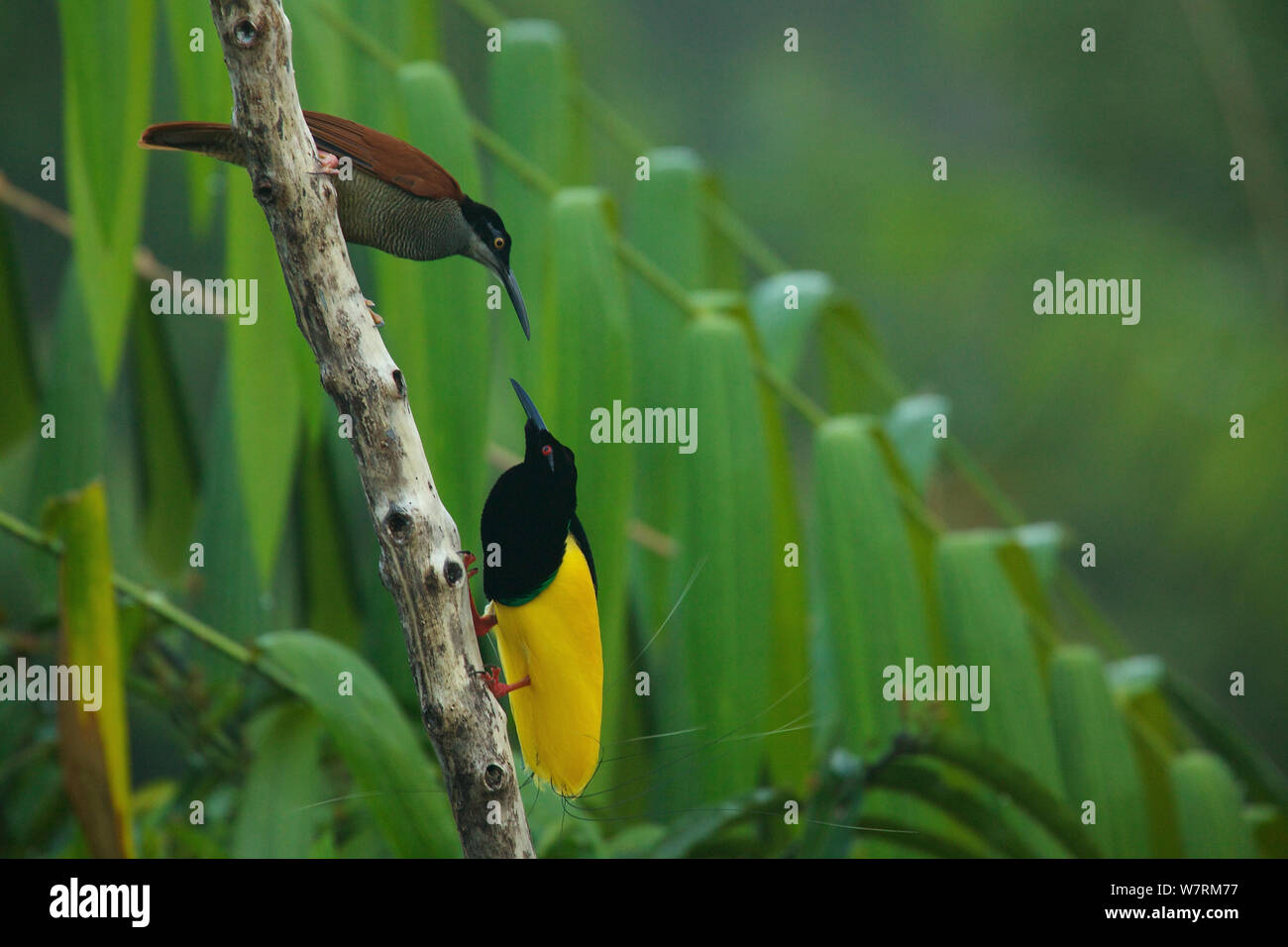
- Female appearance: Olive-brown, buff, and barred
- Male appearance: Glossy black with yellow head feathers and twelve flank wires
- Diet: Fruit, insects, and other small forest foods
- Conservation status: Listed as Least Concern by the International Union for Conservation of Nature, while local habitat loss remains a concern
The term sexual dimorphism describes the strong difference between males and females of the same species. This bird is strongly sexually dimorphic. The male uses bright feathers and a complex display, while the female relies more on concealment.
Why the female looks less colorful
A female bird-of-paradise must often move through dense plants while avoiding predators. Brown, olive, and buff feathers can disappear among leaves, vines, roots, and shadows.
The male has a different role during courtship. His dark body and bright yellow crown make him easier to see. That visibility may help attract a mate, but it also makes camouflage less useful.
Female Twelve-Wired Bird-of-Paradise Identification
You can identify a female twelve-wired bird-of-paradise by its muted body color, barred underside, and New Guinea habitat. Do not identify the bird by the twelve wires alone, because those feathers belong to the male.
Female field marks
A female usually shows these traits:
- Olive-brown or brown upperparts
- Lighter buff or pale underparts
- Dark bars or markings across the breast and belly
- A compact body and medium-length tail
- No long, stiff flank wires
- No glossy black male plumage
- No bright yellow crown patch like that of the male
Color can change with light, distance, age, and image quality. A wet bird may look darker. A shaded bird may appear almost black in a poor photograph. For a reliable identification, use several traits together.
Female and male comparison
| Feature | Female | Male |
|---|---|---|
| Main body color | Olive-brown and buff | Glossy black |
| Head | Brown or muted | Bright yellow crown and neck area |
| Flank feathers | No long wires | Twelve long wire-like feathers |
| Underside | Often barred | Mostly dark |
| Courtship role | Watches and selects | Performs the display |
| Camouflage | Strong | Limited |
| Typical visual impression | Plain and well hidden | Bold and highly visible |
The female may be confused with another brown forest bird when seen briefly. Range, shape, behavior, and the presence or absence of a male nearby can help. A photograph is easier to identify when it shows the bird’s side, underside, and habitat.

Where Does the Female Twelve-Wired Bird-of-Paradise Live?
The female twelve-wired bird-of-paradise lives in New Guinea, including areas of Papua New Guinea and the Indonesian provinces on the western half of the island. It is associated with low elevations and wet habitats.
Typical habitat includes:
- Swamp forest
- Lowland rainforest
- Forest edges near water
- Wet woodland
- Dense vegetation near streams or flooded ground
This species is not a normal wild bird of the United States. A bird seen in the United States with brown plumage and a barred underside is almost certainly another species unless it is in a licensed zoological collection.
Why wet forest matters
Wet forest supplies the bird with food, cover, and display sites. Fruit-bearing plants support feeding. Dense leaves provide shelter. Open branches or clear perches allow males to perform courtship displays.
Habitat changes can affect both sexes in different ways. A male may lose a display site, while a female may lose safe nesting cover. The loss of fruiting plants can also reduce food for adults and young.
Female Behavior and Feeding
The female twelve-wired bird-of-paradise spends much of her time searching through vegetation for food. Her diet includes fruit and small animal foods such as insects and other invertebrates.
Her feeding behavior may include:
- Moving through low and middle levels of forest growth
- Searching leaves, branches, bark, and vines
- Taking small fruits
- Catching insects and other small prey
- Staying quiet or moving carefully when danger is near
Bird-of-paradise diets can vary by season and habitat. A fruit-rich forest may provide more plant food at one time of year, while insects may become more important at another.
The female’s muted colors help during these movements. She can remain harder to see while feeding alone or while caring for young.
Courtship and Reproduction
The male twelve-wired bird-of-paradise performs a specialized courtship display. He uses his black body, yellow head feathers, and long flank wires to attract a female.
The female does not simply copy the male’s display. She is the evaluating sex in the courtship process. She may approach, watch, move away, or accept the male based on signals that researchers continue to study in detail.
The purpose of the twelve wires
The twelve wires are modified flank feathers. They are not bones, plant stems, or actual wires.
During display, the male can position these feathers around the female. Their movement adds a visual signal to the display. The feathers may also make contact with the female, but their exact role can depend on the display position and viewing angle.
Nesting and parental care
The female is responsible for the main nesting work. She selects a suitable place, builds or completes the nest, incubates the eggs, and cares for the young after hatching.
The exact nesting site can vary. Dense vegetation helps hide the nest from predators. The female’s brown and barred plumage is especially useful during this period because she must spend time near one location.
Bird-of-paradise species often have limited direct male care after mating. For the twelve-wired bird-of-paradise, the male’s main contribution is courtship rather than nest construction or chick care.
How the Female Differs From Other Bird-of-Paradise Females
Many female birds-of-paradise look more subdued than their male partners, but they are not all alike. The female twelve-wired bird-of-paradise is best separated by its combination of muted brown color, barred underparts, lowland New Guinea range, and association with the distinctive male.
A brown bird in New Guinea is not automatically a female twelve-wired bird-of-paradise. Identification should consider:
- Location: Is the bird in the known New Guinea range?
- Habitat: Is it in lowland wet forest or swamp woodland?
- Pattern: Does it show a barred underside?
- Body shape: Does it have the compact form expected for this species?
- Nearby birds: Is a black male with yellow head feathers present?
- Sound and movement: Does its behavior fit a forest bird-of-paradise?
A male nearby can be a strong clue, but females may travel or feed away from males. The absence of a male does not rule out the female.

Conservation Status and Main Threats
The twelve-wired bird-of-paradise is generally assessed as Least Concern at the global level. That status does not mean every local population is secure. It means the species does not currently meet the global thresholds for a higher threat category under the assessment used.
The main long-term concern is habitat loss. Lowland forest and swamp forest can be damaged by:
- Logging
- Agricultural conversion
- Mining and road building
- Drainage of wetlands
- Fire and other land-clearing practices
The female may be especially affected when dense nesting cover disappears. A forest can still look green from a distance while losing the plants, fruit, and quiet cover that the bird needs.
Conservation decisions should use current local surveys. Global status is useful, but it may not describe the condition of a particular valley, forest block, or protected area.
How to Identify a Female From a Photograph
Start with the location and habitat before studying color. A photograph from New Guinea’s lowland forest has a very different identification context from a photograph taken in a U.S. aviary.
Use this sequence:
- Check the location. Confirm that the image was taken within the species’ known range or in a documented collection.
- Look for the male traits. If the bird is glossy black with a yellow crown and long flank wires, it is a male.
- Examine the underside. Brown or buff feathers with dark bars support a female identification.
- Check the wings and back. Look for olive-brown rather than deep glossy black plumage.
- Study the habitat. Dense lowland forest or wet woodland fits better than open grassland.
- Compare with a trusted field guide. Use a regional guide or a recognized bird database.
- Ask for expert review if the record matters. Rare sightings and collection records need more than a casual visual match.
Do not rely on one color word. Brown, olive, buff, and gray can look very different under tropical shade or a camera flash.
Common Identification Mistakes
The most common mistake is to search for the twelve wires on the female. The wires are a male feature, so their absence is expected in a female.
Other errors include:
- Treating every brown bird-of-paradise as a female twelve-wired bird
- Ignoring the geographic range
- Confusing a dark photograph with male plumage
- Assuming the female is dull gray rather than patterned brown and buff
- Using a captive bird’s setting as proof of its wild habitat
- Trusting an unlabeled social media image
- Calling the flank feathers “antennae” or “tail wires”
The safest approach is to combine field marks, range, habitat, and a reliable image source.
Is the Female Twelve-Wired Bird-of-Paradise a Good Pet?
No. This is a wild tropical bird with specialized habitat, diet, social behavior, and breeding needs. It is not a practical pet for a private home in the United States.
Birds imported or held in the United States may also be subject to federal, state, international, and animal-welfare rules. A person should never capture a wild bird or buy an animal without checking its legal source and permits.
For most people, the best way to support this species is to:
- Visit an accredited zoological institution when available
- Use trusted wildlife photography and field guides
- Support habitat conservation in New Guinea
- Avoid buying wildlife with unclear origins
- Report suspected illegal wildlife trade to the proper authorities
A quiet photograph or observation is safer for the bird than an attempt to approach, handle, or feed it.
Frequently Asked Questions
Does the female twelve-wired bird-of-paradise have twelve wires?
No. The twelve long, wire-like flank feathers are a male feature. The female has a shorter, muted plumage without those display feathers.
What color is the female twelve-wired bird-of-paradise?
She is mainly olive-brown, brown, and buff, with darker bars or markings on the underside. Lighting can make her appear darker or grayer.
Where can the female twelve-wired bird-of-paradise be found?
She occurs in lowland forests and wet woodland in New Guinea, including Papua New Guinea and Indonesian New Guinea. She is not native to the United States.
What does the female twelve-wired bird-of-paradise eat?
Her diet includes fruit, insects, and other small invertebrate foods. The balance can change with season and habitat.
Does the female raise the chicks?
Yes. The female performs the main nesting and chick-care work. The male’s best-known role is courtship display.
Is the twelve-wired bird-of-paradise endangered?
The species is generally listed as Least Concern globally. Local habitat loss can still threaten particular populations, especially where lowland forest and wetlands are cleared.
Sources for Further Research
For a reliable identification or conservation check, consult:
- Cornell Lab of Ornithology — Birds of the World
- eBird — Cornell Lab of Ornithology
- BirdLife International
- IUCN Red List
- A current field guide to the birds of New Guinea
These sources may differ in detail, taxonomy, or regional records. Check the species account date and the geographic scope before using a record for research.
Conclusion
The female twelve-wired bird-of-paradise is a brown and olive forest bird from New Guinea. Her lack of long wires is normal. The famous wires belong to the male, whose black-and-yellow courtship display gives the species its common name.
For identification, focus on the female’s muted plumage, barred underside, lowland wet-forest habitat, and geographic range. For conservation, remember that a global Least Concern status does not remove the need to protect local forests, wetlands, and nesting cover.