
The American Robin is the bird most people mean when they ask, “What bird has an orange belly?” Across the United States, this familiar songbird has a warm orange-red breast, a gray-brown back, a dark head, and a thin white ring around each eye.
However, several U.S. birds can show orange on the breast or belly. The Eastern Bluebird, Baltimore Oriole, and Orchard Oriole are common alternatives. The bird’s size, habitat, wing pattern, and head color can help you identify it with more confidence.

The American Robin Is the Most Likely Answer
The American Robin (Turdus migratorius) is the best answer in most cases. Its orange-red breast stands out against its gray back and dark head. In bright light, the breast may look orange, rust-colored, or reddish brown.
American Robins are common across much of the United States. You may see them in:
- Lawns and parks
- Suburban yards
- City green spaces
- Forest edges
- Fields and golf courses
- Areas with berry-producing shrubs
Robins often run across the ground, stop, and tilt their heads while searching for earthworms. They also eat insects, fruit, and other small invertebrates.
How to recognize an American Robin
Look for this combination of traits:
| Feature | American Robin |
|---|---|
| Size | About 10 inches long |
| Breast | Orange-red or rusty orange |
| Back | Gray-brown |
| Head | Dark gray to black |
| Eye | White eye ring |
| Bill | Yellow with a dark tip |
| Tail | Dark, with white corners visible in flight |
| Behavior | Runs on lawns and searches for worms |
The orange area is technically the breast, not always the lower belly. This distinction matters because bird field guides often describe color by body region. In casual speech, many people call the entire orange front the bird’s “belly.”
Young robins can look different. Their breasts often have dark spots instead of one smooth orange-red patch. Females may also appear paler than males, although both sexes usually show the same basic pattern.

Other U.S. Birds With Orange on the Belly or Breast
The American Robin is not the only bird with orange underparts. The best match depends on the bird’s body size, location, and other markings.
Eastern Bluebird
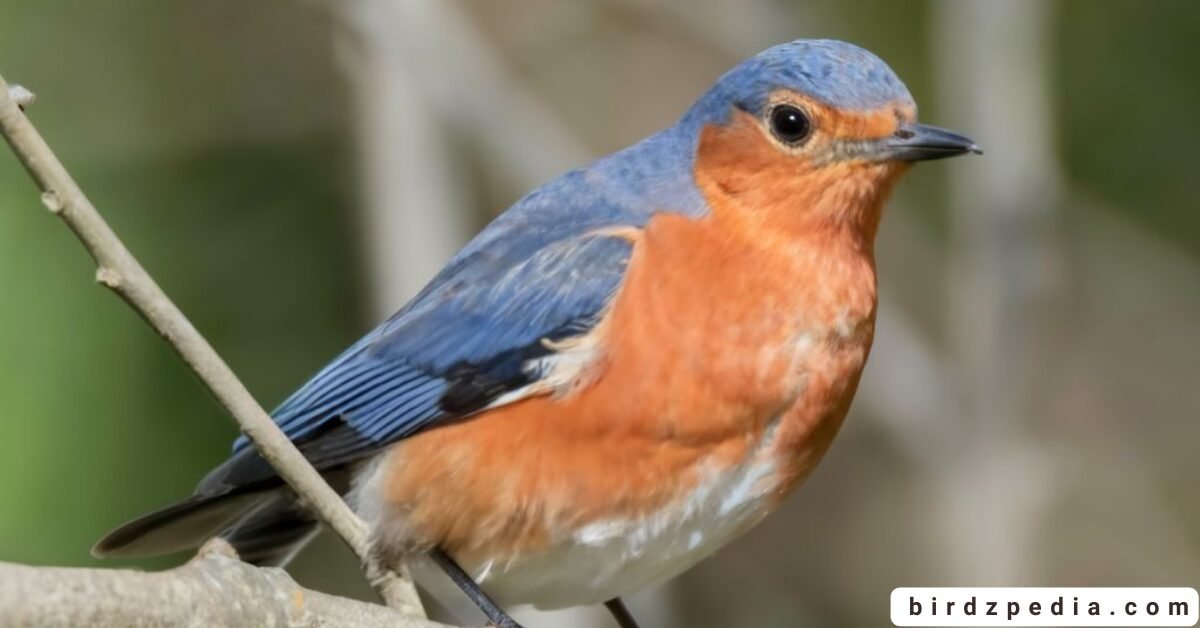
The Eastern Bluebird (Sialia sialis) has a bright blue back and a rusty orange breast. Its orange color usually covers the throat, breast, and upper belly.
Male Eastern Bluebirds show the strongest blue color. Females are usually duller blue-gray, and their orange breast may be lighter. The bird is smaller and more compact than an American Robin.
You may find Eastern Bluebirds in:
- Open woodlands
- Pastures
- Orchards
- Rural roadsides
- Large yards with nest boxes
A blue back is the key clue. If the bird has a blue head or wings and an orange chest, it is likely an Eastern Bluebird rather than a robin.
Baltimore Oriole
The Baltimore Oriole (Icterus galbula) has vivid orange underparts, black wings, and a black head. Adult males often show orange on the breast, belly, shoulders, and lower back.
Baltimore Orioles are slimmer than robins. They also have a longer, pointed bill and a more striking black-and-orange pattern.
They often visit:
- Flowering trees
- Woodland edges
- Mature shade trees
- Hummingbird-style nectar feeders
- Fruit feeders
Females and young birds may look yellow-orange rather than bright orange. This can make them harder to identify. The bird’s slender shape, pointed bill, and black wings are strong clues.
Orchard Oriole
The Orchard Oriole (Icterus spurius) is another U.S. bird with orange or reddish underparts. The adult male is usually darker and more chestnut-colored than the Baltimore Oriole. It has a black back and head, with rich chestnut on the breast and belly.
Females are yellow-green and do not show the same strong orange pattern. Orchard Orioles often live near:
- River edges
- Open woodland
- Orchards
- Shrubby fields
- Farm areas
This bird is smaller and more slender than an American Robin. Its pointed bill and long, narrow shape also suggest an oriole.
Varied Thrush
The Varied Thrush (Ixoreus naevius) has orange or burnt-orange markings on the breast and sides. It is most common in the Pacific Northwest, Alaska, and parts of western mountain forests.
It usually has:
- A dark blue-gray or blackish back
- A bold orange eyebrow
- An orange breast band
- Dark wings with orange markings
A Varied Thrush is less likely in the eastern or central United States. In its western range, the orange eyebrow and strong breast band help separate it from an American Robin.
American Kestrel
The American Kestrel (Falco sparverius) can show rusty orange on its back and tail. Its belly is usually pale, not fully orange, so it is not the best match for the question.
This small falcon has a narrow, pointed wing shape and often hovers while hunting. Males have blue-gray wings and a rusty back. It is a bird of open land, not a typical lawn-walking songbird.

Quick Identification: Which Orange-Bellied Bird Did You See?
Use the bird’s full pattern instead of focusing only on the orange color.
| What you noticed | Most likely bird |
|---|---|
| Gray-brown back, dark head, orange-red breast | American Robin |
| Blue back and rusty orange breast | Eastern Bluebird |
| Black head, black wings, vivid orange body | Baltimore Oriole |
| Dark chestnut body with black head and back | Orchard Oriole |
| Orange eyebrow and breast band in the Pacific Northwest | Varied Thrush |
| Rusty back, pointed wings, hovering flight | American Kestrel |
Size helps
An American Robin is medium-sized and has a rounded body. An Eastern Bluebird is smaller. Orioles are slimmer, with long bodies and pointed bills. A kestrel has the shape of a small falcon, with sharp wings and a hooked bill.
Behavior helps
Behavior is often more useful than color alone:
- Walking on grass and pulling worms: American Robin
- Perching on fences near open fields: Eastern Bluebird
- Moving high in trees and visiting fruit or nectar: Baltimore Oriole
- Hunting from a post or hovering: American Kestrel
- Staying in dense western forest: Varied Thrush
Location helps
Bird range can narrow the answer, but it should not be the only clue. American Robins occur across most of the United States. Eastern Bluebirds are common in the East and parts of the central states. Baltimore Orioles are widespread in the eastern and central United States during the breeding season.
In the West, a Varied Thrush becomes more likely. A bird seen in Florida, Texas, or the Southwest may also be a seasonal migrant or a less common regional species.

Is the Orange Area Really the Bird’s Belly?
Usually, people use “orange belly” as a simple description of the bird’s front. Bird guides use more exact terms, such as breast, throat, flanks, and lower belly.
For example:
- An American Robin mainly has an orange-red breast.
- An Eastern Bluebird has a rusty orange throat, breast, and upper belly.
- A Baltimore Oriole can have orange across much of the underbody.
- A Varied Thrush often has an orange breast band rather than a fully orange belly.
This difference explains why two people may describe the same bird in different ways. One person may say “orange belly,” while another says “rusty breast.”
Color can also change with:
- Sunlight
- Distance
- Age
- Molting
- Feather wear
- Sex
- Camera settings
A blurry photo may make yellow look orange or brown look red. Shape and behavior should support the color clue.

When and Where You May See These Birds
The season can help identify an orange-bellied bird in the United States.
American Robin
American Robins can be seen year-round in many parts of the country. Some birds remain in one area, while others move south or gather in large flocks after the breeding season.
They are especially easy to spot in spring and summer when they feed on lawns and carry nesting material.
Eastern Bluebird
Eastern Bluebirds stay year-round in much of the eastern United States, though some populations move seasonally. They favor open areas with scattered trees and low vegetation.
A nest box near open grassland may attract them if the location and box design suit local conditions.
Baltimore Oriole
Baltimore Orioles usually arrive in spring across the eastern and central United States. Many leave for Central America or the Caribbean in fall.
They spend much of their time in tree canopies. You may hear one before you see it.
Orchard Oriole
Orchard Orioles also appear in spring and summer across much of the eastern and central United States. They often choose more open and brushy habitat than Baltimore Orioles.
Varied Thrush
Varied Thrushes are most strongly linked with the Pacific Northwest and western forests. Some move to lower elevations or nearby neighborhoods during winter.
How to Attract Birds With Orange Underparts
The safest way to attract these birds is to provide native food plants, clean water, and shelter. Avoid trying to handle wild birds or placing food where it can spoil.
Useful steps include:
-
Plant native berry-producing shrubs and trees.
Native plants can provide fruit and cover for robins, bluebirds, and orioles. -
Keep a clean birdbath.
Replace the water often and scrub the basin. Still water can collect dirt and allow mosquitoes to breed. -
Offer suitable food in small amounts.
Orioles may visit orange halves, jelly, or nectar feeders, but these foods can spoil quickly. Remove old food and clean feeders often. -
Avoid pesticides when possible.
Robins and other birds eat insects from lawns and gardens. Use nonchemical methods first and follow every product label if treatment is needed. -
Keep cats indoors or supervised outdoors.
Outdoor cats can kill songbirds even when they are well fed. -
Place feeders away from windows or very close to them.
Birds can strike glass when a feeder is in a risky location. The U.S. Fish and Wildlife Service recommends reducing reflective views and using bird-safe window measures.
Do not feed bread as a main food. It offers little nutritional value and can contribute to poor diets when birds eat too much of it.
Common Identification Mistakes
Color alone can lead to a wrong identification. Several birds have orange, rust, or reddish feathers, but their patterns differ.
Mistaking a robin for an oriole
Robins are rounder and usually spend more time on the ground. Orioles are slimmer, more active in trees, and have a longer pointed bill.
Mistaking a bluebird for a robin
Both can have orange breasts. The bluebird is smaller and has a clear blue back. The robin is larger and usually has a gray-brown back.
Confusing a female oriole with another yellow bird
Female and young orioles may look yellow-orange rather than black and orange. Their long body, pointed bill, and wing pattern can still reveal their identity.
Identifying a bird from one color
A single color is not enough for a firm identification. Check at least three traits:
- Body shape
- Head and wing pattern
- Habitat or behavior
A photograph that shows the bird’s side, back, and head is much more useful than a close image of the orange feathers alone.
Frequently Asked Questions
What is the most common bird with an orange belly?
The American Robin is the most common answer in much of the United States. It has an orange-red breast, a gray-brown back, and a dark head.
What small bird has a blue back and orange belly?
An Eastern Bluebird has a blue back and a rusty orange breast. It is smaller than an American Robin and often lives near open fields, pastures, and woodland edges.
What black-and-orange bird visits feeders?
A Baltimore Oriole is a likely answer. Adult males have black heads and wings with bright orange underparts. They may visit fruit, nectar, and flowering trees.
Do female birds have the same orange color?
Not always. Female and young birds often have duller colors than adult males. Female orioles, for example, may look yellow-orange rather than bright orange and black.
What bird has an orange breast in the western United States?
An American Robin is still possible across much of the West. In the Pacific Northwest, a Varied Thrush may also fit, especially if the bird has an orange eyebrow and a dark breast band.
Research Basis
The identification details in this guide are based on species accounts and range information from established U.S. and North American bird references, including:
- Cornell Lab of Ornithology: American Robin
- Cornell Lab of Ornithology: Eastern Bluebird
- Cornell Lab of Ornithology: Baltimore Oriole
- Cornell Lab of Ornithology: Orchard Oriole
- Cornell Lab of Ornithology: Varied Thrush
- U.S. Fish and Wildlife Service: Birds and window strikes
These sources document species appearance, behavior, habitat, and distribution. A single color can vary with light, age, sex, and season, so field identification works best when several traits match.

Bottom Line
If you saw a medium-sized bird with a gray-brown back and an orange-red front in the United States, it was probably an American Robin. A blue back points to an Eastern Bluebird. A black head and bright orange body suggest a Baltimore Oriole.
For the best identification, note the bird’s size, back color, bill shape, habitat, and behavior. Those details turn a general color clue into a reliable species match.