

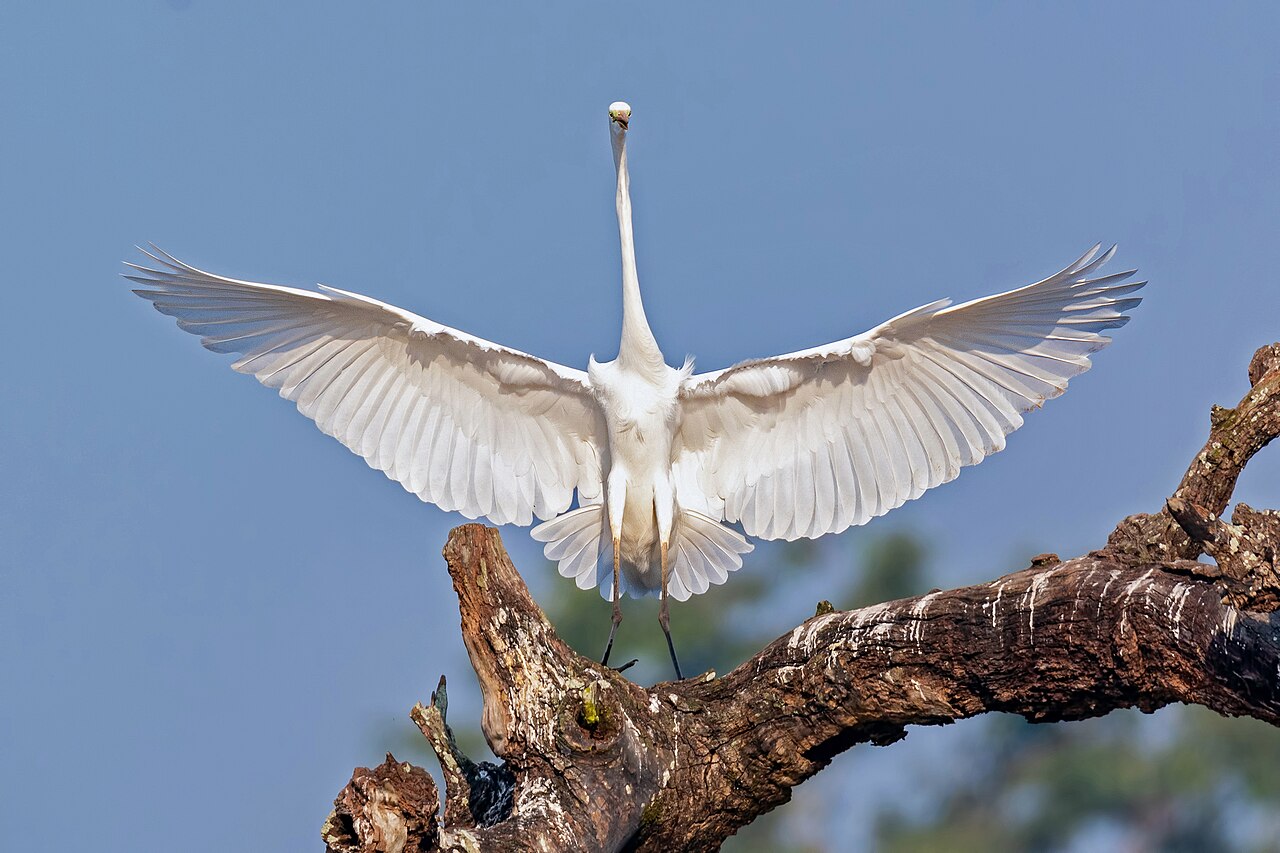
A great egret is usually about 3.3 feet tall when standing, or roughly 39 inches (1 meter) from its feet to the top of its head. In the United States, the bird is easy to recognize by its tall white body, long black legs, and long yellow bill.
Its full body length is often listed as 37–41 inches, but body length is not the same as standing height. The bird’s long, curved neck makes its height change as it stretches, rests, feeds, or flies.
How Tall Is a Great Egret?
A standing great egret is about 3.3 feet tall. This measurement is a practical estimate because bird references often report total length rather than a strict standing-height measurement.
The great egret belongs to the heron family, Ardeidae. Its height comes from several parts working together:
- Long legs for walking through shallow water
- A long neck that can extend or fold
- A narrow body
- A long bill used to catch fish and other prey
The bird may look shorter when it bends its neck into an S shape. When it fully extends its neck, it can appear much taller than its relaxed height.
Great egret height in common units
| Measurement | Approximate size |
|---|---|
| Standing height | About 3.3 feet |
| Standing height in inches | About 39 inches |
| Standing height in centimeters | About 100 centimeters |
| Total body length | 37–41 inches |
| Wingspan | About 51–57 inches |
| Weight | About 1.5–3.3 pounds |
The 37–41-inch length commonly reported by Cornell Lab of Ornithology measures the bird from the tip of its bill to the end of its tail. It should not be read as a direct measurement from the ground to the top of the head.

Great Egret Height Compared With Other Birds
The great egret is taller than many familiar backyard birds but shorter and lighter than the great blue heron.
A great egret’s thin body can also make it seem taller than its weight suggests. Its long legs and neck create much of its visible height, while its body remains relatively narrow.
| Bird | Approximate standing or body height |
|---|---|
| Great egret | About 3.3 feet standing |
| Snowy egret | About 22–27 inches in total length |
| Great blue heron | About 45–54 inches in total length |
| American robin | About 9–11 inches in total length |
| Canada goose | About 30–45 inches in total length |
These figures are useful for scale, but they are not always measured in the same way. For example, bird guides may report total length for one species and standing height for another. That makes direct comparisons less exact.
Great egret vs. great blue heron
A great blue heron is generally larger. It has a longer body, a larger wingspan, and a heavier frame. The great egret, however, can look nearly as tall when it stretches its neck and stands upright.
The easiest visual differences are color and shape:
- Great egrets are almost entirely white.
- Great blue herons have blue-gray bodies.
- Great egrets have black legs and a yellow bill.
- Great blue herons have a heavier bill and a dark crown stripe.
- Great egrets often look slimmer and more delicate.

Why Great Egrets Look So tall
great egrets look tall because their body is built for wading. They hunt in marshes, ponds, lakes, tidal flats, slow rivers, and other shallow-water habitats. Long legs let them move through water without swimming.
Their neck adds even more apparent height. A great egret has a long neck that can fold tightly against the body or extend quickly during a strike. When hunting, the bird often holds its neck in a bent position. When alert, it may raise its head and stretch upward.
The bird’s posture can change its visible height by several inches. A relaxed egret may look compact, while an alert or displaying egret can appear much taller.
The role of the legs
Great egret legs are long, thin, and dark. They support the bird in water and mud while keeping much of its body above the surface.
Long legs also help the egret:
- Walk slowly through reeds and marsh grass
- Stand still while waiting for prey
- Cross shallow pools
- Move through wet areas where shorter birds cannot hunt as easily
Their black color is especially noticeable against the bird’s white body.
The role of the neck
The neck acts like a folded measuring stick. It can shorten the bird’s visible profile when curved and increase the apparent height when extended.
This is also important for feeding. A great egret can hold its head still, then thrust its neck forward to catch fish, frogs, insects, crustaceans, and small reptiles.

How Great Egret Size Is Measured
Bird researchers and field guides use several different measurements. Knowing the difference helps prevent confusion when comparing great egret height, length, and wingspan.
Standing height
Standing height is the distance from the ground to the highest point of the bird’s head while it stands upright. It can vary with:
- Neck position
- Head angle
- Leg position
- Whether the bird is alert or relaxed
- The surface where it stands
For this reason, standing height is often given as an approximate value rather than a precise range.
Total length
Total length usually runs from the tip of the bill to the end of the tail. For the great egret, this is commonly listed at about 37–41 inches.
Total length includes the neck and bill. It does not mean the bird stands that many inches tall.
Wingspan
Wingspan is the distance from one wingtip to the other when both wings are fully spread. A great egret has a wingspan of about 51–57 inches, or roughly 4.25–4.75 feet.
Its wingspan is therefore wider than its standing height. This is common in wading birds because broad wings help them take off from wetlands and glide over open water.
Weight
Great egrets usually weigh about 1.5–3.3 pounds. Their hollow bones, slender body, and broad wings help them fly despite their height.
A tall bird is not always a heavy bird. The great egret is a good example of a species that looks large but has a relatively light frame.

Great Egret Size During the Breeding Season
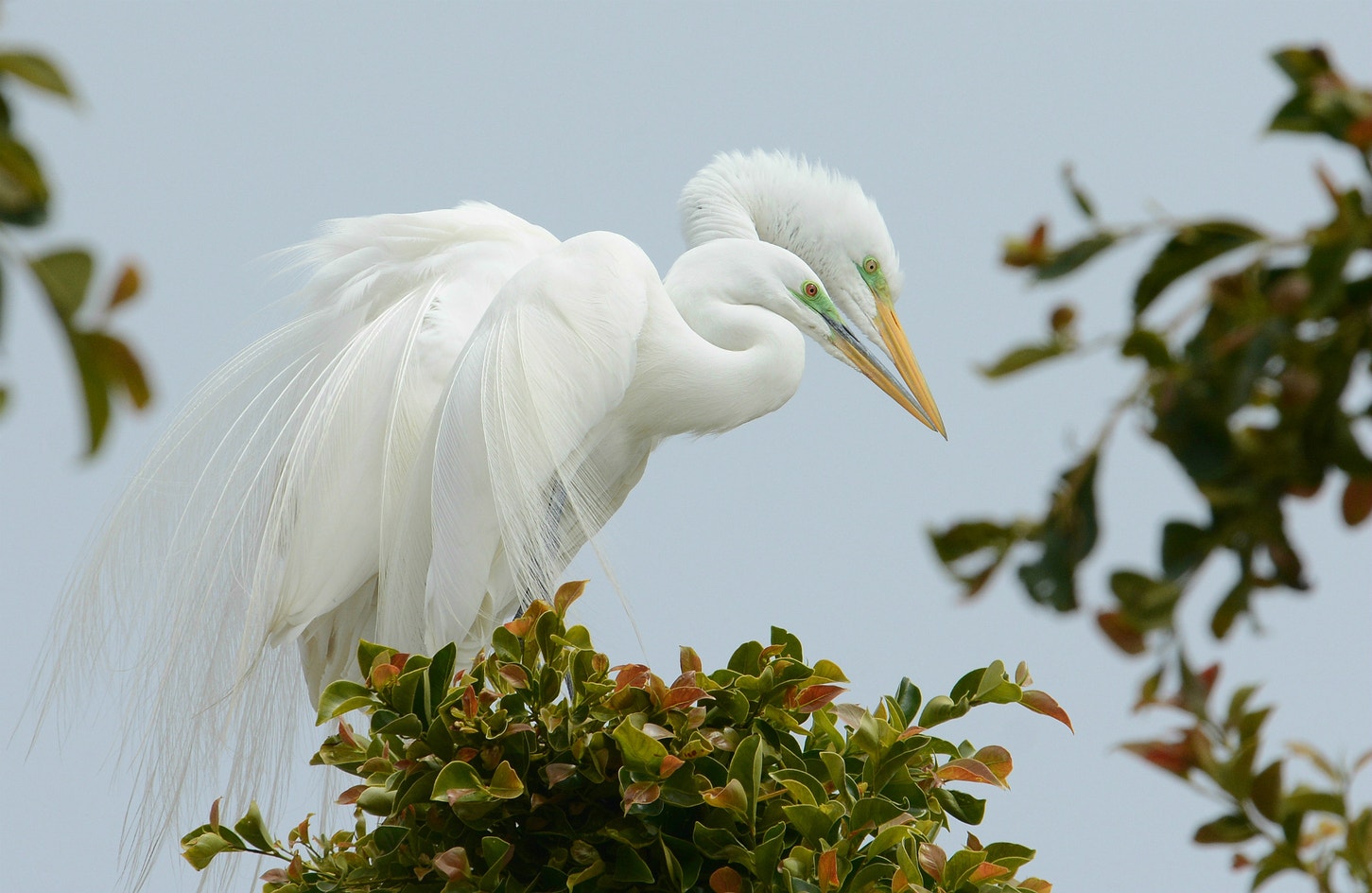
Great egrets do not become permanently taller during breeding season. Adults reach their normal body size before breeding, but their appearance changes because of breeding plumage and behavior.
During the breeding season, adults develop long ornamental feathers called aigrettes on the back. These feathers extend beyond the body and can make the bird appear larger or more elegant. They are not part of the bird’s actual leg-to-head height.
Breeding adults may also:
- Hold the neck higher
- Raise their head and bill
- Display their long back feathers
- Stand more upright during courtship
- Show brighter bill and facial colors
Historical hunting for these decorative feathers severely harmed egret populations in North America. Legal protection and conservation work helped the species recover in the United States, although nesting colonies still need protection from disturbance.
Where Great Egrets Live in the United States
Great egrets occur across much of the United States. They are especially common in wetlands and coastal areas, including:
- Florida and the Gulf Coast
- The Atlantic Coast
- California and other parts of the Pacific Coast
- Inland lakes and reservoirs
- Rivers, marshes, ponds, and flooded fields
Many great egrets remain in warm parts of the country year-round. Others move south for winter or migrate between breeding and wintering areas.
Their height gives them an advantage in shallow water, but it does not make them safe from threats. Habitat loss, nesting disturbance, pollution, and collisions with structures can affect local populations.
If you see one, watch from a distance. Do not approach a nest, enter a colony, or try to make the bird stand upright for a better photograph. A wild egret may appear calm while still feeling threatened.

How to Estimate a Great Egret’s Height in the Field
You can estimate a great egret’s height by using a known object nearby, but the result will only be approximate.
A useful method is:
- Find a flat object near the bird, such as a dock post, fence rail, or sign.
- Estimate the object’s height.
- Compare the bird’s feet-to-head height with that object.
- Allow for the egret’s neck posture.
- Avoid using the bird’s bill-to-tail length as its standing height.
For example, if an egret stands beside a 3-foot post and its head rises slightly above the post, its standing height may be close to 3.3 feet. If the neck is bent, the bird may look shorter even though its actual body size has not changed.
Photographs can distort scale. A bird closer to the camera may look much larger than an object farther away. Use objects on the same ground plane for the best estimate.

Common Mistakes About Great Egret Height
Several common errors lead to inaccurate size estimates.
Mistaking body length for height
A guide may state that a great egret is 37–41 inches long. That is usually bill-to-tail length, not the height of a standing bird.
Counting breeding feathers as body height
Long back plumes can extend past the body. They affect appearance, but they do not represent the bird’s normal standing height.
Comparing different measurements
A great egret’s wingspan should not be compared directly with another bird’s standing height. Use the same measurement type for both species.
Assuming every adult is the same size
Age, sex, posture, health, and individual variation can affect apparent size. Most field estimates should be treated as ranges, not exact values.
Using a photograph without checking perspective
Camera angle, distance, and lens choice can change how tall a bird appears. A photo is useful for identification, but it is not always reliable for measurement.

Frequently Asked Questions About Great Egret Height
Is a great egret taller than a person’s knee?
Usually, yes. A great egret standing upright is about 3.3 feet tall, which is above the knee for many adults but below the hip. Its long neck may make it appear taller when fully extended.
Is a great egret taller than a snowy egret?
Yes. The great egret is much larger than the snowy egret. A snowy egret has a total length of about 22–27 inches, while a great egret stands about 3.3 feet tall and has a total length of about 37–41 inches.
Is a great egret taller than a great blue heron?
Usually not. The great blue heron is the larger bird overall and can reach about 45–54 inches in total length. A great egret may look nearly as tall when it stretches its neck.
How wide is a great egret’s wingspan?
A great egret’s wingspan is about 51–57 inches, or roughly 4.25–4.75 feet. This is wider than its standing height.
Do male great egrets grow taller than females?
Male and female great egrets look very similar. Small differences may occur between individuals, but field guides generally do not use a major height difference to separate the sexes.
What should I do if I find an injured great egret?
Do not handle the bird unless a wildlife professional tells you to do so. Keep people and pets away, note the location, and contact a licensed wildlife rehabilitator or your state wildlife agency. Great egrets have sharp bills and can strike when frightened.
Key Takeaways
- A great egret is about 3.3 feet tall when standing upright.
- Its commonly reported 37–41-inch body length is measured from bill to tail.
- Its wingspan is about 51–57 inches.
- Neck posture can make the bird look shorter or taller.
- Great egrets are larger than snowy egrets but generally smaller than great blue herons.
- Use nearby objects only for rough field estimates, and observe wild birds from a safe distance.
Conclusion
The best short answer to “How tall is a great egret?” is about 3.3 feet, or 39 inches, when standing. Its long legs and flexible neck create its striking height, while its light body keeps it capable of strong flight.
When comparing sources, check whether the number describes standing height, total length, wingspan, or weight. That small distinction explains most differences in reported great egret size.