
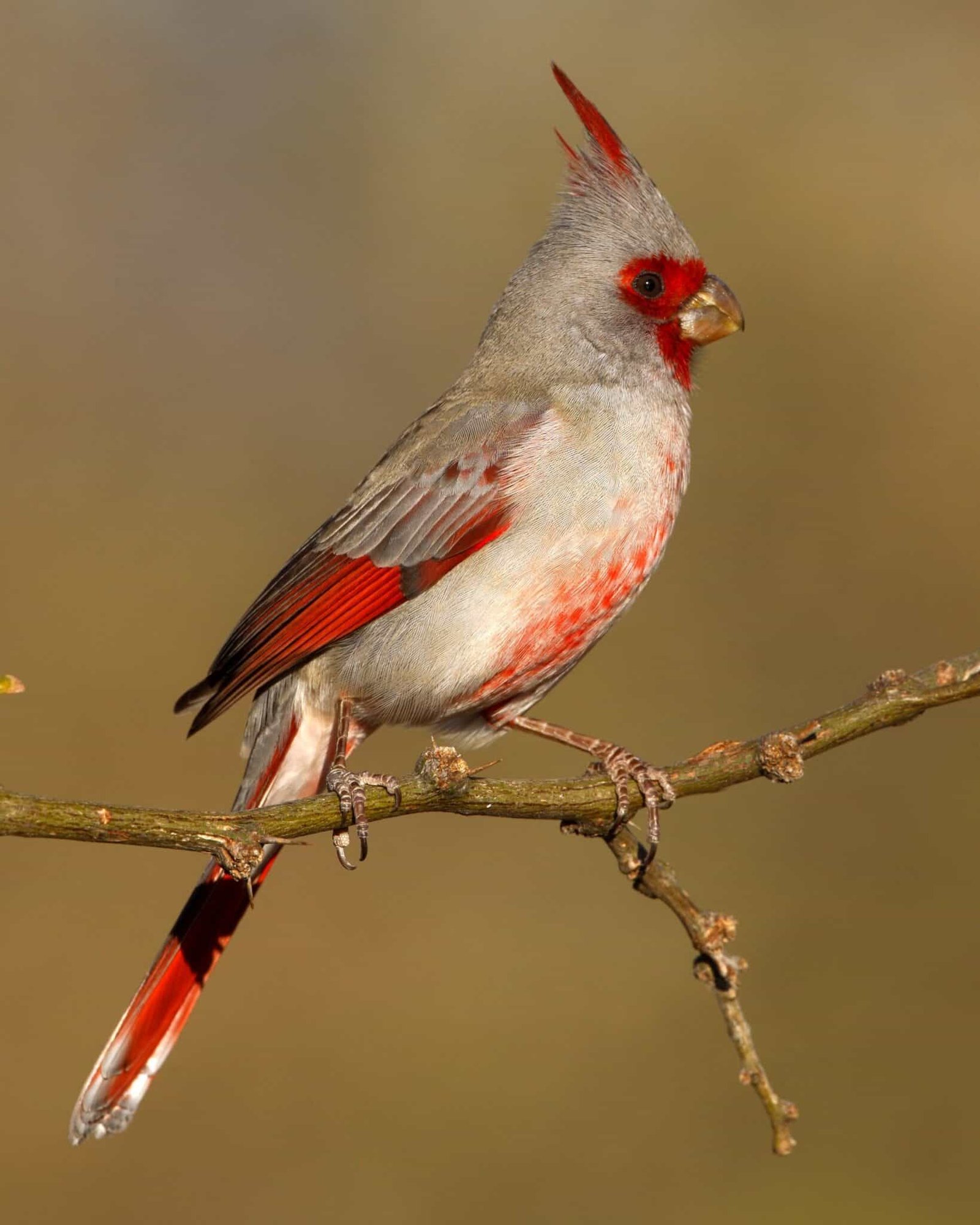
The Northern Cardinal is the red-headed bird most people in the United States mean. The male has a bright red body, red crest, black face, and orange bill. However, several other U.S. birds also have red heads, including the Red-headed Woodpecker, House Finch, Purple Finch, Scarlet Tanager, and Vermilion Flycatcher.
The bird’s size, habitat, body color, bill shape, and location can help you identify it.
Quick Answer: Which Bird Has a Red Head?
If you saw a bright red bird at a backyard feeder, it was most likely a male Northern Cardinal. Cardinals are common across much of the eastern and central United States and are frequent visitors to yards, parks, and woodland edges.
Other likely matches include:
| Bird | What the red looks like | Where you may see it in the USA |
|---|---|---|
| Northern Cardinal | Entire male is red, with a crest and black face | Most of the eastern and central U.S., parts of the Southwest |
| Red-headed Woodpecker | Head, neck, and upper chest are fully red | Central and eastern U.S. |
| House Finch | Red forehead, throat, and upper chest | Across much of the U.S. |
| Purple Finch | Raspberry-red crown and upper body | Northern U.S., forests, and during migration |
| Scarlet Tanager | Red head and body with black wings | Eastern forests in spring and summer |
| Vermilion Flycatcher | Bright red crown, throat, and underside | Southwest and parts of the southern U.S. |
The shape of the bird and its habitat matter as much as the color. Red alone is not enough for a certain identification.

The Most Common Red-Headed Bird: Northern Cardinal
The male Northern Cardinal is the best-known red-headed bird in the United States. It has vivid red feathers, a pointed crest, a black mask around the bill, and a thick orange-red bill.
Northern Cardinals often visit sunflower feeders. They also eat seeds, berries, and some insects. You may see them in backyards, hedges, woodland edges, gardens, and city parks.
The female is mostly tan or warm brown. She may show red on the crest, wings, and tail. This difference often causes people to think they have seen two different species.
How to identify a male Northern Cardinal
Look for these features:
- Bright red body
- Pointed red crest
- Black area around the face
- Thick, cone-shaped orange bill
- Long red tail
- Upright posture on branches or feeders
The cardinal’s crest is one of its best clues. A red bird without a crest may be a House Finch, Purple Finch, or another species.
According to the Cornell Lab of Ornithology, Northern Cardinals live in many habitats, including suburban areas and forest edges. Their broad range makes them one of the most likely red birds seen in an American yard.

Red-Headed Woodpecker: The Bird With an Entirely Red Head
The Red-headed Woodpecker has one of the clearest red head patterns in North America. Its head, neck, and upper breast are a strong crimson red. The rest of the bird is mostly black and white.
This woodpecker has:
- A completely red head and neck
- A black back
- Large white patches on the wings
- A white belly
- A short, sturdy bill
- A straight, stiff-backed posture
Unlike a cardinal, the Red-headed Woodpecker often clings to tree trunks, fence posts, and utility poles. It may also catch insects in the air or store food in cracks.
The species occurs across much of the central and eastern United States, though its numbers and local range can vary. It uses open woodlands, forest edges, parks, farms, and areas with dead trees.
The U.S. Fish and Wildlife Service identifies the Red-headed Woodpecker as a distinctive species with a red head and bold black-and-white body pattern.
Cardinal or Red-headed Woodpecker?
Use this simple test:
- Red bird with a crest and orange bill: likely a Northern Cardinal
- Red head with black-and-white body: likely a Red-headed Woodpecker
- Bird climbing a tree trunk: likely a woodpecker
- Bird sitting at a seed feeder: more likely a cardinal or finch

House Finch: A Red Head at Feeders
The House Finch is another common red-headed bird in the United States. A male House Finch usually has red feathers on the forehead, throat, and upper chest. The red may extend over the face and breast, but the back and belly are often brown and streaked.
House Finches are common in:
- Residential neighborhoods
- Towns and cities
- Parks
- Farms
- Open woodland
- Backyard feeding areas
They often feed on sunflower seeds and other small seeds. Their thick, rounded bill helps them crack seeds.
The amount of red can vary. Diet affects the intensity of the male’s color, so some House Finches look bright red while others look orange, pink, or dull red.
The Cornell Lab of Ornithology House Finch guide notes that the species is common across much of the United States. House Finches are especially likely if the bird has a streaked brown body and no pointed crest.

Purple Finch: A Raspberry-Colored Head
The Purple Finch does not have a solid purple head. Adult males have a raspberry-red or wine-colored crown, face, throat, and upper breast. Their back may also show red tones.
Purple Finches are usually more compact and round-bodied than House Finches. They often have:
- A raspberry-red head and throat
- A red wash across the breast and back
- A brown-streaked belly
- A short, conical bill
- A soft, rounded body shape
Purple Finches live mainly in northern forests and parts of the western United States. They may move south during winter, making them possible visitors outside their usual breeding range.
To separate a Purple Finch from a House Finch, compare the color pattern:
- Purple Finch: red spreads over the crown, face, throat, and back
- House Finch: red is strongest on the forehead, throat, and chest
- Purple Finch: often looks more rounded and softly colored
- House Finch: often has stronger brown streaking below
The Cornell Lab of Ornithology provides range and identification details for this species.

Scarlet Tanager: A Red Bird With Black Wings
The male Scarlet Tanager is easy to recognize in eastern U.S. forests. It has a bright scarlet-red body, black wings, and a black tail. Its red head blends into the red body, creating a bold color pattern.
Scarlet Tanagers are usually found in:
- Mature forests
- Large wooded parks
- Forest edges
- Woodland canopies
They spend much of their time high in trees. This can make them harder to spot than cardinals and finches.
A Scarlet Tanager is not usually a backyard feeder bird. Its dark wings are the key clue. The bird may also look less bulky than a cardinal and lacks a crest.
Female Scarlet Tanagers are yellow-green rather than red. Young birds can show less vivid colors, so not every member of the species will match the bright adult male pattern.
The National Audubon Society describes the Scarlet Tanager as a forest bird that breeds in the eastern United States and migrates south for winter.

Vermilion Flycatcher: A Bright Red Bird of the Southwest
The Vermilion Flycatcher is one of the brightest red birds found in the United States. Adult males often have a vivid red crown, throat, chest, and underside. Their back and wings are darker brown.
This bird is most likely in:
- Arizona
- New Mexico
- Texas
- Southern California
- Parts of Nevada, Utah, Colorado, and nearby states
It prefers open areas near water, grasslands, desert edges, farms, and scattered trees. It often perches in an exposed spot before flying out to catch insects.
Important identification clues include:
- Small to medium size
- Bright red underside
- Brown back and wings
- Dark bill
- Upright flycatcher posture
- Habit of returning to the same perch
A male Vermilion Flycatcher can look more orange-red than a cardinal. Its open-country habitat also separates it from forest birds such as the Scarlet Tanager.
The Cornell Lab of Ornithology lists the species’ range, habitat, calls, and field marks.

How to Identify a Red-Headed Bird
Start with the whole bird, not just its head. Red feathers can appear on the crown, face, throat, chest, back, or entire body.
Use this sequence:
1. Check the bird’s size
- Small finch-sized bird: House Finch, Purple Finch, or Common Redpoll
- Medium songbird with a crest: Northern Cardinal
- Medium bird with black-and-white wings: Red-headed Woodpecker
- Slim forest bird: Scarlet Tanager
- Small, upright bird in open country: Vermilion Flycatcher
2. Look for a crest
A pointed crest strongly suggests a Northern Cardinal. Most other red-headed birds in the United States do not have the same raised, triangular crest.
3. Examine the wings
Black wings on a red body point toward a Scarlet Tanager. Black-and-white wings with a fully red head suggest a Red-headed Woodpecker.
4. Notice the bill
- Thick orange bill: Northern Cardinal
- Short cone-shaped bill: House Finch or Purple Finch
- Sturdy pointed bill: Red-headed Woodpecker
- Narrow dark bill: Vermilion Flycatcher or Scarlet Tanager
5. Consider the habitat
Habitat can quickly narrow the choices:
- Backyard feeder: Northern Cardinal or House Finch
- Tree trunk: Red-headed Woodpecker
- High forest canopy: Scarlet Tanager
- Open desert or grassland: Vermilion Flycatcher
- Northern forest or winter yard: Purple Finch or Common Redpoll
6. Listen for the call
A cardinal often gives clear whistles. Woodpeckers may drum on wood. Flycatchers often make short calls from an exposed perch. Sound is useful, but a photograph and habitat clues are usually more reliable for beginners.

Red-Headed Bird Identification Chart
This chart compares the most likely U.S. species.
| Species | Head color | Body pattern | Crest | Typical habitat |
|---|---|---|---|---|
| Northern Cardinal | Bright red in males | Red body with black face | Yes | Yards, shrubs, woodland edges |
| Red-headed Woodpecker | Entire head and neck red | Black back and white wings | No | Open woods, farms, dead trees |
| House Finch | Red forehead and throat | Brown, streaked body | No | Cities, yards, feeders |
| Purple Finch | Raspberry-red crown and upper body | Soft brown streaking | No | Northern forests, feeders |
| Scarlet Tanager | Red head and body | Black wings and tail | No | Mature eastern forests |
| Vermilion Flycatcher | Red crown, throat, and underside | Brown back and wings | No | Open country in the Southwest |
The main distinction is the relationship between the red head and the rest of the body. A bird with a red head and black-and-white wings is not the same as a mostly red bird with a crest.

Red-Headed Birds by U.S. Region
The bird’s location can be a strong clue, especially when the colors overlap.
Eastern United States
The most likely species include:
- Northern Cardinal
- House Finch
- Red-headed Woodpecker
- Scarlet Tanager
- Purple Finch in suitable habitats or during migration
Central United States
You may see:
- Northern Cardinal
- Red-headed Woodpecker
- House Finch
- Scarlet Tanager during the breeding season
- Purple Finch during migration or winter
Western United States
Likely options include:
- House Finch
- Purple Finch
- Northern Cardinal in parts of the West
- Vermilion Flycatcher in the Southwest
- Red-headed Woodpecker in parts of the Great Plains and western range
Southern United States
Possible red-headed birds include:
- Northern Cardinal
- House Finch
- Vermilion Flycatcher
- Red-headed Woodpecker
- Scarlet Tanager during migration
Range is only a guide. Birds migrate, wander, and sometimes appear outside their usual areas. Always combine geography with body shape and behavior.

Why Are Some Birds Red?
Red feathers often come from pigments called carotenoids. Birds get these pigments from food, then use them to produce red, orange, or yellow feather color.
A bird’s red color can change in strength because of:
- Age
- Sex
- Diet
- Feather wear
- Molting
- Health
- Genetic differences
This is why two male House Finches may not look exactly alike. One may appear bright red, while another looks orange or pale rose.
Red plumage can also play a role in courtship and social signals. However, color alone does not prove that a bird is healthy, dominant, or ready to breed. Those claims depend on the species and the context.

Common Mistakes When Identifying Red Birds
Mistaking a House Finch for a cardinal
A House Finch usually has a streaked brown body and no crest. A male cardinal has a smoother red body, a clear crest, and a larger orange bill.
Calling every red woodpecker a Red-headed Woodpecker
Some woodpeckers have red on the crown or nape rather than across the entire head. The Red-headed Woodpecker has a fully red head and neck, which makes it distinctive.
Confusing a Scarlet Tanager with a cardinal
Both can look red, but the Scarlet Tanager has black wings and no crest. It also spends more time high in forest trees.
Assuming a female cardinal is a different species
Female Northern Cardinals are brown or tan with red highlights. They have the same crest, thick bill, and overall shape as males.
Relying on color in poor light
Shade, sunset, and window glare can make orange look red or brown look purple. Shape, behavior, and habitat are safer clues than color alone.

How to Help Red-Headed Birds in Your Yard
You can make a yard more useful to many red birds by providing food, cover, and water.
Try these steps:
- Offer black-oil sunflower seed in a clean feeder.
- Plant native shrubs that produce berries.
- Keep dense shrubs for shelter.
- Add a shallow birdbath with fresh water.
- Clean feeders and baths often.
- Keep cats indoors or use safe outdoor enclosures.
- Avoid pesticides when possible.
- Prevent birds from striking windows with properly placed window markers.
Do not try to capture or handle a wild bird for identification. Use binoculars, a camera, or a bird identification app instead. If a bird appears injured, contact a licensed wildlife rehabilitator rather than attempting treatment at home.

Frequently Asked Questions
What is the most common bird with a red head in the USA?
The male Northern Cardinal is the most common answer, especially in eastern and central states. Its red body, pointed crest, black face, and orange bill make it easy to recognize.
What bird has a red head and black wings?
A Scarlet Tanager has a red body and black wings. A Red-headed Woodpecker has a fully red head, a black back, and bold white wing patches.
What small bird has a red head at a feeder?
It is often a House Finch or Purple Finch. A House Finch has more brown streaking and red concentrated on the face, throat, and chest. A Purple Finch often has a broader raspberry-colored wash across the head and back.
Is a red-headed woodpecker rare?
The Red-headed Woodpecker is not rare everywhere, but its local numbers vary. It depends on suitable open woodland, dead trees, and food sources. It may be less common in some neighborhoods than Northern Cardinals or House Finches.
Do female birds have red heads?
Some do. Female Northern Cardinals are mostly brown with red highlights. Female Scarlet Tanagers are yellow-green, while female House Finches and Purple Finches are usually brown and streaked rather than bright red.
What should I do if I cannot identify the bird?
Record the location, date, habitat, size, behavior, and colors. Take a photo if possible. Then compare the bird with a trusted field guide, such as the Cornell Lab of Ornithology’s bird guide, or ask a local birding group for help.
Key Takeaways
- The Northern Cardinal is the most likely red-headed bird in an American backyard.
- A bird with a fully red head and black-and-white body is likely a Red-headed Woodpecker.
- A bird with a red face and streaked brown body is often a House Finch.
- A bird with red plumage and black wings may be a Scarlet Tanager.
- A bright red bird in open Southwestern habitat may be a Vermilion Flycatcher.
- Use the bird’s shape, habitat, wings, bill, crest, and behavior—not color alone—to identify it.
Conclusion
Many birds in the United States have red feathers on the head, but the Northern Cardinal is the most familiar and most likely answer. Its red crest, black face, and orange bill set it apart from other species.
For a more precise identification, look at the entire bird. A red head paired with black-and-white wings suggests a Red-headed Woodpecker. Red plumage with black wings suggests a Scarlet Tanager, while red feathers on a streaked brown finch point toward a House Finch or Purple Finch.