
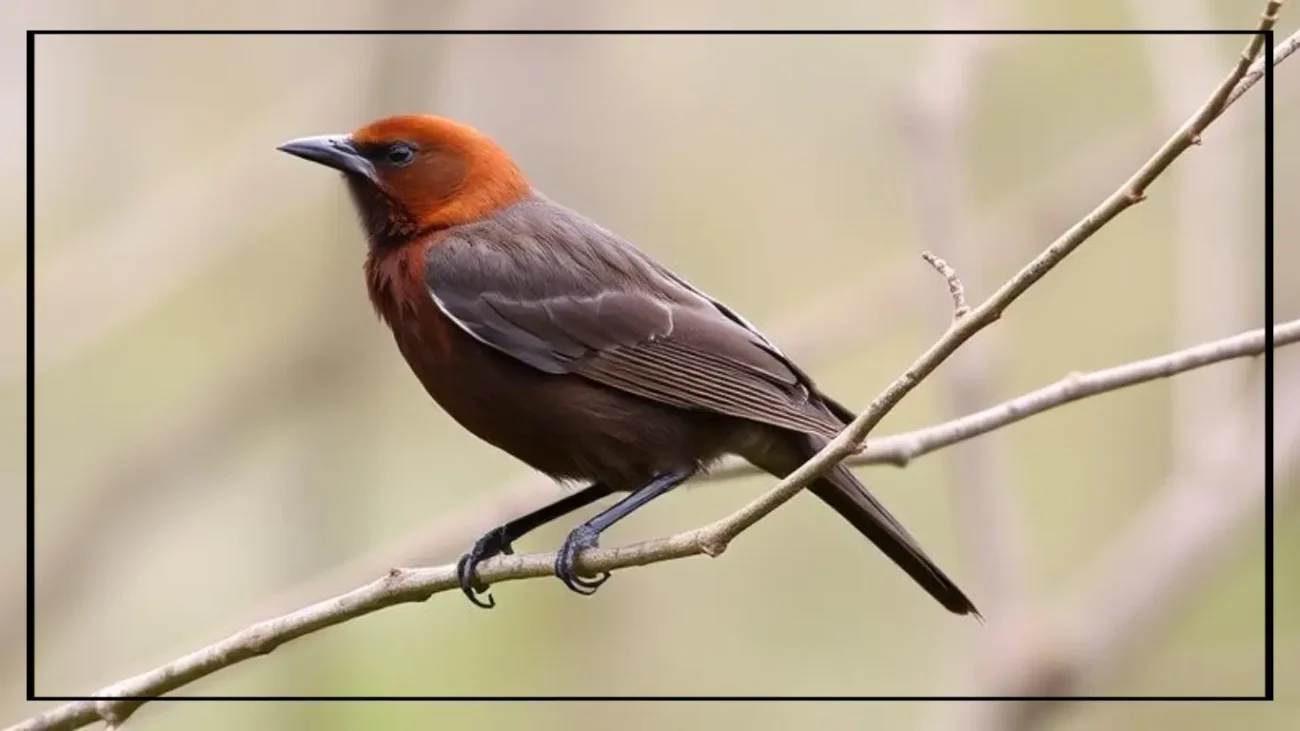
In the United States, the black-headed grosbeak is one of the best matches for a bird with a dark or black head and a brown, orange, or cinnamon-colored body. The male has a black head, dark back, white wing patches, and a warm orange-brown breast.
However, several other U.S. birds can look similar. A spotted towhee, eastern towhee, orchard oriole, or Baltimore oriole may also appear to have a black head and brown or rusty body. The bird’s size, location, belly color, wing pattern, and behavior can help you identify it.

The black-headed grosbeak is the leading match
The male black-headed grosbeak (Pheucticus melanocephalus) is the most likely answer when the bird has a black head and a rich brown, orange, or cinnamon body.
Look for these key marks:
- A black head and throat
- A black back with white spots or patches on the wings
- A broad, thick bill
- A warm orange, cinnamon, or brown breast
- A paler orange or yellow belly
- A medium-sized, heavy-bodied shape
- A song with clear, rich, robin-like notes
The male’s body is not usually plain brown. In good light, the breast often looks orange or rust-colored. In shade, those colors may look brown.
Black-headed grosbeaks live across much of the western United States. They breed in parts of the West and may appear farther east during migration. They often visit woodland edges, streams, parks, orchards, and backyard feeders.
The female looks very different. She is mostly brown, streaked, and pale, with a light eyebrow line. A young bird may also lack the adult male’s black head.
Why the name can cause confusion
The name black-headed grosbeak describes the male’s head, not the whole bird. Its body may show several colors at once:
- Black on the head and back
- White on the wings
- Orange or cinnamon on the breast
- Yellow or pale orange below
That mix can lead people to describe the bird as “black-headed and brown-bodied,” even though “orange-brown” is more accurate.
The thick bill is one of the best clues. Grosbeaks have large, cone-shaped bills built for cracking seeds and eating fruit. A towhee has a smaller, more typical sparrow-like bill.

Other U.S. birds that may match the description
A short color description is useful, but it is not enough for a certain identification. These birds can also show a dark head with brown, rusty, or orange body feathers.
| Bird | Head pattern | Body color | Best clue |
|---|---|---|---|
| Black-headed grosbeak | Black head in adult males | Orange, cinnamon, and brown | Large bill and white wing patches |
| Spotted towhee | Black hood and back in males | Rusty sides and white belly | White spots on back and wings |
| Eastern towhee | Black hood and back in males | Rusty sides and white belly | Found mainly in the eastern U.S. |
| Orchard oriole | Black head and back in adult males | Chestnut or reddish-brown underside | Slim body and pointed bill |
| Baltimore oriole | Black head and back in adult males | Bright orange underside | Orange is stronger than brown |
| Brown-headed cowbird | Brown head, not black | Black body in males | Head is brown and body is glossy black |
| Brewer’s blackbird | Dark head and body | Black or dark brown | Long tail and slimmer shape |
Spotted towhee
A male spotted towhee has a black head, black back, rusty sides, and a white belly. Small white spots cover parts of its back and wings.
It is often seen scratching through dry leaves under shrubs. This ground-feeding habit is a strong clue. Spotted towhees are common across much of the western United States and parts of the Great Plains.
A spotted towhee is smaller and slimmer than a grosbeak. Its bill is also less massive.
Eastern towhee
The male eastern towhee has a black head, black upper body, rusty sides, and a white belly. It resembles the spotted towhee but usually has fewer white spots on its back.
Eastern towhees occur mainly in the eastern half of the United States. Their familiar call is often described as “drink-your-tea.”
If the bird is in an eastern state and stays low in brush, an eastern towhee may be a better match than a black-headed grosbeak.
Orchard oriole
An adult male orchard oriole has a black head and back with a chestnut-colored underside. The chestnut feathers can look brown from a distance.
Orchard orioles are slimmer than grosbeaks and have narrow, pointed bills. They often feed high in trees, where they search for insects, nectar, and fruit.
Their dark upper body usually extends well down the back. The reddish-brown color is strongest on the breast, belly, and shoulders.
Baltimore oriole
A male Baltimore oriole has a black head and back with bright orange underparts. In poor light, the orange may look brown.
The bird’s long, pointed bill and slender shape help separate it from a grosbeak. Baltimore orioles also spend much of their time in tree crowns and may visit oranges, jelly, or nectar feeders.
Color alone can mislead you. If the bird looks thin and bright orange, consider a Baltimore oriole. If it looks thick-bodied with a large bill, consider a grosbeak.

How to identify the bird in your yard
Use more than one field mark. Color changes with light, distance, age, season, and feather wear.
1. Estimate the bird’s size
Start with a familiar bird nearby.
- Sparrow-sized: It may be a towhee or another sparrow relative.
- Robin-sized and thick-bodied: A black-headed grosbeak is more likely.
- Slim and long-bodied: An oriole is a better possibility.
- Larger with a long tail: A blackbird may fit better.
Size estimates are not exact. A bird seen alone can look larger or smaller than it really is.
2. Check the bill
The bill often solves the mystery.
A black-headed grosbeak has a large, pale, cone-shaped bill. It looks powerful compared with the bill of a towhee.
Orioles have a thin, pointed bill. Towhees have a smaller, triangular bill that looks less heavy.
3. Look for white wing marks
White wing patches strongly support a black-headed grosbeak. A spotted towhee also has white spots, but they usually appear as many small marks across the back and wings.
A grosbeak’s white wing markings may look like two clear bars or patches when the wing is folded.
4. Study the underside
The body color gives another useful clue:
- Orange or cinnamon breast with a pale belly: Black-headed grosbeak
- Rusty sides with a white belly: Spotted or eastern towhee
- Chestnut underside with a black back: Orchard oriole
- Bright orange underside: Baltimore oriole
- Mostly black body: Brewer’s blackbird or another blackbird
5. Watch where it feeds
Behavior can help confirm the visual clues.
- On the ground under shrubs: Towhee
- At a seed feeder: Grosbeak
- High in leafy trees: Oriole
- In open lawns or fields: Blackbird or cowbird
- Scratching through leaf litter: Towhee
A bird may use more than one habitat, so behavior should support—not replace—the field marks.
6. Listen to the call or song
Adult male black-headed grosbeaks often sing a rich, melodic song. Their song may sound somewhat like an American robin but is more varied and flute-like.
Towhees often give sharp calls and scratchy songs. Eastern towhees are well known for the “drink-your-tea” phrase, although individual songs vary.
Do not rely on sound alone. Birds can call from nearby trees, and songs may change across regions.

Black-headed grosbeak vs. spotted towhee
These two birds are among the most common sources of confusion.
| Feature | Black-headed grosbeak | Spotted towhee |
|---|---|---|
| Overall shape | Thick and heavy | Slimmer and more sparrow-like |
| Bill | Large and conical | Smaller and pointed |
| Male head | Black | Black |
| Breast | Orange, cinnamon, or brown | Mostly white |
| Sides | Orange or cinnamon | Rusty |
| Wings | White patches | Many white spots |
| Usual feeding place | Trees, feeders, shrubs | Ground and leaf litter |
| Range | Mainly western U.S. | Mainly western U.S. |
The breast is often the fastest clue. A black-headed grosbeak usually shows warm color across the breast. A spotted towhee usually shows a white belly with rusty sides.
If the bird is on the ground and flicks leaves aside, favor a towhee. If it sits at a feeder with a large bill, favor a grosbeak.

Black-headed grosbeak vs. orchard oriole
These birds can both show black above and brown or reddish color below.
A black-headed grosbeak has a heavier body and a much larger bill. Its wings often show noticeable white patches. It also tends to look rounder.
An orchard oriole is slimmer. Its bill is narrow and pointed, and its underside is usually chestnut or brick red rather than soft orange. Orchard orioles often move through tree branches while searching for insects.
A bird feeding high in a tree may be an oriole. A bird at a platform feeder or eating large seeds is more likely to be a grosbeak.
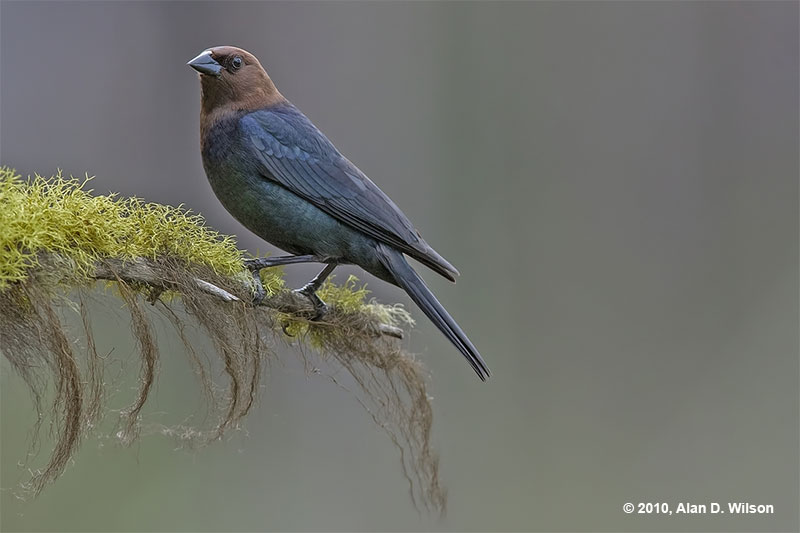
Does a black-headed bird with a brown body mean a brown-headed cowbird?
Usually, no. The brown-headed cowbird has the opposite pattern.
The adult male brown-headed cowbird has:
- A brown head and neck
- A glossy black body
- A short, thick bill
- A compact shape
At a distance, the head may look dark brown or nearly black. But the body is generally black, not brown.
Females are mostly plain brown and do not have the male’s black body and brown head contrast.
This bird is common across much of the United States, especially in open areas, pastures, roadsides, and suburban landscapes. Its feeding behavior and flocking habits can help separate it from a black-headed grosbeak.
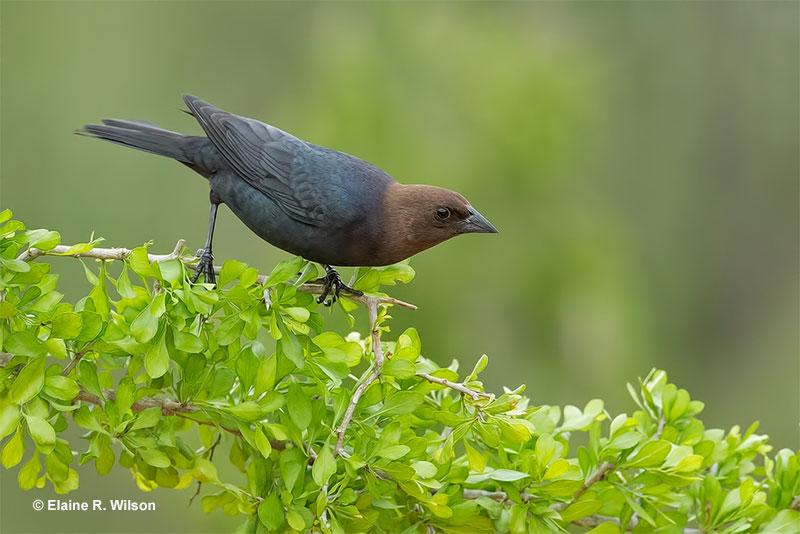
How season, age, and light change the bird’s appearance
Bird color is not fixed in every sighting.
Lighting
Warm evening light can make black feathers look dark brown. Shade can make orange feathers look brown or dull. Bright sunlight can make a rusty body look orange or red.
Try to view the bird from more than one angle before deciding.
Age
Young birds often lack adult male plumage. A young black-headed grosbeak may look brown and streaked instead of black and orange.
Immature orioles and towhees can also look less sharply marked than adult males.
Molting and feather wear
Old feathers may fade. Fresh feathers may look darker or brighter. During molt, a bird can show a patchy mix of adult and immature feathers.
Sex
Male and female birds often look very different. A female black-headed grosbeak is mostly brown and streaked, while the adult male has the dark head and warm-colored body.
For this reason, a bird’s sex and age matter as much as its species.

Where black-headed grosbeaks are found in the United States
Black-headed grosbeaks are most closely linked with the western United States. They use open woodlands, streamside trees, forest edges, parks, and suburban areas with mature trees.
Their range includes much of the West, and they may occur farther east during migration. They also move south into Mexico during part of the year.
Exact timing depends on latitude, elevation, weather, and local habitat. A bird seen in a western woodland is more likely to be a black-headed grosbeak than one seen in a dense eastern forest.
For a location-specific check, compare your sighting with the current range maps from:
- Cornell Lab of Ornithology: Black-headed Grosbeak
- Audubon Field Guide: Black-headed Grosbeak
- eBird species maps
These sources provide photographs, sounds, seasonal maps, and comparisons with similar species.

Common identification mistakes
Mistaking orange for brown
Orange feathers often look brown in shade or through a window. Check the bird in direct daylight if possible.
Ignoring the bill
The bill is one of the strongest clues. A large bill points toward a grosbeak. A thin bill points toward an oriole.
Using only the head color
Many birds have dark heads. The body pattern, wing marks, habitat, and behavior usually provide better evidence.
Assuming every dark-headed bird is male
Females and young birds may have completely different plumage. A brown, streaked bird near a male may be the same species.
Treating a distant view as certain
A quick glimpse may support a likely identification, but it may not prove the species. Record several clues rather than relying on one color.
A photo taken from a safe distance can help. Avoid chasing or handling the bird. Wild birds can be stressed by repeated pursuit, and protected species should not be disturbed.

Quick identification checklist
Use this short checklist when you see the bird again:
- Is it thick-bodied or slim?
- Is the bill large and cone-shaped or narrow and pointed?
- Is the underside orange, rusty, white, or black?
- Are there white wing patches or small white spots?
- Is the bird on the ground, at a feeder, or high in a tree?
- Is the head truly black, or could it be dark brown?
- What part of the United States are you in?
- Is the bird an adult male, female, or immature bird?
The best match is usually the species that fits the most clues, not just the head color.
Frequently asked questions
What bird has a black head and rusty brown sides?
A spotted towhee or eastern towhee is a strong possibility. Both have a black head and rusty sides with a white belly. Spotted towhees are more common in the West, while eastern towhees are mainly found in the eastern United States.
What bird has a black head, orange body, and white wing patches?
A male black-headed grosbeak fits this description well. Its orange or cinnamon breast, large bill, and white wing markings are useful field marks.
What bird has a black head and brown body in the eastern United States?
An eastern towhee or orchard oriole may fit. An eastern towhee has rusty sides and a white belly. An orchard oriole is slimmer and has a chestnut underside.
Is a black-headed grosbeak rare?
No. Black-headed grosbeaks are regular birds across much of the western United States. Their visibility changes by season, habitat, and local migration patterns.
What should I do if I cannot identify the bird?
Write down the location, date, size, colors, behavior, and habitat. Take a photo without approaching the bird. Then compare the image with a regional field guide or a trusted bird database such as Cornell Lab’s All About Birds or eBird.
Conclusion
The black-headed grosbeak is the leading answer to “what bird has a black head and brown body,” especially when the bird has a large bill, white wing patches, and an orange-brown breast.
A spotted towhee, eastern towhee, or orchard oriole may look similar. To separate them, check the bird’s bill, body pattern, size, feeding place, and location. A photo and a few notes can turn a quick color impression into a reliable identification.