
Introduction
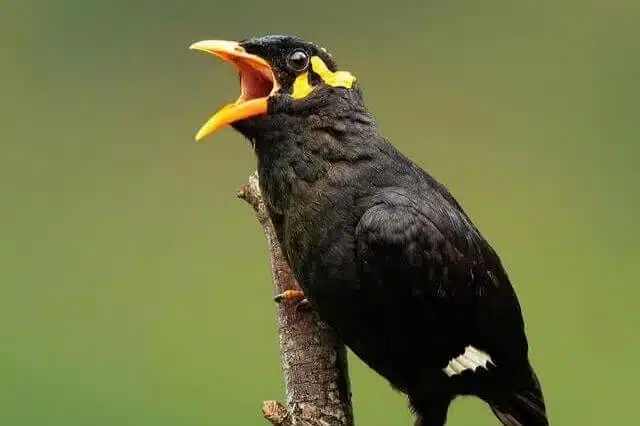
In the United States, a black bird with a yellow beak is most often a European starling. The starling has glossy black feathers, small light spots, and a long, pointed yellow bill during the breeding season. It is common in cities, suburbs, farms, parks, and open fields across much of the country.
If you saw the bird outside the United States, especially in the United Kingdom or Europe, it may be a male Eurasian blackbird. That bird has plain black feathers and a bright yellow or orange-yellow bill. Location, body shape, and feather markings help separate these two birds.

The Most Likely Answer: European Starling
The European starling (Sturnus vulgaris) is the best match for most sightings in the United States. It is a stocky songbird with dark, glossy feathers and a yellow bill that is most visible in spring and summer.
Adult starlings often look black from a distance. In good light, their feathers can show purple, green, or blue shine. Many also have small white or buff spots, especially outside the breeding season.
The Cornell Lab of Ornithology lists the European starling as a common bird in towns, cities, agricultural areas, and open habitats. The species was introduced to North America in the late 1800s and now lives across much of the United States.
European starling identification
Look for these features:
- Black or dark glossy body
- Yellow, slender, pointed bill
- Short tail
- Pointed wings
- Speckled feathers, often more visible in fall and winter
- Walks on lawns and ground while searching for food
- Common around buildings, parking lots, farms, and livestock areas
- Often travels in large flocks
A breeding starling can have a bright yellow bill. In winter, the bill is often darker. This seasonal change is one reason people may see the same bird looking different at different times of year.
Starlings eat insects, fruit, seeds, grains, and food scraps. They often forage on lawns and may gather near livestock feed. Their habit of forming large flocks can make them easy to notice.
The Cornell Lab of Ornithology provides range, behavior, sound, and identification details for this species.

The Eurasian Blackbird Is the Classic “Black Bird With a Yellow Beak”
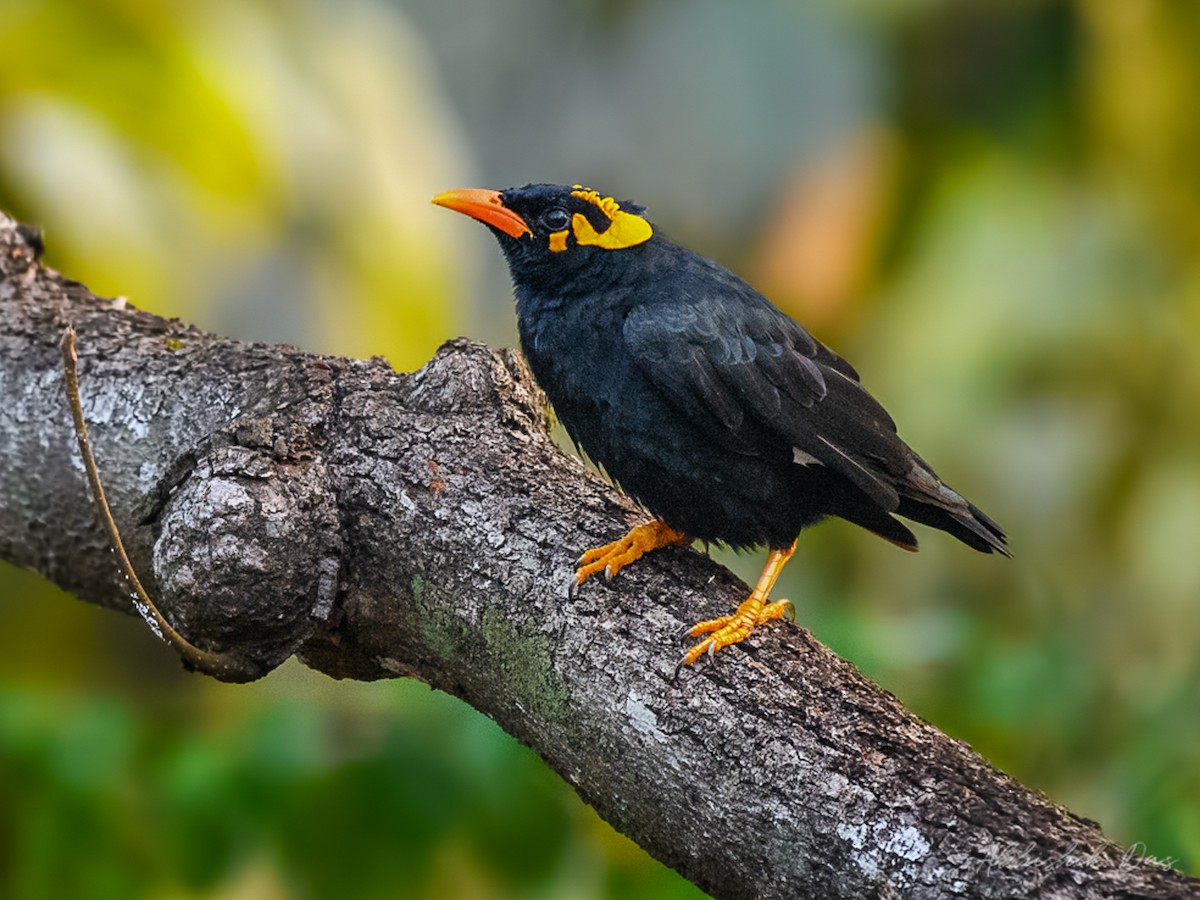
The Eurasian blackbird (Turdus merula) is the classic answer when someone uses the phrase “a black bird with a yellow beak.” An adult male has rich black feathers and a yellow to orange-yellow bill. It may also have a yellow ring around the eye.
This bird is common in Europe, parts of Asia, and North Africa. It is not a normal wild species across the United States. A person in the United States may see one only in captivity, in an unusual escaped-bird situation, or in a photograph taken overseas.
Male Eurasian blackbirds usually have:
- Plain black feathers
- A bright yellow or orange-yellow bill
- A yellow eye ring
- A rounded body
- A fairly long tail
- A rich, flute-like song
Female Eurasian blackbirds are different. They are usually brown, with a mottled chest and a duller bill. Young birds also lack the solid black look of adult males.
The Eurasian blackbird often feeds on lawns, gardens, leaf litter, and woodland edges. It may hop on the ground and pause with its head tilted while looking for worms and insects.
The RSPB and British Trust for Ornithology offer useful information about its appearance, habitat, and behavior.

European Starling vs. Eurasian Blackbird
The quickest way to identify the bird is to compare its location, feathers, bill, and body shape.
| Feature | European starling | Eurasian blackbird |
|---|---|---|
| Most likely location | United States and Canada | Europe and nearby regions |
| Body color | Glossy black with possible spots | Plain black in adult males |
| Bill | Yellow in breeding season; darker in winter | Yellow or orange-yellow in adult males |
| Tail | Short | Longer and more rounded |
| Body shape | Compact and stocky | Larger, rounder thrush shape |
| Flight | Pointed wings and quick wingbeats | Broad, direct flight |
| Flock behavior | Often forms large flocks | More often seen alone or in pairs |
| Typical setting | Towns, lawns, farms, parking lots | Gardens, woods, parks, and farmland |
A bird that is plain black, alone, and has a strong yellow-orange bill may be a Eurasian blackbird if the sighting occurred in Europe.
A bird that is speckled, glossy, compact, and part of a group is more likely to be a European starling.
Bill color alone is not enough. Light, season, age, and distance can change how the bird appears.

Other Black Birds You Might Mistake for One
Several North American birds look dark but do not usually fit the full black-and-yellow-beak description.
Common grackle
The common grackle is a widespread bird in the United States. It has a long body, a long keel-shaped tail, and glossy feathers that may look blue, green, or purple in sunlight.
Its bill is usually dark or grayish rather than bright yellow. The grackle is often larger and longer than a European starling.
Brewer’s blackbird
The male Brewer’s blackbird is dark and glossy. It often has a purple head and a greenish or blue body. Its bill is usually dark, with a pale or yellowish area around the eye in some individuals.
This bird can look black at a distance, but a clearly bright yellow bill points more strongly to a starling or Eurasian blackbird.
Yellow-headed blackbird
The yellow-headed blackbird has a black body, but its head and upper chest are bright yellow. Its bill is dark. If the bird has a yellow head rather than a yellow bill, this is a better match.
It is most common in wetlands and grasslands in the western and central United States.
American crow
An American crow is entirely dark, but its bill is black. It is also much larger than a starling. Crows have broad wings, heavy bills, and a deeper, slower wingbeat.
Black oystercatcher
The black oystercatcher has dark feathers and a long orange-red bill. It lives along rocky Pacific Coast shores. Its bill may look yellow-orange in poor light, but it is usually red or orange and much longer than a starling’s bill.
How to Identify the Bird in Your Yard
Use the bird’s location, size, behavior, and bill shape together. This method is more reliable than judging color from one quick glance.
1. Check where you saw it
In the United States, a bird near a lawn, sidewalk, farm, parking lot, or city building is likely to be a European starling if it has a yellow bill.
A bird along a rocky coast may be a black oystercatcher. A bird in a marsh with a yellow head may be a yellow-headed blackbird.
2. Compare its size
A European starling is about the size of a robin, though its body is more compact. A common grackle is longer and often has a noticeably long tail. A crow is much larger.
Size can be hard to judge when the bird is far away. Compare it with a known object, such as a fence post, sparrow, robin, or pigeon.
3. Look at the tail
A short tail supports European starling identification. A long, wedge-like or keel-shaped tail suggests a grackle. A longer rounded tail can support Eurasian blackbird identification.
4. Study the feathers
Do not expect every starling to look solid black. Many have pale spots. Their feathers may also shine green, blue, or purple in direct light.
A plain black bird with no spots is more likely to be a Eurasian blackbird in Europe, a grackle, or another dark species.
5. Watch its behavior
Starlings often:
- Walk across grass while probing the soil
- Gather in noisy groups
- Enter roof spaces or building cavities
- Feed near farms and livestock
- Move quickly between the ground and low perches
Eurasian blackbirds often feed alone or in pairs. They may search through leaves and sing from trees, walls, or rooftops.
6. Listen to the call
Sound can help, but it is not always easy for beginners. European starlings make whistles, clicks, rattles, and copied sounds. Their calls may sound varied and mechanical.
Eurasian blackbirds are known for a clear, musical song with smooth phrases. A recording can be useful, but visual clues should still come first.

Why the Beak May Not Look Bright Yellow
A European starling’s bill changes color during the year. It is often yellow in spring and summer, then becomes darker in fall and winter.
Young birds usually have brown or dark bills. Lighting can also alter the apparent color. A yellow bill in warm sunlight may look orange, while shade may make it seem gray or pale.
The bill can also look yellow when the bird is actually a different species with a pale bill. For this reason, check the following traits before making an identification:
- Is the tail short or long?
- Does the bird have white spots?
- Is it alone or in a flock?
- Is the bill thin and pointed or thick and heavy?
- Is the bird the size of a robin, grackle, or crow?
- Was it seen in the United States or overseas?
A single color clue is useful, but a group of matching traits is much stronger.

What to Do if You Are Still Unsure
Take a clear photograph from a safe distance. Try to capture the side of the bird, its bill, tail, wings, and the surrounding habitat.
Record these details:
- Date and location
- Approximate size
- Bill color and shape
- Tail length
- Feather pattern
- Whether it was alone or in a flock
- Habitat, such as lawn, wetland, woodland, or coast
- Any song or call
You can compare the image with regional bird guides from the National Audubon Society or the Cornell Lab of Ornithology. The free Merlin Bird ID app may also help, but computer or app suggestions should be checked against the bird’s range and visible features.
Do not approach, catch, or feed an unfamiliar wild bird. If the bird appears injured, contact a licensed wildlife rehabilitator or a local wildlife agency. Do not handle a bird of prey, shorebird, or other wild bird without professional guidance.

Common Identification Mistakes
Mistake 1: Calling every dark bird a blackbird
“Blackbird” can mean different things in different countries. In the United States, many people use the word for several dark-colored birds. In Europe, “blackbird” often means the Eurasian blackbird.
Use the full species name when possible.
Mistake 2: Ignoring the season
A starling’s bill may be yellow in the breeding season and darker later in the year. Seasonal plumage can also make its spots easier or harder to see.
Mistake 3: Judging color in poor light
Shade, sunset, distance, and phone-camera settings can change black feathers into brown, blue, or purple. They can also change orange bills into yellow ones.
Mistake 4: Confusing a starling with a grackle
Both birds can look glossy and dark. The starling is smaller, has a shorter tail, and often shows pale spots. The grackle is longer and has a more obvious long tail.
Mistake 5: Using the bill without checking the range
A species must be possible in the place where it was seen. A male Eurasian blackbird is a strong visual match, but a European starling is usually the better answer for a sighting in the United States.

Frequently Asked Questions
What is the most common black bird with a yellow beak in the United States?
The European starling is the most likely answer. It has glossy dark feathers and a yellow bill during the breeding season. It is common in urban, suburban, farm, and open habitats.
Is a blackbird the same as a starling?
No. The Eurasian blackbird and European starling are different species. A male Eurasian blackbird is plain black with a yellow-orange bill, while a starling is usually smaller, more glossy, and often speckled.
Do American blackbirds have yellow beaks?
Some North American birds called blackbirds may have pale or yellowish bills, but a bright yellow bill is not the usual feature of common grackles, Brewer’s blackbirds, or red-winged blackbirds. A starling is a better match when the whole bird looks black and the bill is bright yellow.
Does a starling’s bill change color?
Yes. Adult European starlings often have yellow bills in the breeding season. Their bills become darker outside that season, and young birds usually have darker bills.
What black bird has a yellow head and a dark bill?
The yellow-headed blackbird has a black body, a bright yellow head and chest, and a dark bill. It is a different bird from one with a yellow bill.
Can a black bird with a yellow bill be dangerous?
The bird is usually not dangerous to people. Still, avoid handling wild birds. Do not disturb nests, and keep a safe distance from birds that act sick, injured, or unusually aggressive.
Key Takeaways
- In the United States, the most likely answer is the European starling.
- A male Eurasian blackbird is the classic black bird with a yellow-orange bill, but it is mainly found in Europe.
- Starlings often have glossy feathers, pale spots, short tails, and flocking behavior.
- Grackles, yellow-headed blackbirds, crows, and black oystercatchers can look similar but have different bill, body, or habitat clues.
- Location, season, tail shape, feather markings, and behavior are more reliable than bill color alone.
Conclusion
If you saw a black bird with a yellow beak in the United States, start with the European starling. Check for glossy feathers, small pale spots, a short tail, and flocking behavior.
If the bird was seen in Europe and had plain black feathers with a bright yellow-orange bill, it was more likely a male Eurasian blackbird. A photo, location, season, and note about the bird’s size can make the final identification much easier.