
Introduction
Some birds of paradise are endangered, but the whole group is not. “Birds of paradise” refers to about 45 tropical bird species in the family Paradisaeidae. Their conservation status ranges from Least Concern to Endangered, depending on the species.
For people in the United States, this is also a name trap. The colorful bird-of-paradise plant (Strelitzia reginae) is not the same as the wild bird. This guide focuses on the birds, their habitats, their legal protection, and what Americans can do to support their survival.

What are birds of paradise?
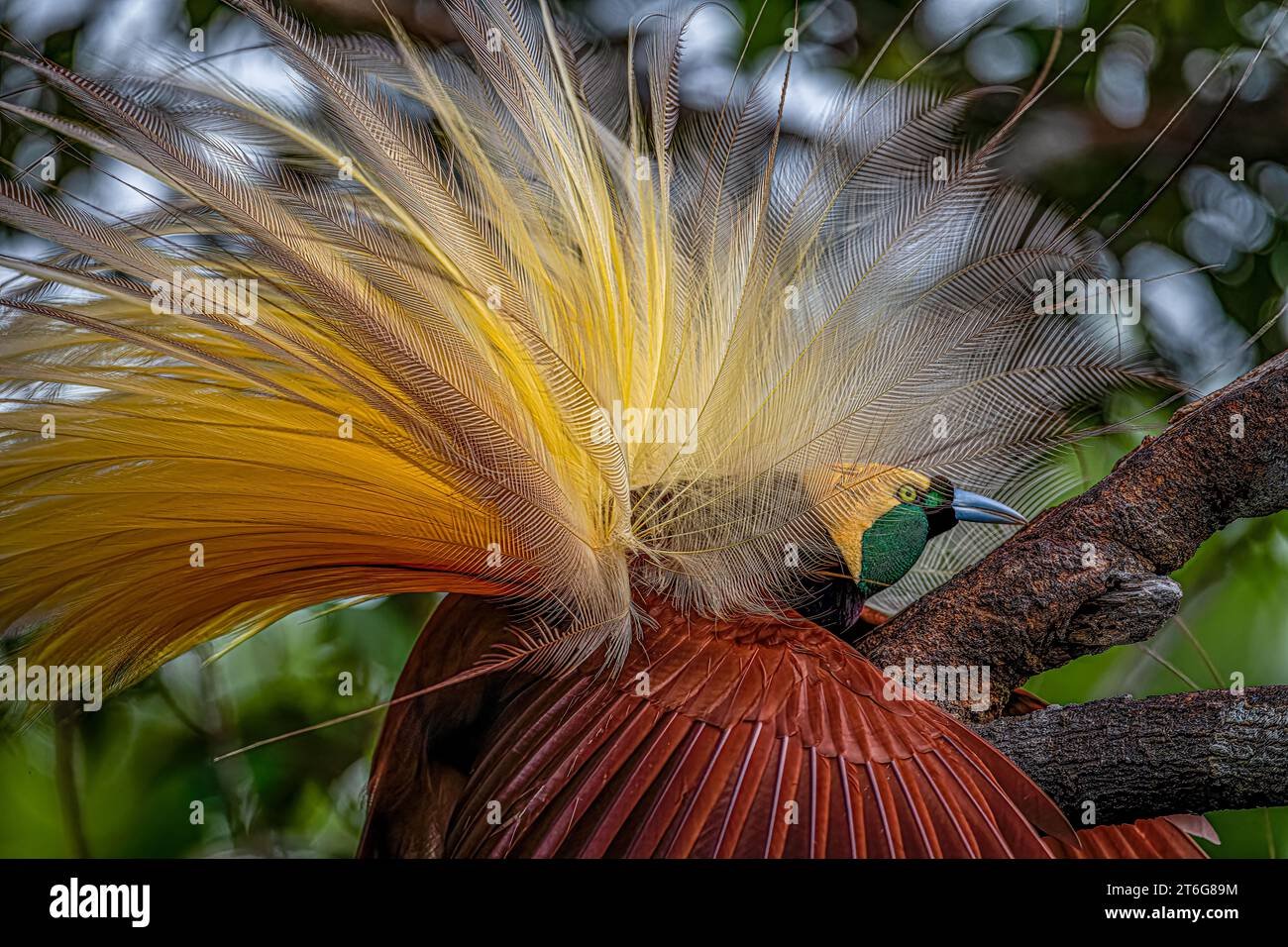
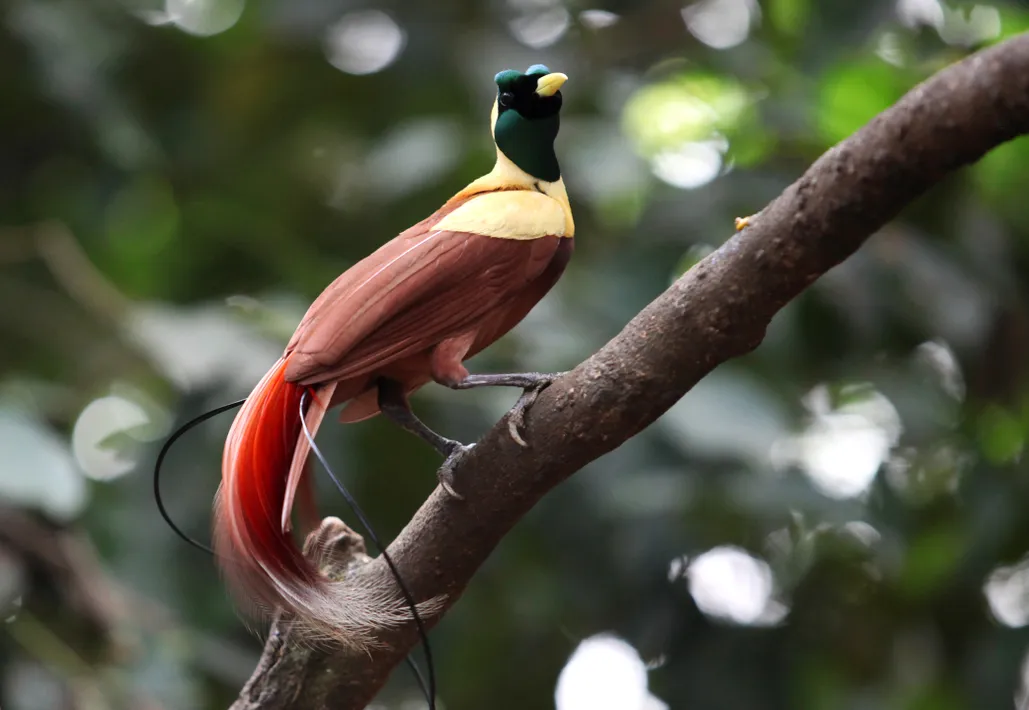
Birds of paradise are a family of songbirds found mainly in New Guinea and nearby islands. A small number also live in eastern Australia. They are best known for bright feathers, long plumes, unusual shapes, and complex courtship dances.
Most birds of paradise live in forests. Some stay high in the canopy, while others feed and display on the forest floor. Their diets often include fruit, insects, and other small animals.
The group includes well-known species such as:
- Greater bird-of-paradise
- King of Saxony bird-of-paradise
- Wilson’s bird-of-paradise
- Blue bird-of-paradise
- Raggiana bird-of-paradise
- Twelve-wired bird-of-paradise
- Superb bird-of-paradise
- Victoria’s riflebird
The family is not a single species with one shared conservation status. Each species has its own range, population trend, threats, and IUCN Red List category.
Bird of paradise bird vs. bird-of-paradise plant
The name can describe two very different living things:
| Name | What it is | Main location |
|---|---|---|
| Birds of paradise | A family of tropical birds | New Guinea, nearby islands, and eastern Australia |
| Bird-of-paradise plant | A flowering plant in the genus Strelitzia | Native to southern Africa; grown widely in the United States |
The plant is common in U.S. gardens and homes in warm areas. Its presence does not show that bird-of-paradise birds live nearby or that the birds are safe from extinction.

Which birds of paradise are endangered?
Some birds of paradise are listed as threatened, while others are not currently considered at high risk. The answer changes by species and by the date of the assessment.
The IUCN uses several main categories:
- Least Concern: The species does not currently meet the threshold for a threatened category.
- Near Threatened: The species is close to qualifying as threatened or may qualify soon.
- Vulnerable: The species faces a high risk of extinction in the wild.
- Endangered: The species faces a very high risk of extinction in the wild.
- Critically Endangered: The species faces an extremely high risk of extinction in the wild.
A species listed as Least Concern is not automatically safe. Its population may still be falling, or its habitat may be shrinking. It means the available evidence does not place it in a higher-risk category at the time of assessment.
Examples of birds of paradise that have received elevated conservation concern include species such as the blue bird-of-paradise, Wahnes’s parotia, and Jobi manucode. Other species, including some widely known birds of paradise, are assessed as Least Concern.
Because assessments can change, readers should check the current IUCN entry for the exact species. A common name can also refer to more than one regional population, so the scientific name gives the clearest result.
Why one species may be safer than another
Conservation status depends on several factors:
- Range size: A species found on one island is often more vulnerable than one found across a large region.
- Habitat quality: Forest loss can remove nesting, feeding, and display sites.
- Population trend: A stable population has a different risk than one declining quickly.
- Hunting pressure: Some species face more hunting than others.
- Protection and enforcement: Laws help only when people can enforce them.
- Natural disasters: Fires, storms, drought, and disease can be especially damaging on small islands.
Does “not endangered” mean birds of paradise are safe?
No. Conservation labels are risk categories, not guarantees. A bird can be legally protected and still lose habitat. It can also have a large range but suffer local declines.
The best answer is therefore precise: some birds of paradise are endangered or vulnerable, some are near threatened, and others are currently classified as Least Concern. The group as a whole does not have one single endangered status.

Why are birds of paradise threatened?
Habitat loss is the main long-term concern for many birds of paradise. Forest clearing for farming, roads, mining, logging, and settlements can break large forests into small patches.
Fragmentation matters because it creates isolated areas of habitat. A forest may still look green from above, yet roads and clearings can separate bird populations. Small populations have fewer breeding partners and may be less able to recover after storms or hunting.
Major threats
Forest loss and fragmentation
Birds of paradise depend on forest structure. Removing tall trees can take away feeding areas, nest sites, and display locations. Even selective logging may change the plants and insects that birds need.
Hunting
Historically, people prized the birds’ plumes for ceremonial clothing and trade. Hunting remains a concern in some areas, although the level of pressure varies by species and region.
Modern laws have reduced some commercial trade. However, illegal hunting can continue where patrols and enforcement are limited.
Climate change
A changing climate can alter:
- Fruit production
- Flowering and insect cycles
- Rainfall patterns
- Mountain and island habitats
- The frequency of fires and extreme storms
Climate change may be especially serious for species with small ranges. A bird with nowhere else to move has fewer ways to escape a changing habitat.
Small populations and island risks
Island species can face special risks. A cyclone, wildfire, invasive predator, or disease outbreak may affect much of the population at once.
Small populations also face genetic and demographic problems. If too few adults breed, a single bad season can have a large effect on future numbers.
Illegal wildlife trade
International trade rules restrict the movement of many birds of paradise. Still, protected animals and feathers can be sold illegally. Online listings, tourist souvenirs, and undocumented specimens may create demand.
A photograph or feather can also be hard to identify. Buyers may not know whether it came from a legal source, a captive-bred bird, or a wild animal.

How are birds of paradise protected?
Protection comes from a mix of local law, international agreements, protected areas, habitat management, and community action. No single rule can solve every threat.
International trade controls
Birds of paradise are covered by the Convention on International Trade in Endangered Species of Wild Fauna and Flora, often called CITES.
CITES regulates international trade in listed wildlife. The exact rules depend on the species and its appendix. A CITES listing does not mean that every bird is endangered. It means international trade must be controlled to avoid harming wild populations.
Travelers from the United States should not assume that a feather, mount, costume item, or souvenir is legal to bring home. Import rules may involve:
- CITES permits
- U.S. Fish and Wildlife Service requirements
- Customs declarations
- State or federal wildlife laws
- Proof of legal origin
The safest choice is to avoid buying bird-of-paradise feathers and products unless the item has been fully verified by the proper authorities.
Habitat protection
National parks, forest reserves, and community-managed areas can protect breeding and feeding habitat. Protected status works best when it includes:
- Clear boundaries
- Local support
- Funding for enforcement
- Forest monitoring
- Sustainable land-use plans
- Protection outside park borders
Many birds use more than one habitat type during the year. A reserve that protects only a display site may not protect the feeding areas needed to support the full life cycle.
Community-led conservation
Local communities are central to conservation in New Guinea and nearby regions. Programs can reduce hunting and forest loss by supporting local stewardship, sustainable livelihoods, education, and wildlife monitoring.
This approach matters because conservation rules work better when local residents help design and enforce them. It also recognizes that forests support people as well as wildlife.
Scientific monitoring
Researchers track birds of paradise through field surveys, habitat studies, camera traps, museum records, and local reports. These data help assess whether populations are stable, falling, or recovering.
The evidence is not equally complete for every species. Remote mountains and islands can be difficult to survey. As a result, some status decisions carry more uncertainty than others.

What can people in the United States do to help?
People in the United States can help most by avoiding illegal wildlife products, supporting credible habitat work, and making informed choices about tropical forest products.
1. Do not buy feathers or wildlife souvenirs
Avoid products advertised as real bird-of-paradise feathers, costumes, mounts, or specimens. A seller’s claim is not proof of legality.
Do not collect feathers found outdoors and mail them overseas or across borders. U.S. wildlife rules can restrict possession and transport of feathers from many birds, even when the person did not kill the bird.
2. Check trade rules before importing wildlife items
If you plan to bring home a feather, specimen, antique costume, or other wildlife product, contact the U.S. Fish and Wildlife Service before purchase or travel.
Ask for guidance before shipping an item. A permit may be required, and some items may not be importable at all.
3. Support habitat conservation carefully
Choose conservation groups that clearly explain:
- Which species or habitat they support
- Where the work takes place
- How funds are used
- What results they measure
- Whether local communities help lead the work
A broad claim such as “save the rainforest” is not enough to show that a program helps birds of paradise. Look for clear project details and recent reports.
4. Reduce pressure on tropical forests
Paper, timber, palm oil, minerals, and food products can be linked to forest loss. No label solves every supply-chain problem, but consumers can:
- Buy less when possible
- Choose recycled paper
- Prefer traceable wood products
- Ask companies about forest-risk materials
- Support stronger supply-chain standards
The effect of one purchase is small. Repeated choices across many buyers can influence business practices.
5. Share accurate information
Do not say that all birds of paradise are endangered. That claim is too broad. A better message is that several species face serious risk, while others remain more common but still need habitat protection.
Accurate wording helps conservation groups, scientists, and local communities make a stronger case for targeted action.

How to tell whether a conservation claim is reliable
A trustworthy claim should identify the species, location, date, and evidence. Be cautious when a page uses a dramatic image but gives no scientific name or source.
Use this quick check:
| Question | Why it matters |
|---|---|
| Does the page name the species? | Common names can be confusing. |
| Does it link to the IUCN or another official source? | The status can be checked. |
| Does it give a date? | Assessments and laws can change. |
| Does it separate habitat loss from trade? | Different threats need different solutions. |
| Does it explain uncertainty? | Remote species may have limited survey data. |
| Does it avoid selling feathers or specimens? | Conservation content should not create demand for wildlife products. |
The IUCN Red List is useful for global extinction risk. It does not replace local law, CITES rules, or a current U.S. import decision.
A note about numbers
Online articles often give different counts for the number of bird-of-paradise species or the number considered threatened. Differences can result from:
- Taxonomic updates
- New species recognition
- Reclassification
- Different assessment dates
- Incomplete population data
For that reason, a precise count should always be tied to a source and date. The safest general statement is that the family contains roughly 45 recognized species, and their risk levels vary.

Frequently asked questions
Are all birds of paradise endangered?
No. Birds of paradise are a family, not one species. Some are listed as Vulnerable or Endangered, while others are classified as Near Threatened or Least Concern.
Where do endangered birds of paradise live?
Many live in New Guinea, including Papua New Guinea and the Indonesian provinces of Papua. Others live on nearby islands. Some species have very small ranges, which can increase their extinction risk.
Are birds of paradise legal to own in the United States?
Ownership depends on the species, item, source, state, and federal rules. A live bird, feather, mount, or imported specimen may face different requirements. Contact the U.S. Fish and Wildlife Service before buying or importing one.
Is the bird-of-paradise houseplant endangered?
The common bird-of-paradise plant is different from the bird family. Strelitzia plants are widely grown in the United States. Their status should not be used to judge the conservation status of birds of paradise.
Can birds of paradise be kept as pets?
They are wild tropical birds with specialized needs. A private owner may face legal, ethical, housing, diet, and veterinary issues. A bird being available for sale does not prove that it was legally or responsibly sourced.
Conclusion
Birds of paradise are not all endangered, but several species face serious risks from forest loss, hunting, illegal trade, climate change, and small populations. Their status must be checked species by species.
For people in the United States, the most useful steps are simple: avoid wildlife souvenirs, verify import rules before buying, support transparent habitat programs, and use current sources such as the IUCN Red List, CITES, and the U.S. Fish and Wildlife Service. The next practical step is to identify the exact species you mean, since its scientific name determines the most accurate conservation answer.