
Introduction
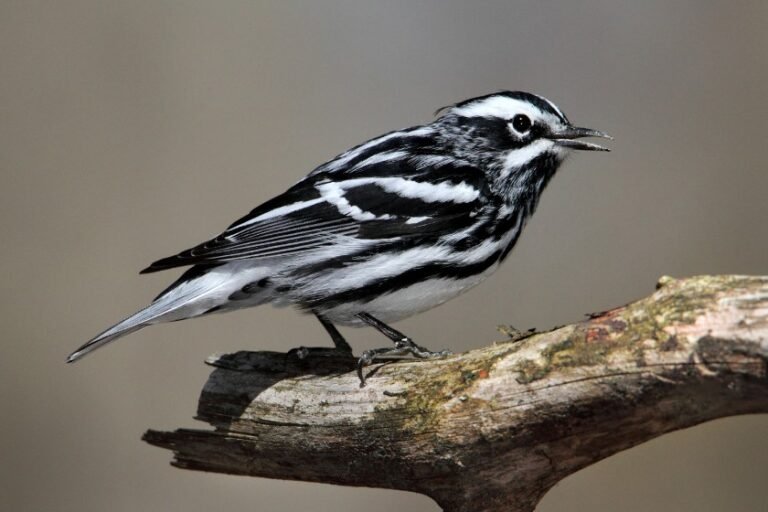
Many birds in the United States have black-and-white feathers, so there is no single answer to “what bird is black and white?” The right match depends on the bird’s size, shape, habitat, location, and behavior.
A small bird at a backyard feeder may be a Black-capped Chickadee. A bird climbing a tree may be a White-breasted Nuthatch or a Downy Woodpecker. A black-and-white bird with a long tail may be a Northern Mockingbird, while a striped bird in a forest may be a Black-and-white Warbler.
This guide covers the most common black-and-white birds seen across the United States. It explains how to tell them apart and what details to check before naming the species.

Common black-and-white birds in the United States
The most likely answer depends on where you saw the bird and what it was doing. This table gives a quick starting point.
| Bird | Main black-and-white marks | Usual habitat | Clue that helps identify it |
|---|---|---|---|
| Black-capped Chickadee | Black cap and throat, white cheeks, gray wings | Woodlands, parks, yards | Small, round body; often hangs near feeders |
| Carolina Chickadee | Black cap and bib, white cheeks | Southeastern forests and yards | Looks like a Black-capped Chickadee but is often smaller |
| Downy Woodpecker | Black-and-white barred wings, white back, small bill | Trees, woods, backyards | Tiny woodpecker with a short bill |
| Hairy Woodpecker | Similar black-and-white pattern to Downy Woodpecker | Mature woods and large trees | Larger body and longer bill |
| White-breasted Nuthatch | White face and chest, blue-gray back, black crown | Woodlands and mature yards | Climbs down tree trunks headfirst |
| Black-and-white Warbler | Strong black-and-white stripes | Forests during migration and breeding season | Creeps along tree trunks like a small woodpecker |
| Northern Mockingbird | Gray body, white wing patches, white outer tail feathers | Open areas, suburbs, towns | Long tail; flashes white while flying |
| Dark-eyed Junco | Slate-gray or blackish upper body, white belly and tail edges | Ground under feeders, woodland edges | Often feeds on the ground in flocks |
| Eastern Kingbird | Black head and back, white belly and tail tip | Open fields, farms, wetland edges | Sits upright on exposed perches |
| Loggerhead Shrike | Gray back, black mask, white underside | Open country and grasslands | Falcon-like shape with a hooked bill |
| Black-billed Magpie | Black-and-white body with blue-green wing and tail shine | Western grasslands, towns, foothills | Long tail and loud, bold behavior |
| American Oystercatcher | Black head and back, white underside, orange bill | Atlantic, Gulf, and Pacific beaches | Large shorebird with a long orange-red bill |
These species are not the only black-and-white birds in the country. Birds such as the Common Tern, Snowy Plover, American Avocet, and Common Loon can also show strong black-and-white patterns.
The best identification comes from combining several clues. Color alone can mislead you, especially in shade, bright sun, or poor viewing conditions.

How to identify a black-and-white bird
start with the bird’s size and shape. These clues often narrow the choices faster than color.
1. Check the bird’s size
Compare the bird with a familiar object. Is it:
- Smaller than a sparrow?
- About the size of a chickadee?
- Similar to a robin?
- As large as a crow?
- Larger, like a goose or loon?
A tiny black-and-white bird is more likely to be a chickadee, nuthatch, warbler, or small woodpecker. A large bird may be a loon, shorebird, magpie, or gull.
2. Look at the bill
The bill often reveals what the bird eats.
- A short, pointed bill fits chickadees and sparrows.
- A thin, sharp bill fits many warblers.
- A long, straight, chisel-like bill fits woodpeckers.
- A long, orange-red bill points toward an American Oystercatcher.
- A thick, hooked bill may indicate a shrike.
- A long, narrow bill may fit a loon or shorebird.
3. Watch how it moves
Behavior can be more useful than plumage.
- Climbing down a tree headfirst: White-breasted Nuthatch.
- Pecking or tapping wood: Downy or Hairy Woodpecker.
- Creeping along a tree trunk: Black-and-white Warbler.
- Hopping on the ground under a feeder: Dark-eyed Junco.
- Making short flights from a fence or wire: Eastern Kingbird.
- Flashing white wing patches: Northern Mockingbird.
- Walking along a beach: American Oystercatcher.
4. Note the habitat
Habitat helps separate similar species.
A bird in a city park may be a Northern Mockingbird or Black-capped Chickadee. A bird in a mature forest may be a woodpecker, nuthatch, or warbler. A bird on a beach is more likely to be a shorebird, tern, gull, or loon than a backyard species.
5. Record the location and season
Some birds occur across much of the United States. Others have smaller ranges.
For example:
- Black-capped Chickadees are common across much of the northern United States and parts of the West.
- Carolina Chickadees are common in the Southeast and parts of the central and eastern United States.
- Black-and-white Warblers are often seen during migration and breed in parts of the eastern United States.
- Black-billed Magpies are strongly associated with the western United States.
- American Oystercatchers stay near coastal areas.
Range maps from the Cornell Lab of Ornithology and the National Audubon Society can help confirm an identification.

The most common backyard black-and-white birds
Several black-and-white birds visit yards, feeders, and suburban parks.
Black-capped Chickadee
The Black-capped Chickadee has a black cap, black throat patch, white cheeks, and a gray body. It is small and round, with a short bill and a long tail relative to its body.
It often visits tube feeders, platform feeders, and suet cages. Chickadees may take one seed and fly to a nearby branch before eating it. Their familiar call sounds like “chick-a-dee-dee-dee.”
The Carolina Chickadee looks very similar. In general, the Black-capped Chickadee is more common in the northern United States, while the Carolina Chickadee is more common in the Southeast. Their ranges overlap in parts of the central and eastern states, where identification can be difficult.
Downy Woodpecker
The Downy Woodpecker is one of the most common small woodpeckers in the United States. It has a white underside, black-and-white wings, and a bold white stripe down its back.
Males have a small red patch at the back of the head. Females do not. The Downy Woodpecker has a short bill that is much smaller than the bill of a Hairy Woodpecker.
It may visit suet feeders or cling to tree trunks. Its small size is often the best clue.
Hairy Woodpecker
The Hairy Woodpecker has a pattern similar to the Downy Woodpecker but is larger. Its bill is longer and more powerful.
Because the two species can share the same habitat, size comparison matters. If the bird looks close to robin-sized and has a long, strong bill, it may be a Hairy Woodpecker.
White-breasted Nuthatch
The White-breasted Nuthatch has a white face and chest, a blue-gray back, and a black crown. It has a compact body and a short tail.
Its most useful clue is its movement. It commonly walks down tree trunks headfirst. Most other common backyard birds do not move in this way.
The species often visits feeders for sunflower seeds, peanuts, and suet. It may also wedge food into bark and strike it with its bill.
Dark-eyed Junco
The Dark-eyed Junco is often called a “snowbird” because many juncos appear in yards during the colder months. The common slate-colored form has a dark gray or blackish head and upper body, a pale belly, and white outer tail feathers.
Juncos usually feed on the ground. When they fly, the white edges of the tail can flash clearly. Their color varies by region, so not every Dark-eyed Junco looks exactly the same.

Black-and-white birds in forests
Forest birds can be hard to identify because they move quickly and remain partly hidden by leaves.
Black-and-white Warbler
The Black-and-white Warbler is one of the easiest warblers to recognize. It has bold black-and-white stripes on the head, back, wings, and underside.
Unlike many warblers, it often moves along tree trunks and large branches. Its behavior can make it look like a tiny woodpecker. It uses its narrow bill to search bark for insects.
The species breeds in parts of the northern and eastern United States and appears in many other areas during migration. It is usually easier to find in spring and fall when many birds pass through wooded habitats.
White-breasted Nuthatch
The White-breasted Nuthatch also lives in forests, but its movement sets it apart from the Black-and-white Warbler. The nuthatch has a thicker body, a shorter tail, and a more obvious white face.
A nuthatch often moves in a steady, deliberate way. A warbler tends to look slimmer and more active as it searches for insects.
Black-and-white woodpeckers
Downy and Hairy Woodpeckers are the main black-and-white woodpeckers many people see in U.S. yards. The Red-bellied Woodpecker can also show strong black-and-white barring on its back and wings, even though its name refers to a red or pink wash on the belly.
The Northern Flicker has a brown body with black spots and a black crescent on the chest. It is not mainly a black-and-white bird, but its patterned back may look that way from a distance.

Black-and-white birds in open areas and towns
Not all black-and-white birds are small forest birds. Several species prefer lawns, fields, roadsides, and open country.
Northern Mockingbird
The Northern Mockingbird has a gray back, pale underside, dark wings, and white wing patches. Its long tail also shows white outer feathers.
The bird often perches on rooflines, fences, poles, and shrubs. When it flies, it may flash large white patches. It is known for copying sounds from other birds, insects, alarms, and other sources.
The Northern Mockingbird is common in much of the United States, especially in open suburban areas. Its long tail and gray body help separate it from chickadees and juncos.
Eastern Kingbird
The Eastern Kingbird has a dark head and back, a white underside, and a white band at the end of its black tail. It often sits upright on a wire, fence, dead branch, or utility line.
It catches insects in flight and may return to the same perch. Its posture is slimmer and more upright than that of a mockingbird.
Loggerhead Shrike
The Loggerhead Shrike is a small songbird with a gray back, pale underside, black facial mask, and hooked bill. Its shape can resemble a miniature hawk.
Shrikes hunt insects, small birds, lizards, and other small animals. They may store prey on thorns or barbed wire. This behavior is unusual among common songbirds and can help confirm the identification.
Black-billed Magpie
The Black-billed Magpie is mostly found in the western United States. It has a black head and chest, white shoulder and belly areas, and a long tail that can show blue or green shine in good light.
It is much larger than a jay and has a very long tail. Magpies often travel in open habitats, towns, ranches, and foothill areas.

Black-and-white birds near water
Water changes the list of likely species. A bird on a beach, lake, marsh, or river may belong to a different group than a bird at a feeder.
American Oystercatcher
The American Oystercatcher is a large coastal bird with a black head and back, a white underside, pinkish legs, and a long orange-red bill.
It lives along parts of the Atlantic, Gulf, and Pacific coasts. Its bill is designed for opening shellfish, so it is easy to separate from small black-and-white shorebirds.
Common Loon
The Common Loon has a striking black-and-white breeding pattern, including a black head, white neck markings, and a checkered back. In winter, its plumage becomes much plainer, with a gray back and pale throat.
Loons are large water birds with long bodies and pointed bills. They sit low in the water and have a distinctive, haunting call.
Common Tern
The Common Tern has a pale body, dark cap, gray wings, and a deeply forked tail. Its bill may show red and black.
It is usually seen near coasts, large lakes, rivers, and wetlands. Flight is a major clue: terns hover, dive, and turn quickly over water.
Snowy Plover
The Snowy Plover is a small, pale shorebird with dark markings on the head and neck. It may look mostly white with black patches rather than evenly black and white.
It lives on sandy beaches, salt flats, and other open shores. Its small size and quick running style help separate it from larger coastal birds.

Quick identification guide by appearance
Use this short guide when you need a likely answer fast:
- Black cap, white cheeks, tiny body: Black-capped Chickadee or Carolina Chickadee.
- Black-and-white bird on a tree trunk with a chisel bill: Downy or Hairy Woodpecker.
- White face and chest, walking down a tree headfirst: White-breasted Nuthatch.
- Strong black-and-white stripes on a slim forest bird: Black-and-white Warbler.
- Gray body, long tail, white wing flashes: Northern Mockingbird.
- Dark gray bird feeding on the ground: Dark-eyed Junco.
- Dark bird on a wire with a white belly: Eastern Kingbird.
- Gray bird with a black eye mask and hooked bill: Loggerhead Shrike.
- Large western bird with a very long tail: Black-billed Magpie.
- Large coastal bird with an orange-red bill: American Oystercatcher.
- Black-headed bird floating low on a lake: Common Loon.
This method gives you a likely group, not always a certain species. Use a regional field guide or a trusted bird identification app to confirm the result.

Common mistakes when identifying black-and-white birds
The most common mistake is relying on color alone. Many birds look black and white when seen from far away, but their body shape, behavior, and habitat may point to different species.
Mistake 1: Ignoring the bird’s size
A Downy Woodpecker and Hairy Woodpecker have similar patterns. Their size and bill length are more useful than color.
Mistake 2: Confusing chickadees
Black-capped and Carolina Chickadees overlap in parts of the United States. Range, voice, wing pattern, and body proportions may all matter. A single photograph may not be enough.
Mistake 3: Missing seasonal plumage
Some birds change appearance after breeding. The Common Loon, for example, looks much less bold in winter than in summer. Young birds may also lack the adult pattern.
Mistake 4: Trusting poor light
Backlighting can turn gray feathers black. Bright sunlight can make pale feathers look white. Take several photos if possible, including one that shows the bird’s side and back.
Mistake 5: Using location as proof
Range is a filter, not a final answer. Migrating birds can appear far outside the place where they breed. Storms and unusual weather can also move birds beyond their usual range.
Mistake 6: Getting too close
Do not chase a bird for a better view. Keep a respectful distance, avoid disturbing nests, and follow local rules in parks and wildlife areas. Binoculars and a camera with a zoom lens are safer choices.

How to confirm your identification
Use a simple evidence-based process:
- Write down the location. Include the state, habitat, and whether the area was urban, wooded, open, coastal, or wetland.
- Record the date. Season can remove or support certain possibilities.
- Estimate the size. Compare it with a sparrow, robin, crow, or another familiar bird.
- Study the bill and tail. These features often separate similar species.
- Watch the behavior. Note whether the bird climbs, hops, swims, probes, pecks, or catches insects in flight.
- Listen to the call. Sound can help distinguish chickadees, woodpeckers, juncos, and other birds.
- Compare several sources. Use a regional field guide, Cornell Lab’s All About Birds, Audubon, or the U.S. Fish and Wildlife Service.
- Check more than one image. Plumage can vary by age, sex, season, and region.
If you use a bird identification app, treat its result as a suggestion. Review the proposed species and compare the visible marks yourself.

Key takeaways
- There is no single black-and-white bird in the United States.
- The most common backyard answers are the Black-capped Chickadee, Carolina Chickadee, Downy Woodpecker, White-breasted Nuthatch, Northern Mockingbird, and Dark-eyed Junco.
- A bird’s size, bill, behavior, habitat, range, and season matter as much as its color.
- Black-and-white stripes on a forest bird may indicate a Black-and-white Warbler.
- A long-tailed black-and-white bird in the West may be a Black-billed Magpie.
- A black-and-white coastal bird with an orange bill is likely an American Oystercatcher.
Frequently asked questions
What is the most common black-and-white bird at a feeder?
The most likely species is often a Black-capped Chickadee, Carolina Chickadee, White-breasted Nuthatch, Downy Woodpecker, or Dark-eyed Junco. The answer depends on your state and the bird’s shape.
What black-and-white bird has a red spot?
A Downy Woodpecker or Hairy Woodpecker may have a red patch on the back of the male’s head. Other woodpeckers, including the Red-bellied Woodpecker, can also show red markings.
What black-and-white bird walks down trees headfirst?
The White-breasted Nuthatch is the best-known answer. Its strong feet and claws allow it to move down tree trunks while facing the ground.
What black-and-white bird has a long tail?
A Northern Mockingbird has a gray body, white wing patches, and a long tail. A Black-billed Magpie also has a long tail but is much larger and is mainly found in the western United States.
What black-and-white bird is found on beaches?
The American Oystercatcher is a large coastal bird with a black head and back, white underside, and orange-red bill. Smaller shorebirds, terns, and gulls may also show black-and-white plumage.
Can a bird identification app identify a black-and-white bird?
It can suggest likely species from a photo or sound, but results are not always correct. Use the app with location, season, behavior, and field marks. A clear side view and a photo of the bird’s back often improve the result.
Conclusion
The answer to “what bird is black and white?” depends on the bird’s full profile, not just its feathers. Start with size, shape, habitat, movement, and range. Then compare those clues with a trusted U.S. bird guide.
For a small backyard bird, check chickadees, nuthatches, woodpeckers, juncos, and mockingbirds first. For a forest bird, consider the Black-and-white Warbler. For open country or coastal habitat, expand the list to kingbirds, shrikes, magpies, oystercatchers, terns, and loons.