
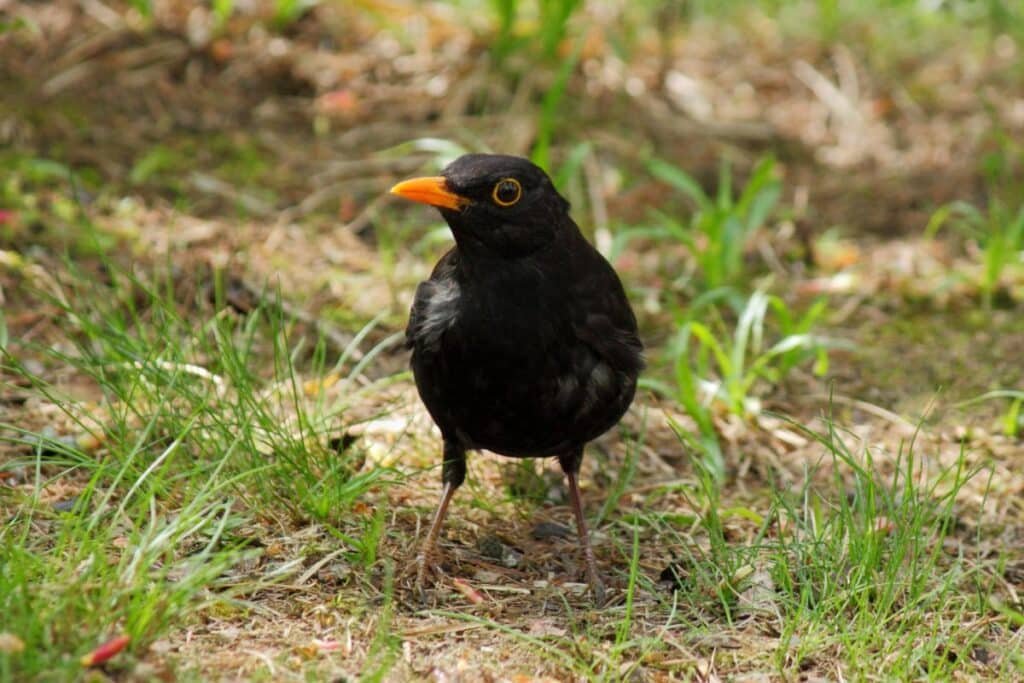
In the United States, a black bird with an orange beak is most likely a Black Oystercatcher if it was seen on a rocky Pacific coast. If the bird had a black body, an orange-yellow bill, and lived in Europe or was an escaped bird in the U.S., it may be a Common Blackbird. Habitat, body shape, eye color, and leg color help tell them apart.
The phrase “black bird with an orange beak” can describe several species. The bird may also be a Common Myna, Eurasian Oystercatcher, or another dark bird seen in unusual light. A clear view of the bird’s size, location, and behavior usually solves the mystery.

The Most Likely Black Birds With Orange Beaks
The Black Oystercatcher is the best match for a truly black bird with a bright orange-red bill in the United States. It lives along rocky shores of Alaska, British Columbia, Washington, Oregon, and California. It has a long, thick bill, pink legs, and a pale or yellow eye.
A Common Blackbird is another strong match, but it is not a normal wild bird across most of the United States. The male has black feathers, a yellow-orange bill, and a yellow eye ring. This species is common in Europe and parts of Asia.
The table below compares the main possibilities.
| Bird | Bill color | Key field marks | Typical U.S. setting |
|---|---|---|---|
| Black Oystercatcher | Orange-red | All-dark body, long thick bill, pink legs, pale eye | Rocky Pacific Coast |
| Common Blackbird | Yellow-orange | Black male, slim bill, yellow eye ring | Rare or escaped bird in the U.S.; common in Europe |
| Common Myna | Yellow-orange | Brown body, black head, yellow skin around the eye | Hawaii and some introduced populations |
| Eurasian Oystercatcher | Bright orange-red | Black-and-white body, long bill, white wing and belly areas | Rare visitor or escaped bird in North America |
| Common Grackle | Dark gray to black | Long tail, glossy feathers, pale yellow eye | Widespread across the United States |
| european Starling | Yellow in breeding season | Short tail, pointed wings, speckled body | Widespread across the United States |
The most useful clue is not color alone. A large, all-dark shorebird with a heavy orange bill points to a Black Oystercatcher. A smaller songbird with a slim orange bill points more toward a Common Blackbird.

How to Identify the Bird by Shape and Habitat
Start with the bird’s habitat. A bird on sea rocks, tidal pools, or a wave-cut shore is more likely to be an oystercatcher. A bird in a lawn, woodland, park, or garden is more likely to be a blackbird, starling, grackle, or myna.
Next, study the bill. Oystercatchers have a long, straight, wedge-shaped bill. It looks built for prying limpets and mussels from rocks. Common Blackbirds have a shorter, slimmer bill suited to feeding on insects, worms, fruit, and seeds.
The bird’s body shape also matters:
- Black Oystercatcher: Heavy body, long bill, pink legs, coastal behavior.
- Common Blackbird: Medium-sized songbird, upright stance, rounded body, slender bill.
- Common Myna: Brown body with a black head, yellow legs, and yellow skin near the eye.
- Common Grackle: Long body and long tail, often with a blue or purple sheen.
- European Starling: Short tail, pointed wings, and a slimmer shape.
Lighting can change how a bill looks. A dark bill may appear orange in warm sunlight. A yellow bill may look orange at a distance. Use several features together rather than relying on one color.

Black Oystercatcher: The Best U.S. Match
The Black Oystercatcher (Haematopus bachmani) is a large shorebird found along the Pacific coast of North America. In the United States, its range includes coastal Alaska and the Pacific coast south through California.
Adults have dark brown to black feathers over most of the body. Their long bill is orange-red, and their legs are pink. The eye often shows a pale ring, which can stand out against the dark head.
Black Oystercatchers usually stay close to rocky shorelines. They feed on mussels, limpets, chitons, crabs, and other marine animals. Their strong bills help them open or remove prey from hard surfaces.
Signs you saw a Black Oystercatcher
You may have seen a Black Oystercatcher if the bird:
- Stood on exposed rocks near ocean water.
- Had an almost entirely dark body.
- Had a long, thick orange-red bill.
- Had pink legs.
- Walked and called along the shoreline.
- Fed around mussel beds or tidal pools.
The species is not the same as the American Oystercatcher. American Oystercatchers live mainly on Atlantic, Gulf, and Caribbean shores and have a dark head and back but a white belly. Their bill is also orange-red, but their body pattern is different.

Common Blackbird: A Likely Answer Outside North America
The Common Blackbird (Turdus merula) is a familiar garden bird in Europe. The adult male is glossy black with a bright yellow-orange bill and a yellow ring around the eye. Females are usually brown and do not match the classic black-and-orange description as closely.
Common Blackbirds live in gardens, parks, farmland, hedges, and forests. They often search on the ground for earthworms and insects. They may pause with their heads tilted while listening for prey under leaves or soil.
This bird is not the same as the American Robin, Common Grackle, or Red-winged Blackbird. In the United States, the word “blackbird” often refers to several unrelated dark birds.
A Common Blackbird sighting in the United States should be checked carefully. It may be:
- An escaped cage bird.
- A visiting bird outside its usual range.
- A misidentified starling or grackle.
- A bird photographed in another country and later shared without location details.

Other Birds That May Look Black With an Orange Bill
Some birds only appear to fit the description from certain angles. These alternatives are worth checking before making an identification.
Common Myna
The Common Myna has a black head, brown body, yellow legs, and a yellow-orange bill. It also has yellow skin around the eye. It is common in parts of Asia and is well established in Hawaii. It is not a typical backyard bird across the continental United States.
Eurasian Oystercatcher
The Eurasian Oystercatcher has a bright orange-red bill, black upper parts, and a large white area across the belly and wings. It is common around many European coasts. A bird that looks black and white rather than fully black may be this species.
European Starling
A European Starling can have a yellow bill during the breeding season. Its body may look black from far away, especially in shade. Up close, the feathers often show pale spots and a purple, green, or bronze sheen.
Common Grackle
Common Grackles are widespread in the United States. Their eyes can be bright yellow, and their glossy bodies may look black. Their bills are normally dark, not orange. A warm reflection or poor photograph can make the bill appear lighter.
Black Scoter
Black Scoters are dark sea ducks with large bills. Adult males have a swollen bill with a noticeable yellow or orange knob. They live near coastal waters and may be mistaken for a black shorebird when seen at a distance.

A Simple Identification Process
Use this five-step process when you see a dark bird with a bright bill.
- Record the location. Note the state, habitat, and whether the bird was inland, on a lake, or by the ocean.
- Estimate the size. Compare it with a robin, crow, gull, or duck.
- Check the bill shape. A long, heavy bill suggests an oystercatcher. A short, slim bill suggests a songbird.
- Look at the legs and eyes. Pink legs and a pale eye support Black Oystercatcher. A yellow eye ring supports Common Blackbird.
- Check for white feathers. A white belly or white wing patches may rule out a fully dark Black Oystercatcher.
A photo taken from the side is often more useful than a front-facing photo. Include the bird’s feet, bill, tail, and nearby habitat if possible. Do not approach a nest or force a bird to move for a better picture.
Bird identification apps can suggest possible species, but they can make errors when the photo is dark, distant, or cropped. Compare the suggestion with a trusted field guide or an established bird database.

Geographic Clues in the United States
Location can narrow the answer quickly.
- Pacific rocky coast: Black Oystercatcher is a strong possibility.
- Atlantic or Gulf beach: American Oystercatcher is more likely than Black Oystercatcher.
- Hawaii: Common Myna is a reasonable possibility.
- City park or farm in the continental U.S.: Starling, grackle, or another introduced bird may be more likely.
- European garden: Common Blackbird is the leading match.
- Open ocean or large bay: A dark sea duck, such as a Black Scoter, may fit better.
Range maps are useful, but they are not absolute limits. Birds can wander, escape captivity, or appear outside their normal range. A location should guide identification, not replace close observation.
For a confirmed report of an unusual bird, submit a clear photo and exact location to a local bird records committee, eBird, or a regional birding group. Keep the original image because its date, time, and location data may help confirm the sighting.

Common Identification Mistakes
The most common mistake is treating “black” as a precise color. Many birds have dark brown, purple, green, or blue feathers that look black in shade. A bird’s bill may also change color with age, season, light, or image quality.
Another mistake is confusing a Common Grackle with a Common Blackbird. Both can look dark, but grackles have longer tails and usually dark bills. Common Blackbird males have a clear yellow-orange bill and eye ring.
Do not assume every orange-billed shorebird is a Black Oystercatcher. The American Oystercatcher has a white belly and is common in parts of the eastern and southern United States. The Eurasian Oystercatcher has even more obvious white areas.
Avoid handling an unfamiliar bird. If it appears injured, contact a licensed wildlife rehabilitator or a local animal control agency. Do not give food or water unless a licensed professional tells you to do so.

Frequently Asked Questions
What black bird has an orange beak in the United States?
The Black Oystercatcher is the strongest match when the bird is fully dark, has a thick orange-red bill, and is on a rocky Pacific shore. Inland sightings may involve a starling, grackle, or an escaped Common Blackbird.
Are Common Blackbirds found in the United States?
Common Blackbirds are not widespread native birds in the United States. They are common in Europe. A U.S. sighting should be verified with a photo because other dark birds can look similar.
What bird has a black body, orange bill, and pink legs?
A Black Oystercatcher often has this combination. It is a Pacific coastal shorebird with an all-dark body, orange-red bill, and pink legs.
Is a Common Grackle a black bird with an orange beak?
Usually, no. Common Grackles have dark bills. Their glossy bodies and yellow eyes can cause confusion, especially in bright sunlight or low-quality photos.
What should I do if I cannot identify the bird?
Write down the exact location, habitat, date, size, bill shape, leg color, and behavior. Take photos from a safe distance. Then compare the bird with a trusted field guide or submit the image to a bird identification database or local birding group.
Reliable Identification Resources
For U.S. sightings, these resources provide range maps, images, calls, and species accounts:
- Cornell Lab of Ornithology: All About Birds
- National Audubon Society Bird Guide
- U.S. Fish & Wildlife Service
- eBird species database
- North American Classification Committee
The best next step is to compare the bird’s habitat, bill shape, legs, eye, and body pattern. On a rocky Pacific shoreline, start with Black Oystercatcher. In a European garden, start with Common Blackbird. In other parts of the United States, check grackles, starlings, mynas, and oystercatchers before settling on an identification.