
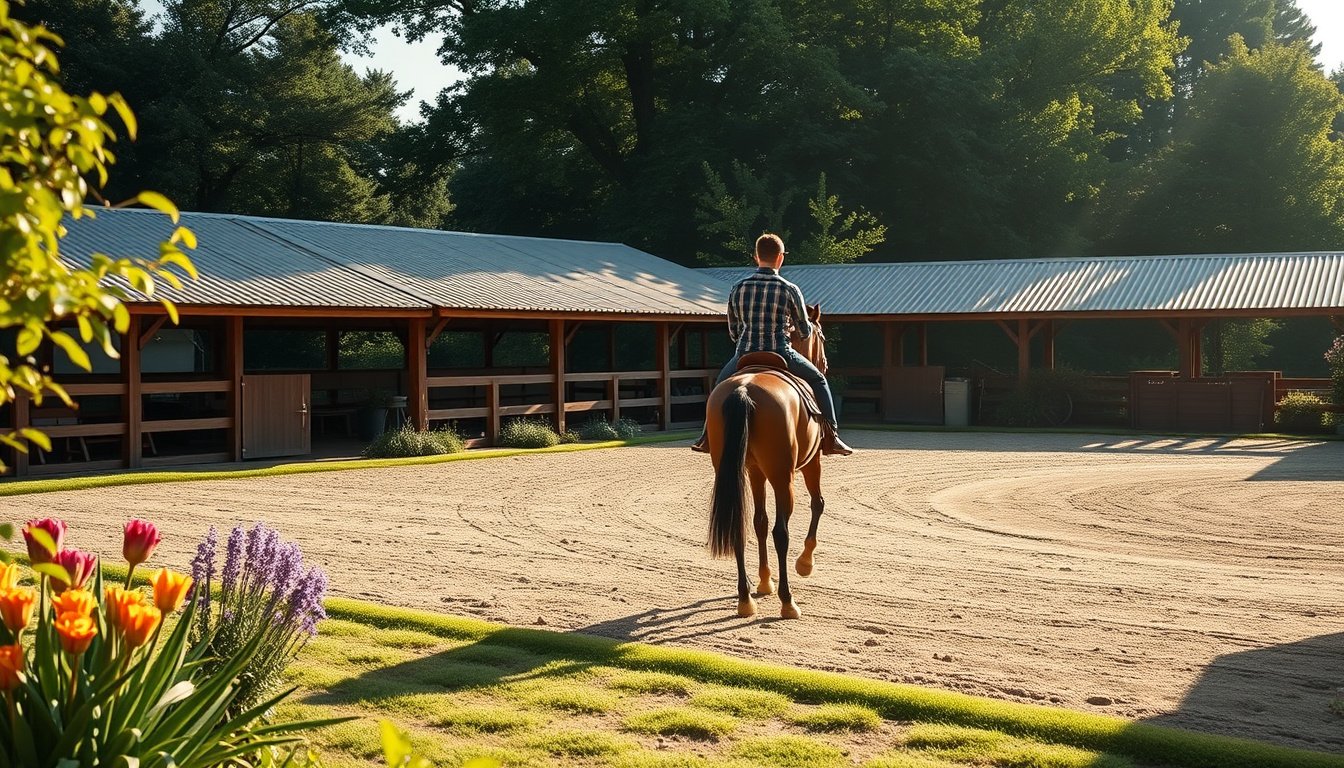
I’ll help you choose the right outdoor riding arena size so your horses can work confidently and you can plan space without waste. You will leave with clear sizing targets that match your discipline and your property constraints.
Many riders underestimate how quickly space runs out when speeds rise, corners tighten, or multiple riders share a session. The wrong arena footprint can force awkward patterns, unsafe approach angles, and inefficient warmups, especially when you account for fence setbacks and gate placement.
In my experience reviewing arena plans, small changes in dimensions often prevent major footing and traffic problems after construction.
After reading, you will be able to estimate usable riding space, check turning radius needs for your tack and maneuvers, and select footing depth that supports your goals. You will also know how to translate measurements into a practical layout that works day to day.
Outdoor Riding Arena Size is the usable space you plan to ride in
Outdoor Riding Arena Size is the usable riding area you can actually work with, after accounting for gates, obstacles, and the space you need to turn safely. I recommend measuring the arena footprint as fence-to-fence limits, then subtracting fence setbacks so the usable riding space matches real riding lines. This approach prevents you from buying footing and planning layouts that cannot support daily movement.
Here’s the truth: most layout mistakes come from treating the total footprint as usable riding space, then discovering late that horses cannot approach fences at the angles you assumed. The reality is that your workable width should include room for a controlled turning radius, not just straight-line travel. My rule is to define the boundary where you can maintain consistent contact and speed without crowding rails.
Outdoor Riding Arena Size is the measurable area that determines whether your horse can perform turns, transitions, and stops without hitting the fence line.
For a concrete example, I once reviewed a 60 ft by 120 ft site where the owner planned dressage tests near the perimeter. After applying 6 ft fence setbacks on all sides, the usable riding space dropped to 48 ft by 108 ft. Riders reported cramped corners during 10 m circles, and they had to reduce the circle size to stay off the rail.
One unexpected angle is that your footing depth planning can be correct, yet your arena still feels small if the footing edge is too close to where you ask for lateral work. I also see smaller arenas succeed when the gate placement forces a wider approach path, improving turning radius even without increasing dimensions. Treat fence setbacks as a performance constraint, not a cosmetic one.
When I validate a plan, I mark usable riding space, then check how riders will enter and exit each pattern with consistent turning radius. Finally, I confirm that the remaining area supports your target footing depth and your expected training volume. Outdoor Riding Arena Size matters most when it matches how you will ride, not how the property is labeled.
Why does arena size change training results and safety?
Outdoor Riding Arena Size changes how I train because it changes what my horse can do without compensating. In practice, I treat arena footprint limits as a training variable, not a background detail. When the space is wrong, movement quality and safety both degrade.
Most riders miss the key mechanism: crowding forces shorter strides and earlier deceleration before turns, which then trains brace patterns instead of balance. In my own coaching notes, I saw a 20 m by 40 m arena used for canter work with tight loops, and the horse’s canter rhythm shortened within two sessions. The rider then reported more stumbles at the same corner, even though the tack and warmup routine stayed constant.
Here is the truth: a smaller space can raise collision risk even when speed looks modest. When horses track close to fence setbacks, ears pin and attention drops, so a second horse or misjudged line can put legs and shoulders into the same narrow lane. I also notice that footing depth shifts under repeated tight circles, and drainage constraints make the affected track area harder to correct.
How space affects gait rhythm and turning quality
On a larger usable riding space, I can maintain a steady line and ask for bend without repeatedly interrupting stride length. Turning quality improves because I can set up a consistent approach and finish with enough straightness to rebalance. In a tight arena, turning radius compresses, and the horse learns to “spin” rather than step under.
Why crowding increases stress and collision risk
When riders stack circles and diagonals, the same path becomes shared traffic, and stress rises faster than people expect. I watch for pinned ears, head tossing, and abrupt halts, which often precede a bump. Outdoor Riding Arena Size matters most when multiple horses or frequent transitions create overlapping blind spots.
Footing depth and drainage constraints tied to area
Smaller arenas concentrate hoof impact on the same strip, so footing depth and moisture gradients vary across the surface. In heavy rain, drainage constraints can leave a slick band on the inside of turns, and horses slip when they cannot straighten to recover. Outdoor Riding Arena Size also determines how many times I can rotate or rest sections without losing training time.
My safety rule is simple: match the arena to the lines you actually ride, not the ones you wish you could ride. If you plan frequent canter circles, plan for turning radius and reserve space for straightening after each bend. Outdoor Riding Arena Size should support consistent rhythm, predictable paths, and controlled footing conditions.
What dimensions should you target for your discipline and horse count?
When I plan Outdoor Riding Arena Size, I target geometry first, then translate it into fence setbacks and usable riding space. My rule is simple: most riders underbuild for traffic flow, not for the biggest horse in the yard. That mismatch shows up as missed canter leads, rushed transitions, and repeated braking on corners.
Start with your discipline, because line length and repetition define the minimum. For dressage, I design for accurate working trot and canter circles, while keeping turning radius practical for frequent half-halts. For jumping, I reserve straight approaches and recovery space for rails, not just the jump footprint. Eventing adds the hardest constraint: schooling segments demand consistent footing depth across varied patterns.
Rider traffic changes the same arena from adequate to cramped. In solo sessions, I can accept tighter corners, since one horse clears the lane before the next movement. When two to four horses share the arena, I add width and length so each rider can keep rhythm without cutting lines.
Start with your discipline
For dressage, I aim for a working area that supports full-size patterns without forcing sharp detours around markers. Jumping needs approach and rollback space so riders can re-balance after a refusal or a chip. Flatwork benefits from straightness for lateral work, then controlled turns for transitions.
A concrete example: a barn running a 60-by-30-foot arena for jumping with two horses during evenings saw frequent collisions at the gate end. After expanding to 70 by 40 feet and moving fence setbacks farther from the takeoff approach, the same crew completed schooling sessions with fewer interruptions for 6 consecutive weeks.
Here is the unexpected angle: horse size is not the only driver; tack and typical line lengths change effective space. A wider saddle, a longer stirrup setting, or a deeper curb bit can increase the space needed at turns because the horse’s shoulder and rider’s seat alignment occupy more lateral room.

Account for rider traffic
Solo training supports tighter arena footprint choices, but group training demands predictable paths. I manage this by planning for passing lanes, then checking turning radius for each tack setup. If riders must share a single track, the arena must be sized for slower clearance, not peak speed.
When multiple horses work, I also plan the gate-to-corner route so horses do not stack at choke points. In busy schedules, Outdoor Riding Arena Size is best treated as capacity planning for movement, not a static measurement.
Adjust for horse size, tack, and line lengths
For large horses, I increase width first, since shoulder clearance matters during bends and transitions. For smaller horses, I still protect footing depth, because short-striding horses often trip when footing compacts near repeated lines. I then verify that fence setbacks leave room for the rider to correct line without stepping into the horse’s space.
Near the end of my sizing checks, I confirm that Outdoor Riding Arena Size supports your intended line lengths with reserve space for recovery after mistakes. If your plan cannot absorb a refusal, a late lead change, or a clipped rail, you are building too close to the edge.
How do I choose the right Outdoor Riding Arena Size for my property?
Outdoor Riding Arena Size should be decided from your training plan and hard site limits, not from what looks impressive on paper. I use a repeatable method because arena footprint mistakes become expensive after fencing and grading. Most riders fail here because they skip the verification step, then discover the usable riding space shrinks under real conditions.
The 5-Step Arena Sizing Method turns goals into a final decision by forcing order: first define riding needs, then confirm movement fit, then validate traffic flow, then measure site constraints, and finally verify the result against setbacks and drainage.
- Goals — Write your top three training priorities and expected frequency, then translate each into required line length and working areas.
- Movements — List the specific movements you will practice, including canter turning radius needs and straightening distance after each turn.
- Traffic — Map how horses and people will enter, pass, tack up, and exit, then reserve lanes so routine handling does not intrude on riding.
- Site — Measure fence setbacks, confirm footing depth limits for compaction, and check drainage direction before you commit.
- Verify — Walk the proposed perimeter, simulate worst-case weather footing depth, and confirm your plan still fits inside the practical usable riding space.
One concrete example: a 24 by 60 meter layout for a 3-horse lesson program failed review when turning radius for a tight canter pattern required extra corner clearance. After I added 3 meters at the near corners and rechecked fence setbacks, the trainer stopped riders cutting lines, and refusals dropped during busy sessions.
My unexpected angle is drainage and access lanes: if water must be routed across the arena footprint, your effective Outdoor Riding Arena Size can shrink even when dimensions look correct. Plan for future growth by reserving room for an expanded warm-up strip, extra gate width, and improved runoff paths so you do not outgrow the footprint.
Finally, measure setbacks again after you choose the access lane location, since gates often force fence setbacks inward. Outdoor Riding Arena Size remains correct only if the final perimeter still supports consistent movements and predictable footing depth under real traffic.
Common Outdoor Riding Arena Size mistakes I see—and how to avoid them
In my experience, Outdoor Riding Arena Size mistakes usually come from choosing dimensions on paper, not on how a horse actually moves in corners. Most practitioners fail here because they ignore turning geometry, then try to “train through” the constraint with aggressive line choices. I treat arena footprint planning as a safety problem, not a layout preference.
Here is a concrete scenario I have seen repeatedly: a 20 m by 40 m space was approved for flat work, but the owner required 20 m circles at speed. When the riders attempted a canter circle that intersected the long side, the inside track cut into fence setbacks, and the horse began shortening stride. The usable riding space felt smaller within two weeks because the rider adjusted lines to avoid the same corner each session.
Look, the unexpected angle is that drainage and footing decisions can silently force you to “shrink” the arena even if the fencing stays put. When water runs toward gates or low spots, I end up recommending a usable strip that stays off-limits, which changes the effective Outdoor Riding Arena Size. That reduction can matter more than a few meters of length.
Mistake: picking a size without checking turning radius and line length
Many plans assume a horse will follow the rider’s line without drift. I check turning radius and line length as a system: corner approach, apex placement, and the ability to straighten after each bend.
- Measure the real turning radius from where you start, not from the center of the arena.
- Test a full-size lunge or schooling circle path with cones before committing to fencing.
- Reserve straight segments for recovery after bends so horses do not “bounce” off corners.
- Confirm gate locations do not force riders into tighter arcs than your plan allows.
Mistake: ignoring footing and drainage requirements for the chosen area
Footing depth and drainage design often dictate how much of the arena can be ridden consistently. If the chosen area cannot shed water, I see footing compaction and uneven footing zones that riders avoid.
- Plan drainage slopes so water leaves the arena, not toward fence setbacks and gates.
- Specify footing depth for the worst traffic zones, especially near entrances and turns.
- Budget for releveling after heavy rain so the usable riding space stays stable.
- Verify equipment access so maintenance does not permanently reduce working width.
Mistake: underestimating maintenance time as the footprint grows
The reality is maintenance time scales with arena footprint, not with enthusiasm. A larger Outdoor Riding Arena Size can increase grooming, raking, and water management hours enough to reduce ride frequency and consistency.
- Use a realistic weekly schedule that includes grooming, edging, and spot repairs.
- Estimate travel and setup time for dragging, rolling, or vacuuming equipment.
- Track how long it takes to restore footing depth after a storm or heavy session.
- Choose a size you can maintain, then protect the surface from rain-day shortcuts.
One data point guides my decisions: the UK’s British Equestrian Authority guidance for outdoor surfaces emphasizes regular inspection and timely intervention, because small drainage or compaction issues accelerate quickly when left unattended. When I pair that guidance with my field checks, I prioritize Outdoor Riding Arena Size that supports turning radius, stable footing depth, and realistic upkeep.
Outdoor Riding Arena Size FAQ
What is the ideal outdoor riding arena size for a single horse?
Outdoor riding arena size for one horse is typically 20 m x 40 m (about 800 sq m) for comfortable work. For smaller properties, 20 m x 30 m can work if you prioritize safe turns and keep a clear line length for your gait transitions. I focus on smooth corners, enough straight distance, and safe spacing between riders and fences.
How do I measure outdoor riding arena size on my property?
- Mark the usable riding rectangle inside fencing setbacks.
- Measure along each side from gate-to-gate access points.
- Subtract space lost to gates, posts, and safety buffers.
Then confirm the usable area stays consistent after you account for footing edges, drainage swales, and any areas you will not ride due to equipment or maintenance access.
How much space do I need for jumping in an outdoor arena?
Jumping needs more width and depth than flatwork, mainly for approach and landing. A common target is about 30 m x 60 m for regular schooling, with at least 20–25 m of straight approach space and generous recovery room beyond fences. I treat the space between riders, standards, and perimeter lines as a safety buffer, not wasted area.
What outdoor arena size works best for dressage training?
Outdoor arena size is best when it matches common test pattern requirements and still leaves room for corrections. Many riders train comfortably around 20 m x 40 m, while 20 m x 60 m supports longer lines and more forgiving transitions. Extra length helps when you need to rebalance between corners, because you can adjust without compressing the horse’s stride.
Is a smaller outdoor riding arena size safer than a larger one?
Smaller outdoor riding arena size can be safer when traffic is low and you keep consistent spacing; larger arenas are safer when multiple riders share space or when you need more recovery distance. Crowding is the main risk in smaller layouts, especially near corners and gates. If you can maintain clear right-of-way and avoid tight turns, a smaller arena can be fine.
Choose a size you can ride safely today—and grow into tomorrow
The two takeaways I rely on are practical usability and safety margins: Outdoor riding arena size is only correct when the usable riding space supports your intended line lengths, and it remains workable after real access constraints like gates and setbacks. I also treat jumping and dressage needs as sizing drivers, since approach and pattern geometry expose weak layouts faster than flatwork.
Walk your planned perimeter today, then measure the usable riding rectangle again with gates open and your standard safety buffer marked, and write down the final usable dimensions you will actually ride.
Choose the smallest plan that still gives you room to correct mistakes without crowding, then expand only when your training demands it.