

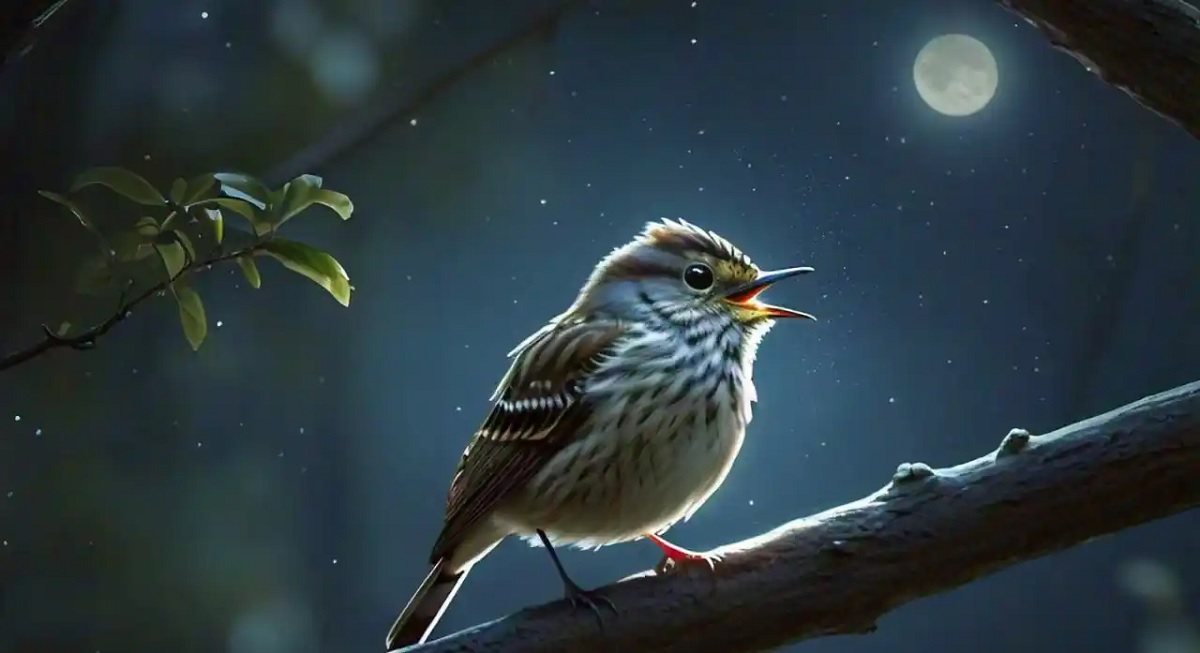
In the United States, the bird most often heard chirping at night is the Northern Mockingbird. It may sing for hours after dark, especially in spring and summer. Other nighttime callers include Eastern Screech-Owls, Barred Owls, Common Whip-poor-wills, Common Nighthawks, American Robins, and migrating songbirds.
Not every nighttime sound comes from a bird. Crickets, tree frogs, bats, and small mammals can sound surprisingly birdlike. The time, rhythm, pitch, and location of the sound can help you identify its source.
Quick Takeaways
- Northern Mockingbirds are the most common source of nighttime bird song in many U.S. neighborhoods.
- Whip-poor-wills and Common Nighthawks are active at night and near dusk.
- Owls do not usually chirp like songbirds. They hoot, trill, whistle, bark, or screech.
- Birds may call at night because of mating, territory defense, alarm, migration, or artificial light.
- A repeated sound from a tree or rooftop is more likely to be a bird. A sound from grass, shrubs, or the ground may come from an insect or frog.

Which Birds Chirp at Night in the United States?
Several U.S. bird species make calls after dark. Their sounds vary from clear songs to soft chips, whistles, trills, and repeated notes.
Northern Mockingbird
The Northern Mockingbird is the leading answer to the question, “What bird chirps at night?”
Male mockingbirds may sing through the night while defending a territory or seeking a mate. Their song can include imitations of other birds, insects, frogs, dogs, car alarms, and mechanical sounds.
A mockingbird often repeats each sound several times before switching to a new one. The song may seem random, but the bird is usually following a pattern. A bright streetlight, porch light, or full moon can make nighttime singing more likely.
Listen for:
- A long, varied song
- Several repeated phrases
- Imitations of other birds
- A sound coming from a high perch
- Singing that continues for many minutes
Mockingbirds are common in towns, suburbs, parks, farms, and open woodland across much of the United States.
American Robin
The American Robin is best known for singing at dawn, but it can also call at night. This is more likely during spring migration, the breeding season, or periods of bright artificial light.
Robin song is usually a series of clear, musical phrases. It sounds less varied than a mockingbird’s song. Robins may also make short alarm calls or soft contact notes after dark.
If the sound occurs just before sunrise, an American Robin becomes more likely. If it continues for hours and includes many copied sounds, a Northern Mockingbird is a better match.
Eastern Screech-Owl
The Eastern Screech-Owl is a small owl found across much of the eastern and central United States. It does not usually make a classic “screech.” Its common calls include a descending whinny and a soft, bouncing trill.
People may describe these sounds as chirps, whistles, or birdlike cries. The call often comes from a tree cavity, wooded yard, or forest edge.
Listen for:
- A wavering whinny
- A steady, tremolo-like trill
- Calls from a wooded area
- Activity soon after sunset or before dawn
Eastern Screech-Owls may call to defend a territory, attract a mate, or communicate with a partner.
Barred Owl
The Barred Owl has a deep, rhythmic call often written as “Who cooks for you? Who cooks for you-all?” It may also produce hoots, cackles, screams, and other sounds.
A Barred Owl is more likely in mature woods, swamps, and large parks than in a dense city center. Its call is low and measured, not a bright songbird chirp.
If the sound is loud, deep, and repeated from a wooded area, listen for a Barred Owl. Do not assume every owl call is a hoot. Owls have a wide range of vocal sounds.
Common Whip-poor-will
The Common Whip-poor-will is a nightjar found mainly in the eastern and central United States. Its name comes from its repeated, three-part call.
The call can continue for long periods on warm nights during the breeding season. It is most likely in open forests, woodland edges, and rural areas with low light pollution.
A whip-poor-will often calls from the ground or a low perch. You may hear it clearly without seeing the bird because its brown and gray feathers blend into leaf litter and tree bark.
Common Nighthawk
The Common Nighthawk is active around dusk, dawn, and sometimes during the night. It makes a nasal “peent” call and produces a loud booming sound with its wings during courtship flights.
Nighthawks often forage over cities, fields, lakes, and open woodland. Their call is short and nasal rather than musical.
A low-flying bird near a streetlight or open field may be a nighthawk hunting insects. The bird may also make sudden dives that create a noticeable rushing or booming sound.
Yellow-breasted Chat
The Yellow-breasted Chat may sing at night during the breeding season, especially when males are defending a territory or seeking a mate. Its song includes whistles, clucks, rattles, and harsh notes.
This species prefers dense shrubs, overgrown fields, and woodland edges. It is less likely than a mockingbird to sing in a typical residential yard, but it can be heard after dark in suitable habitat.
Migrating Songbirds
Many songbirds migrate at night. Most do not sing continuously during migration, but some may give short flight calls while moving overhead.
These calls are often:
- Brief
- Thin or high-pitched
- Repeated at irregular intervals
- Heard above rooftops or tree level
- More common during spring and fall migration
A single short “tsip” or “chip” overhead may come from a migrating sparrow, warbler, thrush, or other songbird. Identifying these calls by ear can be difficult without a recording and a regional bird guide.

Why Do Birds Chirp at Night?
Birds call at night for several reasons. The main cause depends on the species, season, habitat, and amount of artificial light.
Courtship and Mating
Male birds often sing to attract a mate. They may also sing to show that they control a territory.
Night singing can reduce competition with daytime sounds. A bird may be easier to hear after traffic, wind, insects, and other birds become quieter.
Northern Mockingbirds, whip-poor-wills, chats, and some robins may sing at night during the breeding season.
Territory Defense
A nighttime song can warn other birds to stay away. This is especially common when a male has a nesting area or feeding territory nearby.
A bird may become more vocal if another bird is close to its territory. Bright lights can make the bird behave as if it is still daytime, which may extend its singing period.
Artificial Light
Streetlights, porch lights, building lights, and illuminated signs can affect bird behavior. Light may change when birds begin or stop singing.
Artificial light can also attract insects. Birds that eat insects may visit bright areas to feed. This can bring nighthawks, nightjars, and other insect-eating birds near homes and businesses.
Turning off unnecessary outdoor lights can reduce disruption to birds and other wildlife.
Alarm or Distress
Birds may call at night when they detect a predator or sudden disturbance. A cat, raccoon, owl, snake, or person near a nest can trigger alarm calls.
Alarm calls are usually shorter and more urgent than songs. They may come from several birds at once.
If a bird repeatedly calls from a low shrub or nest site, keep your distance. Approaching can increase stress and may draw predators toward the nest.
Migration
Many North American birds migrate after sunset. Night travel helps them avoid some predators and take advantage of cooler air.
Migrating birds may make short calls to keep contact with one another. You may hear these calls during clear nights in spring and fall, especially in areas under a major migration route.
Parent and Young Communication
Young birds may call at night if they are hungry, separated, or disturbed. Parents may respond with soft contact calls.
A nestling or fledgling on the ground may sound weak or persistent. Do not assume it needs help right away. Many young birds leave the nest before they can fly well and continue receiving care from their parents.
How to Identify a Bird Chirping at Night
The best way to identify a nighttime bird is to combine sound, timing, habitat, and behavior. Do not rely on the word “chirp” alone because people use it for many different bird sounds.
1. Record the Sound
Use a phone to make a short recording. Stand still and record for at least 20 to 30 seconds if it is safe to do so.
Avoid walking toward the bird. A close approach may cause it to stop calling or leave its perch.
A recording can help you compare the sound with regional guides from:
- Cornell Lab of Ornithology’s All About Birds
- Merlin Bird ID
- The National Audubon Society
- Local bird club recordings
- State wildlife agency resources
Automated sound identification can suggest a species, but it may be wrong. Treat the result as a lead, not proof.
2. Note the Time
Time can narrow the choices.
| When you hear the sound | More likely possibilities |
|---|---|
| Just after sunset | Eastern Screech-Owl, whip-poor-will, insects, frogs |
| Several hours after dark | Northern Mockingbird, owl, nightjar, insects |
| Before sunrise | American Robin, mockingbird, early songbirds |
| During spring or fall migration | Migrating songbirds |
| Only near bright lights | Mockingbird, robin, nighthawk, insects |
These are general patterns, not fixed rules. Birds can call outside their usual time because of weather, nesting, predators, or artificial light.
3. Describe the Sound
Write down what you hear before searching for a species.
Useful descriptions include:
- Repeated or changing
- Musical or harsh
- High or low
- Fast or slow
- Single note or long phrase
- Even rhythm or irregular rhythm
- From a tree, roof, ground, or open sky
For example, a long song with many copied sounds points toward a mockingbird. A repeated, nasal “peent” over an open field suggests a Common Nighthawk. A deep phrase from woods may come from a Barred Owl.
4. Check the Habitat
Habitat is one of the strongest clues.
- Urban and suburban yards: Northern Mockingbird, American Robin, owls
- Dense woods: Barred Owl, Eastern Screech-Owl
- Shrubby fields: Yellow-breasted Chat, whip-poor-will
- Open fields and rooftops: Common Nighthawk
- Wetlands and ponds: Frogs, marsh birds, owls, and night migrants
- Bright parking lots: Insect-eating birds and insects
A species must be present in your region and habitat before it can be the source.
5. Compare the Rhythm
Rhythm often separates birds from insects and frogs.
Bird songs usually have clear phrases, pauses, and changes in pitch. Crickets often produce a steady, mechanical pulse. Frogs may repeat one call at regular intervals, often from low vegetation or water.
Some mockingbirds imitate insects so well that rhythm alone may not solve the mystery.

Bird Calls That Are Often Mistaken for Chirping
Not all nighttime “bird” sounds come from birds. Several animals make calls that can fool even careful listeners.
Crickets and Katydids
Crickets produce a steady chirp or trill. Katydids may sound like a high, repeated clicking or buzzing note.
These sounds often come from grass, shrubs, leaf litter, or low vegetation. They may continue at the same pace for a long time.
A bird song usually changes more than an insect song. However, a mockingbird can imitate insects, so location and timing still matter.
Tree Frogs
Tree frogs can make short chirps, trills, peeps, and whistles. Their calls are common near ponds, wetlands, rain gardens, and damp yards.
Frog calls often increase after rain or during warm, humid weather. If several identical sounds come from low plants near water, frogs are a strong possibility.
Bats
Bats do not usually produce audible chirps that people hear during normal flight. Their echolocation calls are mainly ultrasonic, meaning they are above the range of human hearing.
Some bat social sounds may be audible, but a clear songlike chirp from a tree or roof is more likely to come from a bird, insect, or frog.
Rodents and Other Mammals
Mice, rats, raccoons, and other mammals can make squeaks, chatters, and cries. These sounds may echo around buildings and appear to come from above.
Look for movement, scratching, or sounds inside walls, attics, vents, or roof spaces. Do not disturb wildlife or enter unsafe areas to investigate.

What Birds Make High-Pitched Sounds at Night?
High-pitched nighttime sounds may come from mockingbirds, migrating songbirds, Eastern Screech-Owls, or nightjars.
A high pitch does not identify a species by itself. The pattern matters more:
- Long and varied: Northern Mockingbird
- Short and repeated overhead: Migrating songbird
- Wavering or trilling: Eastern Screech-Owl
- Nasal and brief: Common Nighthawk
- Repeated three-part phrase: Common Whip-poor-will
Young birds can also make high, thin calls. If the sound seems to come from a nest or shrub, avoid shining a light directly at it.

Does a Bird Chirping at Night Mean Something Is Wrong?
Usually, no. Nighttime calling is often normal behavior tied to breeding, migration, feeding, or communication.
A bird may need help if you see clear signs of injury, such as:
- A drooping or unusable wing
- Bleeding
- Trouble standing
- Being trapped indoors
- Repeated collision with a window
- A cat holding or attacking the bird
If you find an injured wild bird in the United States, place it in a ventilated box only when you can do so safely. Keep the box dark, quiet, and away from pets and children. Do not give the bird food or water unless a licensed wildlife rehabilitator tells you to.
Contact a licensed wildlife rehabilitator or your state wildlife agency for advice. Rules and available services vary by state.
A healthy young bird on the ground may be a fledgling. Watch from a distance for several hours. Its parents may be nearby even if you cannot see them.

How to Reduce Nighttime Bird Noise Without Harming Birds
You can reduce disturbance without trapping, harming, or chasing birds.
Turn Off Unneeded Lights
Use motion sensors, timers, shields, and warm-colored bulbs for outdoor lighting. Aim lights downward and keep them away from trees and shrubs when possible.
Less light may reduce nighttime singing and help migrating birds avoid illuminated buildings.
Remove Food Sources That Attract Predators
Secure pet food, birdseed, and trash. These items can attract cats, raccoons, and other animals that disturb nesting birds.
Do not remove active nests or block nest cavities. Many native birds are protected by federal and state laws.
Keep Cats Indoors at Night
Outdoor cats can injure birds and disrupt nesting areas. Keeping cats indoors also protects the cats from cars, predators, disease, and fights.
Use Distance Instead of Harassment
Do not use loud devices, lasers, chemicals, or harmful deterrents against birds. Do not destroy a nest because of nighttime noise.
If a bird is using a legal nest site near a home, contact a local wildlife agency or licensed professional for options.

Common Mistakes When Identifying Nighttime Bird Sounds
A few errors cause most misidentifications.
Mistake 1: Assuming Every “Chirp” Is a Bird
Crickets and frogs are common at night. Listen for the sound’s source and whether it changes over time.
Mistake 2: Relying on a Single App Result
Sound-identification apps can confuse similar calls, background noise, and imitations. Confirm the result with habitat, season, range, and a second recording.
Mistake 3: Ignoring the Location
A deep call from mature forest is unlikely to come from a Common Nighthawk flying over an open field. Habitat can rule out many species before you compare recordings.
Mistake 4: Calling Every Owl a “Screech-Owl”
Owls make many kinds of calls. A high, wavering sound may come from an Eastern Screech-Owl, but a harsh scream or soft trill may come from another owl species.
Mistake 5: Getting Too Close
Approaching a calling bird can interrupt feeding, mating, or parental care. Listen from a safe distance and avoid shining bright lights into trees.

Frequently Asked Questions
What is the most common bird that sings at night?
The Northern Mockingbird is one of the most common nighttime singers in the United States, especially in towns and suburbs. Males may sing for long periods and imitate other sounds.
What bird sounds like a baby crying at night?
Several birds can sound like a crying baby, including some owls, nightjars, and young birds. A Barred Owl or other owl may produce harsh or wavering calls that seem humanlike from a distance.
What bird makes a “chirp chirp” sound at night?
The answer may be a Northern Mockingbird, Eastern Screech-Owl, migrating songbird, cricket, or tree frog. The rhythm, habitat, and pitch are needed for a reliable identification.
Do robins chirp at night?
Yes. American Robins can call or sing at night, especially during migration, breeding season, or near bright artificial lights. They are more commonly heard around dawn.
Why do birds chirp at 2 a.m.?
A bird may call at 2 a.m. because it is defending territory, attracting a mate, responding to light, migrating, feeding, or reacting to a predator. Northern Mockingbirds are a frequent cause in residential areas.
How can I identify a bird call at night?
Record the sound, note the exact time, describe its rhythm and pitch, and compare it with recordings from a reliable regional bird guide. Use sound apps as suggestions rather than final identification.
Key Takeaways
The Northern Mockingbird is the most likely source of a birdlike song heard late at night in many U.S. neighborhoods. Whip-poor-wills, Common Nighthawks, robins, chats, and owls are also possible.
Start with the sound’s rhythm, location, habitat, and time of night. Then compare a recording with a trusted bird guide. If the sound comes from a nest, injured bird, or young bird, keep your distance and contact a licensed wildlife rehabilitator when needed.
Conclusion
Nighttime bird sounds are usually normal signs of communication, mating, migration, or feeding. In the United States, a long and changing song most often points to a Northern Mockingbird, while a nasal, booming, trilling, or deep call may indicate a nightjar or owl.
The most useful next step is simple: record the sound without approaching it, write down when and where you heard it, and compare those details with a reliable regional bird guide.