
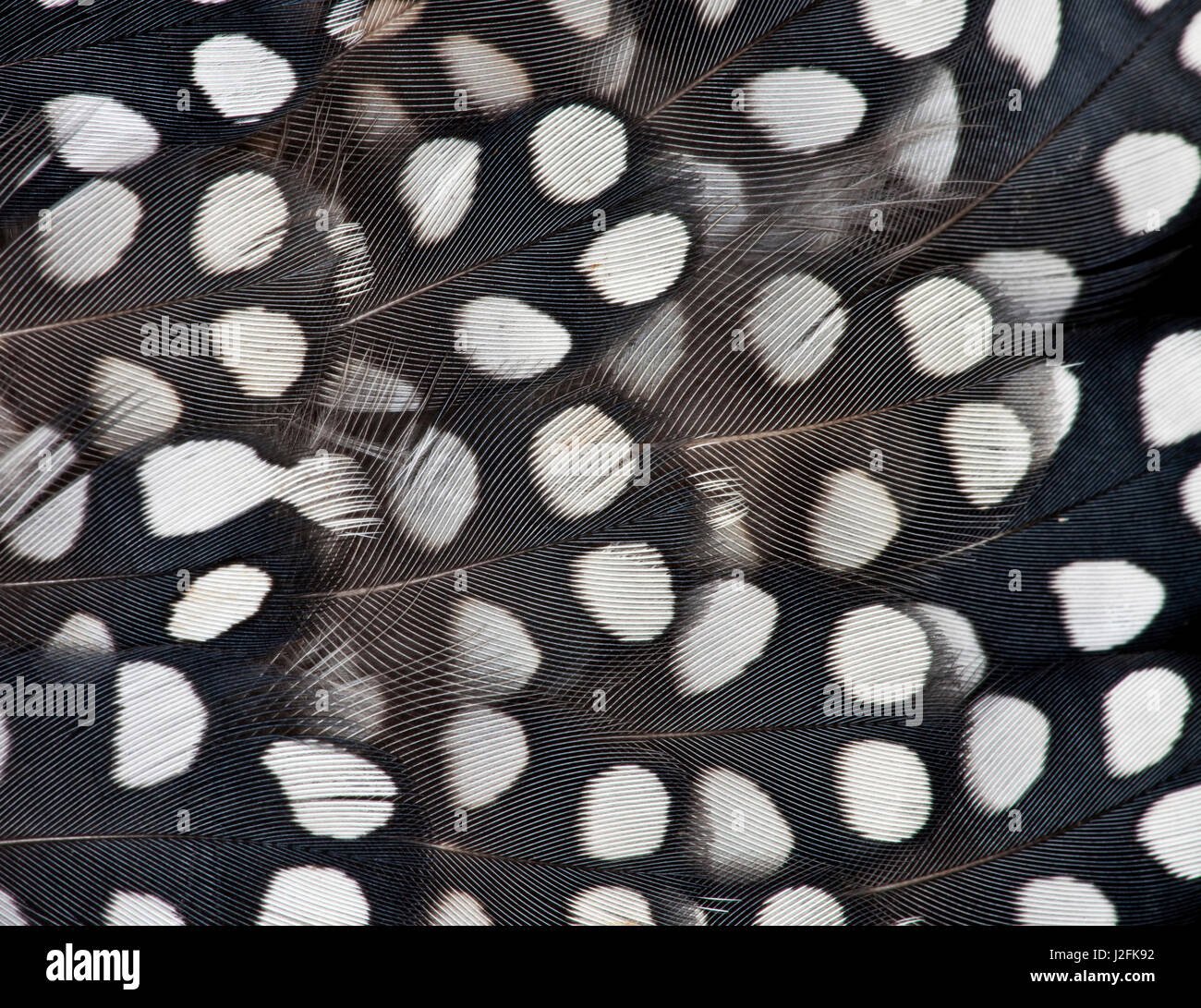
The Downy woodpecker is the most likely answer if you see a small U.S. bird with black-and-white spotted or patterned feathers. It has a white back, black wings marked with white spots, a white underside, and a black-and-white head. A male also has a small red patch on the back of his head.
However, several North American birds can look black and white from a distance. The bird’s size, bill shape, habitat, and the location of the spots can help you identify it.

The Downy Woodpecker Is the Most Likely Match
The Downy Woodpecker (Dryobates pubescens) is a small backyard bird found across much of the United States. It often visits suet feeders, tree trunks, dead branches, and wooden fence posts.
Look for these marks:
- Small body, about 6 to 7 inches long
- Short, straight bill
- White back with black wings
- White spots or bars across the wings
- White belly
- Black-and-white striped face
- Black tail with white outer feathers
- Red patch on the back of the head in adult males
The black-and-white pattern may look spotted, barred, or checkered. This changes with the bird’s position and the light. When the Downy Woodpecker clings to a tree, its white back and patterned wings often stand out.
The Downy Woodpecker is common in suburbs, parks, woodland edges, and backyards. It may feed on insects beneath tree bark, seeds, and suet. Its small size and short bill are useful clues.
Downy Woodpecker vs. Hairy Woodpecker
The Hairy Woodpecker looks almost like a larger Downy Woodpecker. Both birds have black-and-white feathers and similar head patterns.
| Feature | Downy Woodpecker | Hairy Woodpecker |
|---|---|---|
| Overall size | Small, about 6–7 inches | Larger, about 9–10 inches |
| Bill | Short and delicate | Long and more powerful |
| Tail | Often looks large compared with the body | Proportionate to its larger body |
| Habitat | Common in backyards and small trees | Often favors mature woods |
| Male marking | Red patch on the head | Red patch on the head |
Size can be hard to judge without a nearby object. Compare the bird with a sparrow, a suet cage, or the tree trunk. A Downy Woodpecker also has a noticeably smaller bill.
The Cornell Lab of Ornithology lists the Downy Woodpecker as a common North American woodpecker. Its species account provides range, behavior, calls, and identification details.

Other U.S. Birds With Black-and-White Spots
The Downy Woodpecker is not the only possible match. The best identification depends on where the spots appear and whether the bird has other strong color marks.
Eastern Towhee
A male Eastern Towhee has a black head, back, and upper breast. White spots appear on the wings and tail. Its sides are rusty orange, and its belly is white.
This bird is much larger and rounder than a Downy Woodpecker. It usually stays on the ground or low in brush. It often scratches through fallen leaves with both feet.
A female Eastern Towhee is brown rather than black, but she still shows pale wing markings and rusty sides.
Northern Flicker
The Northern Flicker has black spots on its lower belly and chest. Its back is brown with dark bars, and it has a black crescent-shaped mark on the upper chest.
It is much larger than a Downy Woodpecker, often measuring about 11 to 12 inches long. In flight, you may see bright yellow or reddish color in the wings and tail, depending on the bird’s region.
Northern Flickers often feed on the ground. Ants make up a large part of their diet, and the bird uses its long, slightly curved bill to probe soil and leaf litter.
White-Breasted Nuthatch
A White-breasted Nuthatch may look black and white, but it usually does not have true spots. It has:
- A blue-gray back
- A white face and underside
- A black cap
- A short tail
- A long, pointed bill
This bird often moves headfirst down tree trunks. That behavior can help separate it from a Downy Woodpecker.
Black-and-White Warbler
The Black-and-White Warbler has bold black-and-white stripes rather than spots. It creeps along tree trunks and branches while searching for insects.
Its streaked pattern can appear spotted when the bird moves quickly through leaves. It is much smaller and slimmer than a woodpecker.
Black-Backed Woodpecker
The Black-Backed Woodpecker has a mostly black back and white underside. It may show white bars on the wings, but it does not usually look like a heavily spotted bird.
This species is linked to conifer forests and areas affected by fire or outbreaks of wood-boring insects. It is less likely than a Downy Woodpecker in a typical residential backyard.

How to Identify a Black-and-White Spotted Bird
Start with the bird’s body shape. This often gives a faster answer than studying every feather.
1. Check where the bird is feeding
A bird on a tree trunk may be a woodpecker or nuthatch. A bird on the ground among leaves may be a towhee or flicker.
- Tree trunk: Downy Woodpecker, Hairy Woodpecker, or White-breasted Nuthatch
- Ground and leaf litter: Eastern Towhee or Northern Flicker
- Thin branches and tree canopy: Black-and-White Warbler or another songbird
- Suet feeder: Often Downy or Hairy Woodpecker
2. Look at the bill
A Downy Woodpecker has a short, narrow bill. A Hairy Woodpecker has a longer bill that looks closer to the length of its head.
A Northern Flicker has a longer, slightly curved bill. A nuthatch has a pointed bill that is shorter than a flicker’s bill but sharper than a Downy Woodpecker’s.
3. Estimate the size
Use familiar birds as rough comparisons:
- Sparrow-sized: Downy Woodpecker or Black-and-White Warbler
- Robin-sized: Eastern Towhee
- Larger than a robin: Northern Flicker or Hairy Woodpecker
Do not rely on size alone. Distance, posture, and fluffy feathers can make a bird seem larger or smaller.
4. Watch how it moves
Movement is one of the strongest clues.
- A Downy Woodpecker braces against bark with stiff tail feathers.
- A nuthatch often walks headfirst down a trunk.
- An Eastern Towhee scratches through leaves on the ground.
- A Northern Flicker commonly walks or hops across open ground.
- A Black-and-White Warbler creeps along bark and branches.
5. Check for red, orange, or yellow
Extra colors can quickly narrow the choices.
- Red patch on the head: Male Downy or Hairy Woodpecker
- Rusty-orange sides: Eastern Towhee
- Yellow or red wing and tail color: Northern Flicker, depending on region
- No strong extra color: Downy Woodpecker, nuthatch, or Black-and-White Warbler
Quick identification table
| What you saw | Most likely bird |
|---|---|
| Small bird with a short bill on a tree | Downy Woodpecker |
| Large black-and-white woodpecker | Hairy Woodpecker |
| Black bird with white wing spots and rusty sides | Eastern Towhee |
| Large spotted bird feeding on the ground | Northern Flicker |
| Gray-backed bird moving headfirst down a tree | White-breasted Nuthatch |
| Small bird with sharp black-and-white stripes | Black-and-White Warbler |

Where You Saw the Bird Matters
Location can support an identification, but it should not replace field marks. Many U.S. bird species overlap in range.
The Downy Woodpecker is widespread across the United States and is especially common near trees, feeders, parks, and woodland edges. It can live near people, so a backyard sighting is not unusual.
Eastern Towhees are more common in brushy areas, forest edges, and thick shrubs. Northern Flickers often use open yards, lawns, parks, and woodland borders. White-breasted Nuthatches favor mature trees but also visit suburban yards.
Regional clues can help:
- Eastern United States: Eastern Towhee and Downy Woodpecker are frequent possibilities.
- Western United States: Look closely at the habitat and the bird’s size, since several western woodpeckers may show contrasting black-and-white patterns.
- Wooded areas: Woodpeckers, nuthatches, and warblers become more likely.
- Open lawns: Northern Flickers and towhees deserve closer attention.
- Brush piles and dense shrubs: Towhees are more likely than woodpeckers.
Use a regional field guide or the Cornell Lab All About Birds species database to compare range maps and photographs.

Common Identification Mistakes
The most common mistake is calling every black-and-white bird a Downy Woodpecker. Color alone is not enough.
Mistake 1: Confusing spots with bars
Spots are separate rounded marks. Bars are lines that cross a feather or body part. The Downy Woodpecker may show both spots and bars, while the Black-and-White Warbler is mainly striped.
Mistake 2: Ignoring the bill
The bill is one of the best ways to separate Downy and Hairy Woodpeckers. If the bill looks long and strong, the bird may be a Hairy Woodpecker.
Mistake 3: Judging size without a reference
A bird seen alone can be difficult to size. Compare it with a feeder, branch, fence board, or nearby species. Take a photograph if possible, but avoid approaching the bird.
Mistake 4: Assuming a red head means one species
Both male Downy and Hairy Woodpeckers can have a red patch. The bird’s body size and bill still matter.
Mistake 5: Using behavior as the only clue
A bird on a tree may not be a woodpecker. White-breasted Nuthatches also climb trunks, and Black-and-White Warblers search tree bark for insects.

How to Observe the Bird Safely
You can identify most backyard birds without touching or trapping them. Use binoculars, a camera with a zoom lens, or a window view.
Keep these practices in mind:
- Stay several yards away when possible.
- Do not chase a bird for a better photograph.
- Never handle a healthy wild bird.
- Keep cats indoors or use a secure outdoor enclosure.
- Clean feeders and birdbaths on a regular schedule.
- Remove a feeder temporarily if sick birds gather around it.
- Contact a licensed wildlife rehabilitator if you find an injured bird.
The U.S. Fish and Wildlife Service and state wildlife agencies provide guidance for injured wildlife and migratory birds. Laws and procedures can vary by state, so use local instructions rather than trying to care for a wild bird yourself.

Frequently Asked Questions
What is the most common black-and-white spotted bird in a backyard?
The Downy Woodpecker is one of the most likely backyard birds with a black-and-white spotted or checkered pattern. It commonly visits suet feeders and tree trunks.
What bird has black-and-white spots and a red head?
A male Downy Woodpecker or Hairy Woodpecker may have a red patch on the back of its head. The Downy Woodpecker is smaller, with a shorter bill.
Is a black-and-white spotted bird always a woodpecker?
No. An Eastern Towhee, Northern Flicker, or another species may also show black-and-white markings. Body shape, habitat, movement, and bill form are needed for a reliable identification.
What bird has black wings with white spots?
Several birds do. The Downy Woodpecker has black wings with white markings, while the Eastern Towhee has white wing spots against black upperparts. The bird’s size and habitat can separate them.
How can I identify the bird if I only saw it briefly?
Write down four details: size, location, body shape, and any extra colors. A photograph, even a poor one, can help show the bill, tail, wing pattern, and posture.
Conclusion
If you saw a small black-and-white spotted bird on a tree or feeder in the United States, the Downy Woodpecker is the best first guess. Confirm the identification by checking its short bill, compact body, white back, patterned wings, and black-and-white face.
If the bird was larger, rusty-sided, ground-feeding, or strongly striped, consider an Eastern Towhee, Northern Flicker, Hairy Woodpecker, White-breasted Nuthatch, or Black-and-White Warbler instead. The next useful step is to note where the bird was, how it moved, and whether it had a red, orange, or yellow mark.