
Across the United States, the Eastern Towhee is one of the most likely birds described as black with a white stripe or white markings on its wings. The male has a black head, back, and breast, with white sides, a rusty-red side, and small white wing patches. However, several other U.S. birds can look similar, including the Black-and-white Warbler, Lark Bunting, Bobolink, and Common Grackle.
The best match depends on the bird’s size, habitat, behavior, and the exact shape of the white mark. A single photo or detail—such as a red eye, white belly, or rusty side—can quickly narrow the answer.
The Most Likely Answer: Eastern Towhee
The Eastern Towhee (Pipilo erythrophthalmus) is often the best match for a black bird with white wing markings in the eastern United States.
A male Eastern Towhee has:
- A black head, throat, back, and upper breast
- White sides and belly
- Rusty-red flanks
- White patches or bars on the wings
- A long, dark tail with white outer edges
- A pink or pale bill
- Red eyes in many adults
The white mark may look like a stripe when the wing is folded. In flight, it usually appears as a white patch along the wing and tail rather than one thin, continuous line.
Eastern Towhees often forage on the ground. They scratch through dry leaves with both feet, then pause to look for seeds and insects. They commonly live in brush, woodland edges, thickets, parks, and suburban yards.
The song is another useful clue. It often sounds like “drink-your-tea!” The call is a sharp, metallic “chewink.”
Eastern Towhee range in the United States
Eastern Towhees occur across much of the eastern and southeastern United States. Their range extends west into parts of the Great Plains and Texas. Some remain in the same area year-round, while others move south during winter.
The similar Spotted Towhee occurs mainly in the western United States. It also has white wing spots, but the male usually shows white spots on a black back and wings, along with more extensive spotting on the wings and back.
According to the Cornell Lab of Ornithology, habitat and plumage help separate Eastern Towhees from western towhee species.
Birds That Can Look Black With a White Wing Stripe
A description based only on color is not always enough. The following birds are common alternatives in the United States.
| Bird | Main white wing marking | Other useful clues | Typical U.S. setting |
|---|---|---|---|
| Eastern Towhee | White wing spots or bars | White belly, rusty sides, ground feeding | Eastern thickets and woodland edges |
| Black-and-white Warbler | White wing bars | Black-and-white striped body, creeps on tree trunks | Forests during migration and summer |
| Lark Bunting | Large white wing patch | Male is mostly black in breeding season | Great Plains and western prairies |
| Bobolink | White wing patches and pale back | Male has a pale rear crown and black underside | Grasslands and hayfields |
| Common Grackle | Pale or white-looking wing edge in some light | Long tail, glossy blue or purple head | Open yards, fields, towns, wetlands |
| Spotted Towhee | Several white wing spots | Black back with white spots and rusty sides | Western brush and dry woodland |
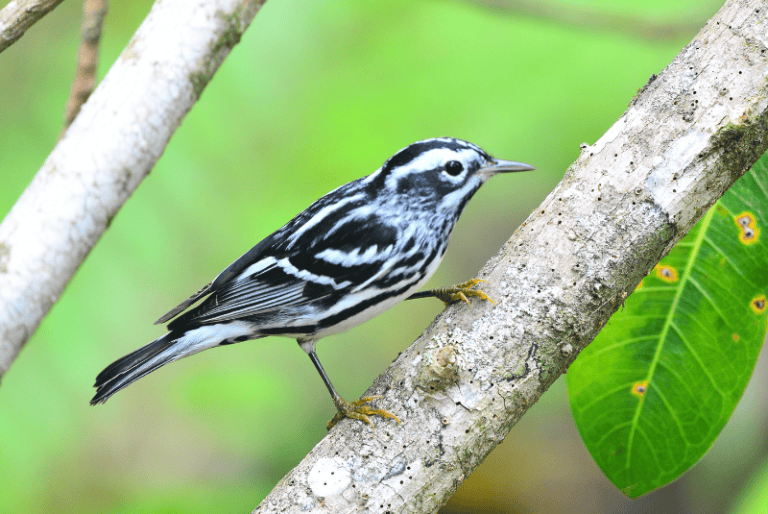
Black-and-white Warbler
The Black-and-white Warbler is a strong possibility if the bird looks striped from head to tail. It has a black-and-white pattern, white wing bars, and a slim body.
Unlike a towhee, it usually moves along tree trunks and large branches. It may look like a small black-and-white bird climbing like a nuthatch.
The bird is found across much of the eastern United States during the breeding season and migration. It also appears in parts of the central and western United States during migration.
The National Audubon Society describes its bold black-and-white plumage and habit of searching tree bark for insects.
Lark Bunting
A male Lark Bunting can look almost entirely black in breeding plumage. Its wings contain large white patches that can look like a white stripe when the bird is flying or holding its wings at an angle.
This bird is most likely in the Great Plains and parts of the western United States. It favors open grassland, prairie, farmland, and dry plains rather than dense woods.
Females and nonbreeding birds look much browner. That difference can make identification harder outside the breeding season.
Bobolink
A male Bobolink is mostly black underneath, with a pale back and white wing patches. In flight, the white on the wings can stand out clearly.
Bobolinks are most often seen in open grasslands, hayfields, and wet meadows. They do not usually behave like towhees. Instead, they feed and perch in tall grass and may travel in loose flocks.
The Cornell Lab of Ornithology Bobolink guide notes its unusual breeding plumage and long-distance migration.
Common Grackle
A Common Grackle can appear black at first glance, especially in poor light. In sunlight, its head may show blue or purple gloss, while the body can look bronze or green.
It does not normally have a clean white wing stripe. Pale reflections, worn feathers, or the white edges of folded wing feathers may create that impression. Its long, keel-shaped tail is usually the clearest clue.
Common Grackles often walk in lawns, visit bird feeders, and gather in parking lots, fields, and wetlands. They are larger and longer-tailed than towhees.

How to Identify the Bird Step by Step
Start with the bird’s shape and behavior, then use color as confirmation. Black-and-white patterns can change with light, distance, age, and the angle of the wing.
1. Estimate the bird’s size
Compare it with a familiar bird:
- Sparrow-sized: Consider a warbler, bunting, or small sparrow.
- Robin-sized: Consider an Eastern Towhee or Spotted Towhee.
- Crow-sized or larger: Consider a Common Grackle or another blackbird.
Size estimates are easier when the bird is near a fence, feeder, branch, or known species.
2. Check whether the white mark is a bar, patch, or edge
Bird guides use different terms for white wing markings:
- A wing bar is a clear line across the folded wing.
- A wing patch is a larger block of color.
- A wing spot is a small isolated mark.
- A wing edge is a pale border along the feather tips.
An Eastern Towhee usually has white wing spots or patches. A Black-and-white Warbler usually shows stronger white wing bars. A Lark Bunting often shows a larger white patch in flight.
3. Look at the belly and sides
The body pattern may solve the mystery:
- White belly with rusty sides: Eastern Towhee
- Black-and-white stripes across the body: Black-and-white Warbler
- Mostly black body with white wing patches: Lark Bunting
- Black underside with a pale back: Male Bobolink
- Glossy body and long tail: Common Grackle
- Rusty sides with many white spots on the back: Spotted Towhee
4. Watch how it moves
Behavior is often more reliable than a quick color impression.
- Scratches through leaf litter: Eastern Towhee or Spotted Towhee
- Creeps up tree trunks: Black-and-white Warbler
- Feeds in open prairie or hayfields: Lark Bunting or Bobolink
- Walks on lawns and gathers in groups: Common Grackle
5. Listen for the call or song
Bird sounds can confirm a visual identification:
- Eastern Towhee: “drink-your-tea”
- Black-and-white Warbler: a repeated, high, even song
- Common Grackle: harsh, creaky, or squeaky calls
- Bobolink: a bubbling, fast, musical song
Use a bird sound app only as a guide. Background noise, regional variation, and poor recordings can lead to errors.

Eastern Towhee vs. Similar Black Birds
The following comparison helps when the bird is in the eastern United States.
Eastern Towhee vs. Black-and-white Warbler
Choose Eastern Towhee if the bird is larger, has rusty sides, and feeds on the ground. Choose Black-and-white Warbler if it is slimmer, strongly striped, and climbing along tree trunks.
The towhee has a bold black upper body and a white belly. The warbler has narrow black-and-white stripes across the head and body.
Eastern Towhee vs. Common Grackle
Choose Eastern Towhee if the bird has a white belly and rusty flanks. Choose Common Grackle if it has a long tail, glossy coloring, and a heavier body.
A grackle’s wing may show a pale edge, but it usually does not show the clean white wing pattern expected on a towhee.
Eastern Towhee vs. Spotted Towhee
The two towhees can be difficult to separate.
- Eastern Towhee: Eastern and southeastern United States; black back is usually plain.
- Spotted Towhee: Western United States; back and wings show many obvious white spots.
Range is useful, but it should not be the only clue. Some birds wander outside their normal range, and seasonal movement can create unusual sightings.
Eastern Towhee vs. Lark Bunting
Choose Eastern Towhee in brushy woodland or a suburban thicket. Choose Lark Bunting in open prairie or dry grassland, especially in the Great Plains.
The Lark Bunting male often appears more uniformly black. Its white wing patch is usually larger and more noticeable during flight.

Where You Saw the Bird Matters
Location can greatly improve identification.
In a backyard or brush pile
An Eastern Towhee is likely if the bird stays low, scratches through leaves, and has rusty sides. It may visit ground-level seed or forage beneath shrubs.
On a tree trunk
A Black-and-white Warbler becomes more likely. It often searches tree bark for insects and moves in a creeping, deliberate way.
In a hayfield or prairie
Consider a Bobolink or Lark Bunting. Both favor open habitats, but their range and body pattern differ.
In a lawn, parking lot, or wetland
A Common Grackle is more likely, especially if the bird has a long tail and travels with other blackbirds.
Near the Pacific Coast or in the western interior
Consider a Spotted Towhee, Lark Bunting, or another western species. The exact state, season, and habitat are important because many birds migrate.

Common Identification Mistakes
Mistaking a white wing edge for a white stripe
A pale feather edge may appear as a line when the wing is folded. Watch the bird in flight if possible. A true wing bar or patch usually remains part of the bird’s normal pattern at several angles.
Ignoring the underside
The back may look black, but the belly and sides often provide the key. A rusty side strongly supports a towhee. A completely glossy body and long tail point more toward a grackle.
Using color without considering light
Black feathers can reflect blue, purple, green, or brown. White feathers may look gray in shade. Try to observe the bird in natural light before making a final identification.
Relying on one feature
No single white mark proves the species. Use at least three clues:
- Body size and shape
- Wing pattern
- Habitat or behavior
A fourth clue, such as voice or range, can provide stronger confirmation.
Assuming every black bird is a blackbird
“Blackbird” is a broad everyday term. In the United States, it may refer to grackles, cowbirds, blackbirds, or any dark-colored bird. Identification requires more than the bird’s general color.

What to Do If You Still Cannot Identify It
Take a clear photo from more than one angle if the bird returns. Try to capture the side, back, underside, and open wing. A short video can reveal how the bird feeds and flies.
Record these details:
- State or region
- Date and time
- Habitat
- Approximate size
- Tail length
- Bill shape
- Belly and side color
- Exact shape of the white wing marking
- Behavior and call
You can compare the result with the Cornell Lab of Ornithology bird guide, the Audubon bird guide, or the eBird species database. These resources provide range maps, photos, sounds, and seasonal information for North American birds.
Do not handle a wild bird to inspect its feathers. If an injured bird needs help, contact a licensed wildlife rehabilitator or a local wildlife agency.

Frequently Asked Questions
What is a black bird with a white stripe on its wing in the eastern United States?
The Eastern Towhee is a likely answer, especially if the bird has a white belly, rusty-red sides, and a habit of scratching through leaves. A Black-and-white Warbler is more likely if the bird is small, heavily striped, and climbing on tree trunks.
What black bird has white wing patches?
Several U.S. birds have white wing patches, including Eastern Towhees, Spotted Towhees, Lark Buntings, Bobolinks, and Black-and-white Warblers. The bird’s size, range, habitat, and body markings are needed for a confident identification.
Is a black bird with white wings a Common Grackle?
Usually not if the white marking is bright and clearly defined. Common Grackles are glossy black or blue-black and have long tails. Their wings may show pale edges in some light, but they generally lack the bold white wing pattern seen on a towhee or Lark Bunting.
What bird is black and white and walks on the ground?
An Eastern Towhee may walk and hop on the ground while searching through leaf litter. A Black-and-white Warbler can also forage low, but it more often climbs tree trunks and branches.
Do male and female birds have the same black-and-white pattern?
Not always. Male Eastern Towhees are much darker than females, while female towhees are mainly brown with similar rusty sides. Lark Buntings and Bobolinks also change appearance by sex and season, so a female or nonbreeding bird may not resemble the male.
Bottom Line
The Eastern Towhee is the best first guess for a black bird with white markings on its wings in much of the eastern United States. Look for a black head and back, white belly, rusty sides, ground-feeding behavior, and a “drink-your-tea” song.
If the bird is small and striped, consider a Black-and-white Warbler. If it is in open prairie, consider a Lark Bunting or Bobolink. If it is glossy, long-tailed, and found in groups, a Common Grackle may be the better match.