
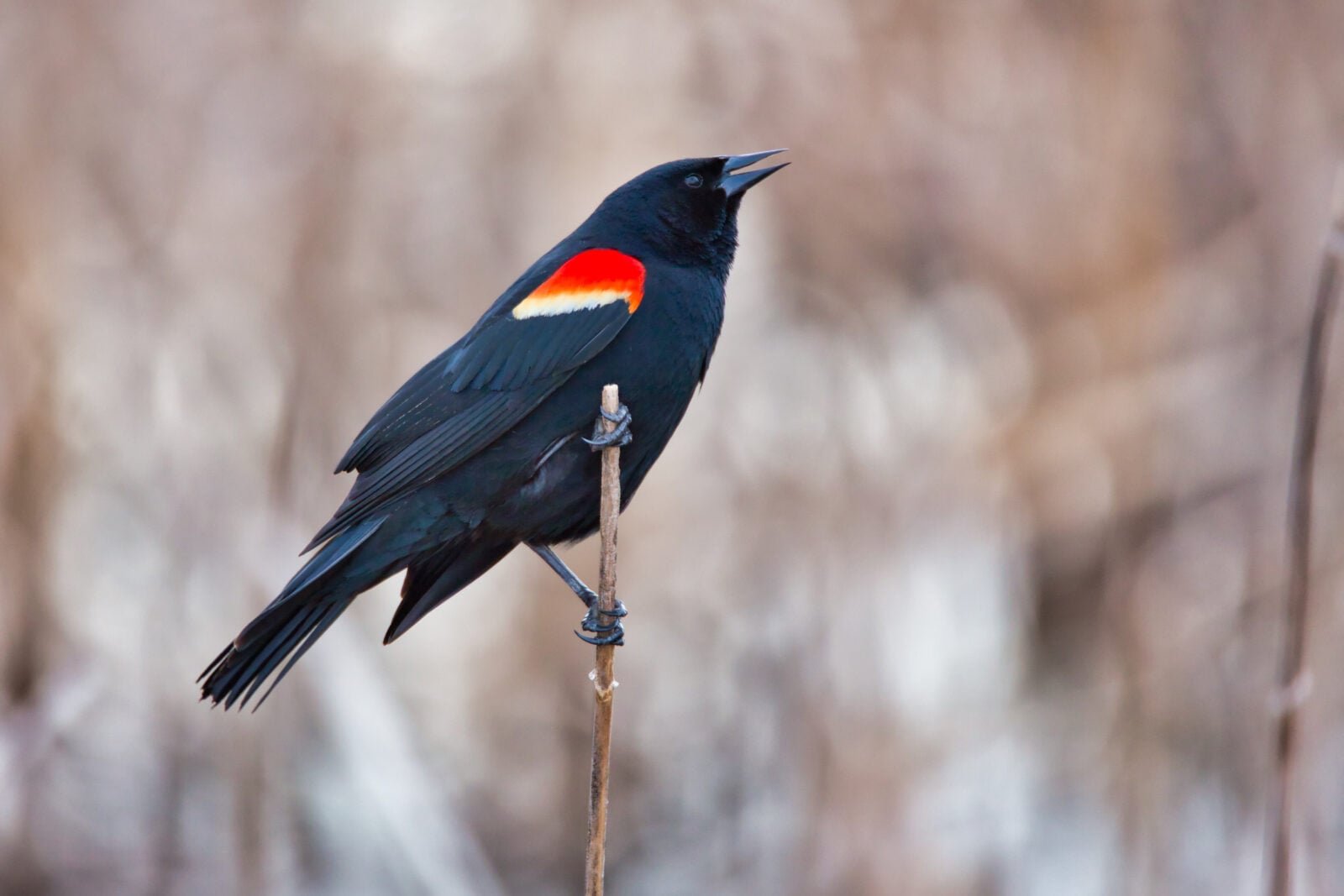
If you see a black bird with bright red shoulder patches in the United States, it is most likely a male red-winged blackbird (Agelaius phoeniceus). The red-and-yellow patches sit on its shoulders, called the lesser wing coverts, and may show when the bird flies, sings, or defends its territory.
Red-winged blackbirds are common across much of the U.S. They live in wetlands, marshes, wet fields, roadsides, and other areas with tall plants. Females look very different: they are brown, streaked, and sparrow-like rather than glossy black.

The most likely answer: red-winged blackbird
The red-winged blackbird is the classic black bird with red wings in North America. Adult males have glossy black bodies with red shoulder patches. Many males also show a narrow yellow or orange stripe below the red patch.
The patches are not usually bright red across the whole wing. They are small shoulder marks that can look hidden when the bird rests. A male may puff them out during a display, making the color much easier to see.
The species is widespread in the United States. It breeds from Alaska and Canada through much of the lower 48 states, and many birds remain in the country all year. Its range and movements vary by region and season.
The Cornell Lab of Ornithology describes the red-winged blackbird as a common bird of wetlands and open habitats. The National Audubon Society also lists marshes, wet meadows, and fields among its typical habitats.
Quick identification
Look for these features:
- Body: Glossy black in adult males
- Shoulders: Red patches, often with a yellow border
- Size: Medium-sized songbird, about the length of a robin
- Bill: Pointed and fairly stout
- Tail: Broad and slightly rounded
- Call: A sharp, nasal song often written as “kon-ka-ree” or “conk-la-ree”
- Habitat: Marshes, ponds, wet fields, ditches, and brushy edges
A bird that looks black from far away may show its red shoulder patch only for a moment. Check the bird again when it flies or turns.

How to tell a red-winged blackbird from similar birds
The red-winged blackbird is the best match, but several other U.S. birds can cause confusion. The location, season, body shape, and exact color pattern can help.
| Bird | Main appearance | Best clue |
|---|---|---|
| Red-winged blackbird | Black male with red and yellow shoulder patches | Common near wetlands and fields |
| Tricolored blackbird | Black male with red shoulder patch and pale stripe | More limited range, especially California |
| Common grackle | Iridescent black with blue or purple head | Longer tail and larger body |
| Brown-headed cowbird | Black male with brown head | Red is absent |
| European starling | Dark, glossy body with pale spots | Short tail and pointed bill |
| Scarlet tanager | Red body with black wings | The body is red, not black |
Red-winged blackbird vs. tricolored blackbird
The tricolored blackbird can look very similar. Its male also has a red shoulder patch, but the patch often includes a more noticeable pale or white stripe. Tricolored blackbirds are strongly associated with California and parts of the western United States, while red-winged blackbirds have a much wider range.
Do not rely on color alone. A clear photograph, location, habitat, and song can make the identification more reliable.
Red-winged blackbird vs. scarlet tanager
A male scarlet tanager has a bright red body and black wings. If the bird’s entire body looks red, it is not a red-winged blackbird. Scarlet tanagers also tend to stay high in trees, while red-winged blackbirds often perch on reeds, fence posts, shrubs, or low vegetation.
Red-winged blackbird vs. common grackle
A common grackle is larger and more slender. It often has a long, keel-shaped tail and a blue or purple sheen on its head. It does not have the red shoulder patch that identifies a male red-winged blackbird.

Male and female red-winged blackbirds look different
The male is black with red shoulder patches, but the female is mostly brown and heavily streaked. This difference is called sexual dimorphism, which means males and females of the same species have different appearances.
Female red-winged blackbirds often have:
- Brown, cream, and buff streaks
- A pale eyebrow stripe
- A lighter throat
- A slim, pointed bill
- A sparrow-like shape
Young birds can look between the two forms. Juvenile males may have brown feathers before they develop the full black plumage of adults.
This difference can lead people to think they have seen two different species. In fact, a black bird with red shoulders and a streaky brown bird may be a male and female red-winged blackbird traveling together.
The female’s muted colors help her blend into reeds and marsh plants while nesting. The male’s bright shoulder patches serve a different purpose. He uses them in visual displays and territorial contests.

Where red-winged blackbirds live in the United States
Red-winged blackbirds are most strongly linked with wet places, but they also use many open habitats. You may see them in:
- Freshwater marshes
- Cattail stands
- Wet meadows
- Farm fields
- Rice fields
- Roadside ditches
- Pond edges
- Prairie grasslands
- Pastures
- Suburban areas with dense vegetation
Their habitat changes with the season. During breeding season, males often defend small areas around nesting cover. Outside the breeding season, red-winged blackbirds may gather in large flocks with other blackbirds.
In the Northeast and Midwest, they are common around marshes and farm edges. In the West, local populations may use agricultural land, wetlands, and irrigation areas. In the South, they can remain present through winter, while northern birds may move south or gather in large winter flocks.
The U.S. Fish & Wildlife Service recognizes the red-winged blackbird as a widespread North American bird. Its broad range means that local behavior can differ by region.

What red-winged blackbirds eat
Red-winged blackbirds eat both plant and animal foods. Their diet often includes:
- Seeds
- Grains
- Insects
- Spiders
- Snails
- Small aquatic animals
- Fruits and other plant matter
During the breeding season, adults may feed insects to their young because animal food provides useful protein. At other times, seeds and grains make up a larger share of the diet.
A red-winged blackbird may forage on the ground, in shallow water, or among grasses and reeds. It may also join mixed flocks with grackles, starlings, and other blackbirds.
If you want to attract them, native grasses, wetland plants, and open ground can provide natural food. Bird feeders may also attract them, but large blackbird flocks can dominate feeding areas and may displace smaller birds.
Avoid feeding birds spoiled food, bread as a main diet, or food placed where cats can easily reach it. Clean feeders and remove wet seed to reduce disease risks.

Why does the male red-winged blackbird show red wings?
The red patch helps the male communicate with other red-winged blackbirds. He may expose it during a territorial display, especially when another male approaches or when a predator comes near a nest.
A male may also hide the patch by folding his wings. This is why the same bird can appear completely black at one moment and show a vivid red-and-yellow mark at the next.
The patch is not a separate wing or a sign of injury. It is a natural group of colored feathers on the shoulder area. The technical term for this visible wing region is the epaulet.
Color displays are only one part of the bird’s behavior. Males also sing from exposed perches, chase rivals, and fly over their territory. Females choose nesting sites and provide much of the nest care.

When and where you are most likely to see one
The best places to look are wet areas with tall plants and nearby open ground. Scan cattails, reeds, fence posts, telephone wires, and the tops of shrubs.
You may see a red-winged blackbird:
- Perched above a marsh while singing
- Flying low over a field
- Feeding on the ground with other blackbirds
- Clinging to reeds near a pond
- Defending an area around a nest
Spring and summer are often the easiest seasons for seeing males display their red patches. In fall and winter, red-winged blackbirds may form large groups. Their shoulder patches can be harder to distinguish when many birds move together.
Use binoculars if you have them, but keep a respectful distance from nests. A bird that repeatedly calls, flies close, or appears agitated may be warning you away from its territory.

Is a black bird with red wings dangerous?
A red-winged blackbird is not dangerous to people under normal conditions. However, a nesting male may swoop near someone who gets too close to the nest. These flights are usually warning behavior rather than an attempt to cause serious harm.
To avoid conflict:
- Stay on a path when possible.
- Do not approach a nest or young bird.
- Keep dogs leashed near nesting habitat.
- Do not wave at or chase a bird.
- Move away calmly if a male repeatedly swoops.
Do not touch a wild bird unless it is in immediate danger and you have guidance from a licensed wildlife rehabilitator. Birds can be harmed by stress, rough handling, or incorrect attempts to feed them.
If you find an injured red-winged blackbird, contact a licensed wildlife rehabilitator or your state wildlife agency. The U.S. Fish & Wildlife Service and state wildlife departments provide region-specific wildlife guidance, although rules and contacts vary by state.

Common identification mistakes
The most common mistake is assuming that any dark bird with a flash of red must be a red-winged blackbird. Check the whole bird before deciding.
Watch for these errors:
- Mistaking red body feathers for red shoulder patches: A scarlet tanager has a red body and black wings.
- Ignoring the bird’s size: A grackle is usually larger and has a much longer tail.
- Overlooking the habitat: Red-winged blackbirds favor wet areas and open fields, though they can occur elsewhere.
- Assuming all blackbirds look alike: Brown-headed cowbirds, grackles, starlings, and red-winged blackbirds have different shapes and patterns.
- Identifying only by a distant color flash: Light, motion, and shadows can change how feathers appear.
- Forgetting female plumage: A streaky brown bird may be a female red-winged blackbird.
A photo from the side, a sound recording, and the location can improve identification. Apps can suggest a species, but treat an app result as a lead rather than proof, especially when the image is blurry.

Frequently asked questions
Is a red-winged blackbird the same as a blackbird?
No. “Blackbird” can describe several species with dark plumage. The red-winged blackbird is one specific species. In the United States, people may also use “blackbird” for grackles, cowbirds, starlings, and other dark birds.
Do female red-winged blackbirds have red wings?
Female red-winged blackbirds usually do not show the bright red shoulder patch seen on males. They are brown and streaked, although individual feathers may show subtle color that is not easy to see.
Do red-winged blackbirds migrate?
Some red-winged blackbirds migrate, while others remain near their breeding areas. Birds in northern regions are more likely to move south in winter. Local weather, food, and habitat affect their movements.
Do red-winged blackbirds live in every U.S. state?
They occur across much of the United States, but abundance differs by region. The species is especially common in wetland and agricultural habitats. Local records from Alaska, Hawaii, and other areas can differ, so a regional field guide is useful for unusual sightings.
What should I do if a red-winged blackbird attacks my window?
First, reduce the reflection by covering the outside of the window or changing the viewing angle. A bird may attack glass because it sees its reflection and treats it as a rival. If the bird appears injured, contact a wildlife rehabilitator rather than handling it without advice.
Conclusion: the red-winged blackbird is the usual answer
A black bird with red wings in the United States is most often a male red-winged blackbird. The key mark is the red shoulder patch, often bordered by yellow, on an otherwise glossy black bird.
For a confident identification, check the bird’s body shape, habitat, call, and shoulder pattern. If the whole body is red, consider a scarlet tanager. If the bird is very large with a long tail, consider a grackle. If it has a pale stripe next to the red patch and occurs in California, compare it with a tricolored blackbird.
The next time you see one, watch from a distance and look for the brief flash of red as it sings, flies, or guards its marsh-side territory.