
Introduction
For readers in the United States, birds of paradise are birds seen mainly in zoos, museums, nature programs, and specialist bird collections—not in the wild across the mainland. These remarkable birds live mostly in New Guinea and nearby islands, with a few species in northern Australia. Their name refers to a family of birds, Paradisaeidae, rather than one single species.
The main difference between male and female birds of paradise is appearance and breeding behavior. Males often have bright feathers, long plumes, breast shields, or unusual body shapes used in courtship. Females are usually smaller and less colorful, with brown or olive plumage that helps them hide while nesting. However, this pattern is not universal, so accurate identification depends on the species, location, behavior, and sometimes DNA testing.

Male vs. Female Birds of Paradise at a Glance
Male birds of paradise usually look more dramatic than females because males use their feathers and movements to attract mates. Females often have softer colors and a less ornate shape because camouflage helps protect them and their nests.
| Feature | Male bird of paradise | Female bird of paradise |
|---|---|---|
| Main breeding role | Displays and competes for mates | Chooses a mate, builds the nest, and raises young in many species |
| Plumage | Often bright, glossy, metallic, or highly ornate | Usually brown, gray, olive, or muted |
| Tail and wing feathers | May be long, curled, wire-like, or highly modified | Usually shorter and less modified |
| Display behavior | Fans feathers, spreads wings, calls, hops, or hangs upside down | Watches, approaches, rejects, or selects males |
| Body size | Often larger, but not always | Often smaller, but not always |
| Nesting color needs | Less need for camouflage during display | Strong need for camouflage near the nest |
| Reliable identification | Species-specific plumage and behavior | Species-specific plumage and behavior |
The clearest rule is this: male birds of paradise are often built for display, while females are often built for concealment and reproduction. This is a broad pattern, not a perfect test.

What Are Birds of Paradise?
Birds of paradise are a group of tropical passerine birds in the family Paradisaeidae. Most species occur in New Guinea, which includes the countries of Papua New Guinea and Indonesia. Some also live on nearby islands, and the Australian riflebirds occur in parts of eastern Australia.
The family includes well-known species such as:
- Greater bird-of-paradise
- Raggiana bird-of-paradise
- Wilson’s bird-of-paradise
- King of Saxony bird-of-paradise
- Superb bird-of-paradise
- Twelve-wired bird-of-paradise
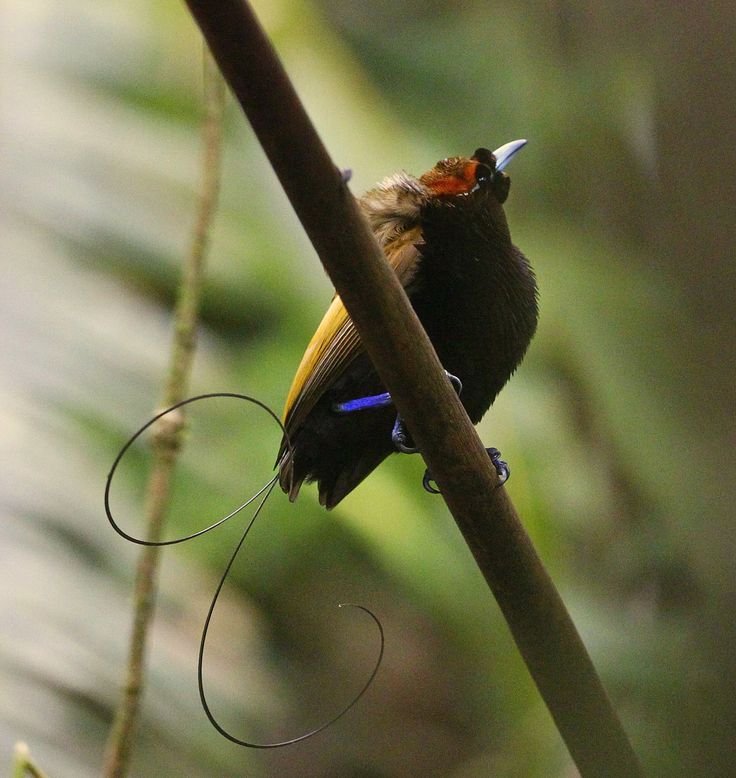
- Magnificent riflebird
The group contains about 45 recognized species, although bird classification can change as scientists study genetics, behavior, and regional forms. Some birds once treated as separate species may be reclassified, while other populations may receive more careful review.
Birds of paradise are not the same as the bird-of-paradise flower often sold in the United States. The plant, commonly called Strelitzia reginae, is native to southern Africa. It shares a name with the birds because its orange and blue flowers resemble a bird’s shape.

How Male Birds of Paradise Differ
Male birds of paradise often have special feathers that act like visual signals. These feathers may appear on the tail, wings, breast, head, or sides of the body. In some species, the feathers look ordinary when folded but form a large fan or shield during a display.
Bright and unusual plumage
Male plumage can include:
- Iridescent blue, green, purple, or bronze
- Glossy black feathers
- White or yellow flank plumes
- Long tail wires
- Curved or ribbon-like feathers
- Bright throat shields
- Decorative head feathers
Iridescence does not always mean the feather contains bright pigment. The color can come from the way light reflects from microscopic structures in the feather. This means a male may look black from one angle and flash blue, green, or violet from another.
Courtship displays
A male may clear a small display site, called a court, on the forest floor or in a tree. He may remove leaves and debris so his feathers stand out. During the display, he can:
- Call to attract a female.
- Face or move around her.
- Raise, spread, or rotate his feathers.
- Change his body shape.
- Hop, bow, shake, or swing his head.
- Pause so the female can inspect him.
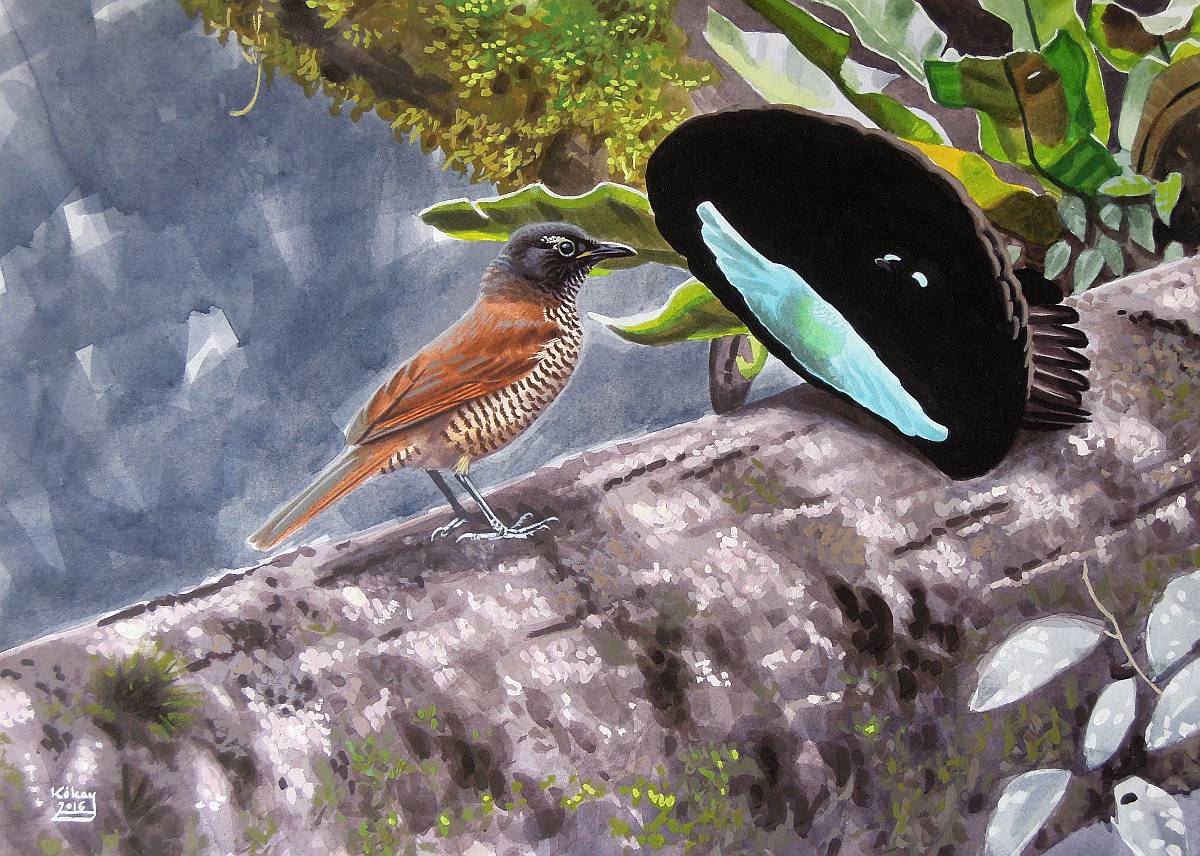
The superb bird-of-paradise provides a clear example. Its male can transform his dark body and blue breast shield into a curved, almost oval shape during courtship. This shape makes his blue breast mark more visible to a watching female.
Male size and vocal traits
In many species, males are larger than females. Some males also have louder or more complex calls. These traits may help with courtship or competition. Yet size alone is not a reliable way to identify sex because species differ, and young birds may not show adult traits.
A male’s display also has costs. Bright feathers can attract predators, and long feathers may make movement harder. A male that spends time displaying may also spend less time feeding or guarding a nest. These costs help explain why such displays are linked to mating success.
How Female Birds of Paradise Differ
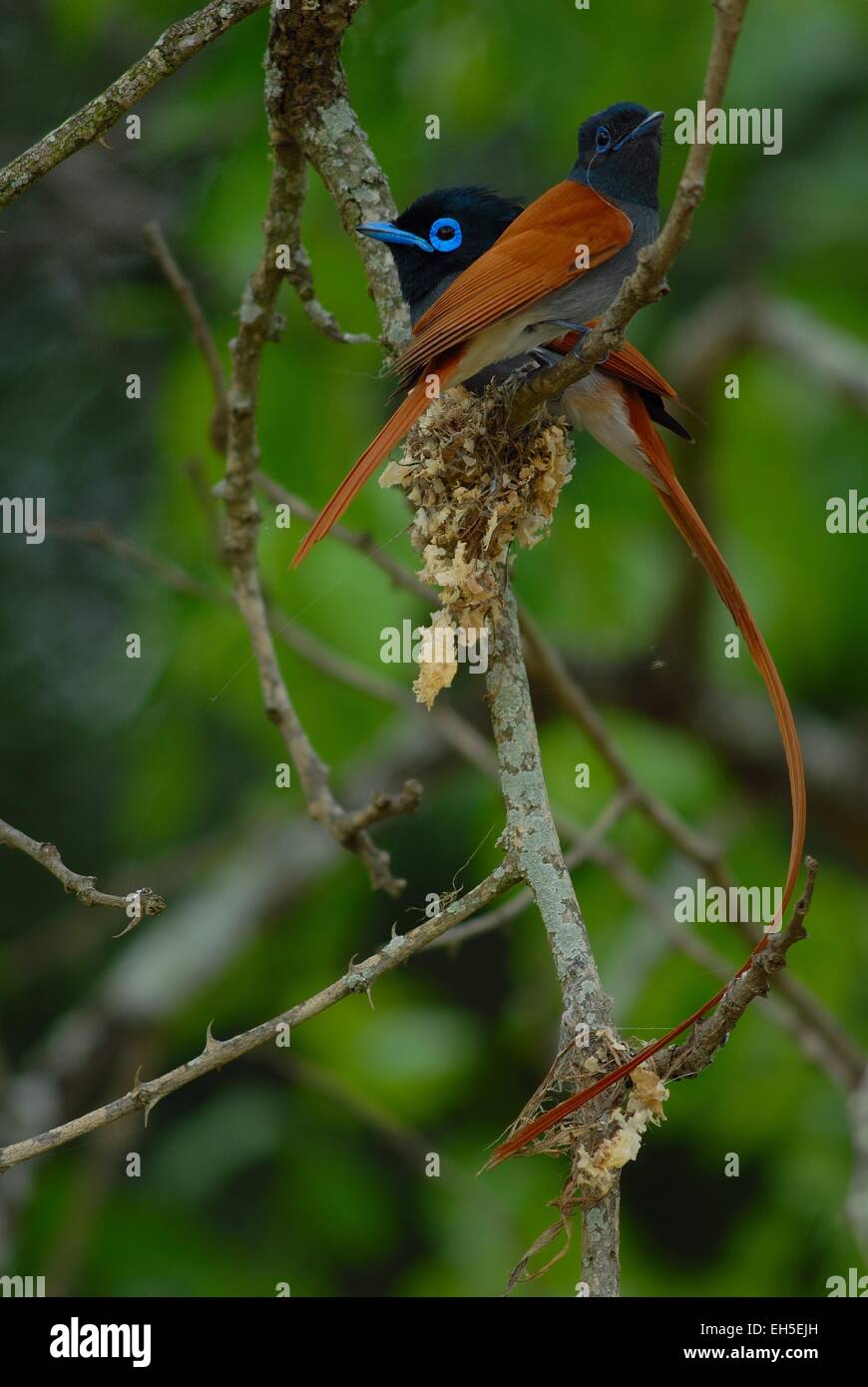
Female birds of paradise often have muted feathers that blend with leaves, bark, and shadow. This camouflage is useful because females usually spend more time near nests and young birds.
Camouflage and body form
A female may have:
- Brown, gray, olive, or reddish-brown feathers
- Light streaks or spots
- A shorter tail
- A simpler head shape
- Less iridescence
- Fewer decorative plumes
The female’s plain appearance does not mean she is biologically unimportant. In many species, the female makes the final mate choice. She may inspect several males before accepting one, or she may leave quickly if a display does not meet her signals.
Nesting and parental care
Female birds of paradise commonly perform most or all of the nesting work. Depending on the species, this can include:
- Choosing a nest site
- Building the nest
- Incubating eggs
- Feeding nestlings
- Removing waste
- Defending the nest from some threats
Many birds of paradise are polygynous. In this system, one male may mate with several females, while each female raises her own brood. The male’s role may focus mainly on courtship rather than nest care.
This pattern varies. Readers should not apply it to every species without checking a species account. The Cornell Lab’s Birds of the World, museum records, and field studies provide more detail for individual species.
Why females may look “plain”
Muted plumage is often an advantage near a nest. A brown female may be harder for a predator to notice than a bright blue or yellow male. Natural selection can therefore favor two very different adult forms within the same species:
- Males that are easy to see during courtship
- Females that are hard to see during nesting
This difference is called sexual dimorphism. It means males and females of one species have different physical traits beyond their reproductive organs.
Species Examples: Male and Female Differences
The degree of difference depends on the species. Some males and females look dramatically different, while others are more similar.
Greater bird-of-paradise
The male greater bird-of-paradise has a dark body with long yellow-white flank plumes and curled tail feathers. During display, he raises these plumes to form a striking shape above his body.
The female is smaller and mostly brown. She lacks the male’s large ornamental flank plumes. Her coloring provides better camouflage in forest habitat.
Raggiana bird-of-paradise
The male Raggiana bird-of-paradise has bright red or orange flank plumes, a dark body, and a yellow head area. Males may gather in display groups where females can inspect several performers.
The female is smaller and brown with a more restrained pattern. She does not develop the male’s long, colorful display plumes.
Wilson’s bird-of-paradise
The male Wilson’s bird-of-paradise is known for a bright blue crown, red back feathers, a turquoise breast area, and two curled tail feathers. He performs on a cleared court on the forest floor.
The female is smaller and brown. Her appearance is much less vivid, which makes her harder to see among leaves and forest debris.
King of Saxony bird-of-paradise
The male King of Saxony bird-of-paradise has two very long head plumes that can rise above his body during courtship. These feathers are among the most unusual ornaments in the family.
The female lacks the male’s long head wires and has subdued brown plumage. This is a strong example of sexual dimorphism.
Superb bird-of-paradise
The male superb bird-of-paradise has a dark body and a bright blue breast shield. He can spread his feathers into a curved shape during his display.
The female is brown and smaller. Her appearance is less dramatic, but it helps her blend into the forest while she nests.
Riflebirds
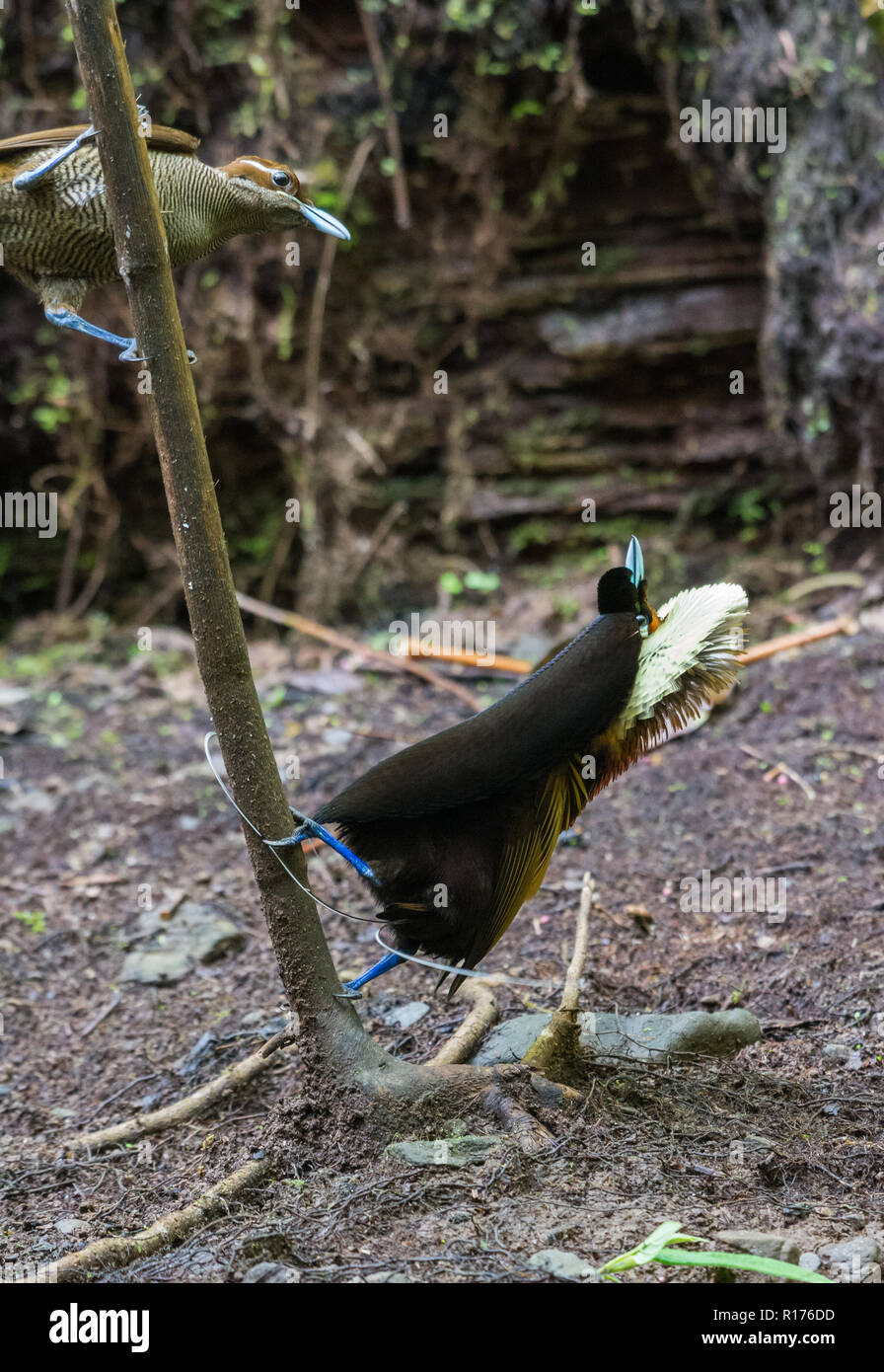
Riflebirds are part of the broader birds-of-paradise family. Male riflebirds often have dark, glossy feathers and perform courtship displays with raised wings and head movements.
Females are generally brown and less glossy. Their shape and color are better suited to nesting and feeding young.
How to Tell a Male and Female Bird of Paradise Apart
The safest approach is to identify the species first. A male and female from two different species may look more alike than a male and female from the same species.
Step 1: Identify the species
Use the bird’s:
- Location
- Habitat
- Body size
- Head shape
- Tail form
- Display feathers
- Call
- Field guide range
Do not begin with color alone. Lighting, age, season, and viewing angle can change how plumage looks.
Step 2: Look for sex-specific ornaments
Ask whether the bird has features known from the adult male of that species, such as:
- Long flank plumes
- A blue breast shield
- Curled tail feathers
- Head wires
- Bright throat feathers
- A large display fan
If the bird lacks those features, it may be female or immature. It is not always safe to call it female immediately.
Step 3: Check age
Young birds may resemble females even when they are genetically male. Many male birds of paradise develop adult display feathers only after more than one molt. A juvenile male can therefore be mistaken for a female.
Look for clues such as:
- Smaller body size
- Incomplete adult plumage
- Soft or worn feathers
- Juvenile streaking
- Behavior that does not match a mature male
Step 4: Observe behavior
A mature male may display from a court or call repeatedly. A female may approach, inspect, and leave. A bird feeding quietly in dense cover is not automatically female, because males also feed and rest.
Behavior helps most when combined with known species traits. It should not replace a field guide or expert review.
Step 5: Use a reliable source
For difficult identifications, compare several sources:
- Cornell Lab of Ornithology
- Smithsonian’s National Zoo and Conservation Biology Institute
- Australian Museum
- Papua New Guinea or Indonesian biodiversity records
- A current regional field guide
- A museum ornithology collection
DNA testing may confirm sex when plumage is unclear, but a home photograph alone usually cannot provide that level of certainty.

Why Male and Female Birds of Paradise Look So Different
The difference is mainly linked to sexual selection and nesting pressure.
Females often choose mates based on color, movement, sound, display quality, or the condition of a male’s court. A male with healthy feathers and strong coordination may signal that he is fit and well fed. Over many generations, female choice can favor more elaborate male traits.
At the same time, females face strong pressure to avoid detection. A female that sits on eggs or feeds nestlings cannot easily escape a predator. Natural selection may therefore favor dull plumage, careful movement, and quiet behavior.
This creates a trade-off:
| Trait | Possible benefit | Possible cost |
|---|---|---|
| Bright male feathers | Attract a mate | Make the bird easier to see |
| Long tail or flank plumes | Improve display | Add weight or limit movement |
| Loud male calls | Reach distant females | Reveal the male’s location |
| Female camouflage | Hide near the nest | Provide less visual appeal during courtship |
| Male display court | Improve visibility | Requires time and energy to maintain |
These are general evolutionary patterns. They do not prove that every female chooses a mate in the same way or that every male has no parental role.

Where Birds of Paradise Live and How They Are Protected
Most birds of paradise live in tropical forests, cloud forests, or nearby woodland habitats in New Guinea and surrounding islands. Several species depend on old forest with tall trees, dense vegetation, or specialized display sites.
The main threats include:
- Forest clearing for agriculture
- Logging and road building
- Mining and infrastructure work
- Hunting in some areas
- Small population ranges
- Climate-related habitat changes
- Illegal wildlife trade
The Convention on International Trade in Endangered Species of Wild Fauna and Flora, or CITES, regulates international trade in many wild bird species. CITES rules do not mean every species has the same population status. Conservation status must be checked species by species through sources such as the IUCN Red List.
People in the United States can help by supporting reputable conservation groups, avoiding products made from protected wildlife, and checking legal rules before buying or importing feathers, specimens, or live birds. A bird-of-paradise feather offered for sale may have an unclear origin, so buyers should ask for legal documentation and avoid unverified wildlife products.
Birds of paradise also benefit from habitat protection led by local communities and conservation programs in their native countries. Protecting forests helps many other species at the same time.

Common Mistakes When Identifying Their Sex
Mistake 1: Calling every brown bird a female
A brown bird may be a female, juvenile, immature male, or a different species. Age and species must be considered.
Mistake 2: Assuming every male is brightly colored
Some males are mainly black or dark brown. Their display may depend on gloss, posture, movement, or a small bright patch rather than an overall bright body.
Mistake 3: Using size as the only clue
Males are often larger, but size differences can be subtle. A small male and a large female may overlap in size.
Mistake 4: Treating the name as a plant reference
The bird family and the bird-of-paradise flower are separate subjects. The flower is a plant in the genus Strelitzia.
Mistake 5: Assuming zoo behavior matches wild behavior
Captive birds may have different space, light, food, social groups, and display opportunities. Their behavior may not represent what happens in the wild.
Mistake 6: Handling feathers or wildlife without checking the law
In the United States, federal and state rules may apply to wildlife parts, imported specimens, and protected species. Do not collect feathers, buy wildlife products, or move a live bird without checking current rules from the U.S. Fish and Wildlife Service and the relevant state agency.

Frequently Asked Questions
Are male birds of paradise more colorful than females?
Usually, yes. Males often have bright, glossy, or highly modified feathers used in courtship. Females are commonly brown or olive and better camouflaged. Some males are mostly dark, so color alone is not a complete test.
Do female birds of paradise choose the male?
In many species, the female evaluates males and chooses whether to mate. She may compare displays, calls, feathers, movement, and the condition of a court. The exact process differs among species.
Do male birds of paradise raise the chicks?
In many species, the female does most or all of the nest work and chick care. Male birds often focus on courtship. This pattern is common but should not be treated as identical across the whole family.
Can a young male look like a female?
Yes. Young males may lack the long feathers, bright colors, or display traits of adult males. A photograph of a brown bird may not be enough to determine its sex.
Are birds of paradise found wild in the United States?
No native birds of paradise live wild across the mainland United States. The family is native mainly to New Guinea, nearby islands, and parts of Australia. People in the United States may see them in accredited zoos, aviaries, museums, or wildlife media.
Conclusion
Male and female birds of paradise often differ because they face different pressures. Males commonly develop dramatic feathers and complex displays to attract mates. Females often retain muted colors that help them hide while nesting and raising young.
The best way to identify sex is to combine species, age, plumage, body shape, and behavior. If those clues conflict, use a trusted species account or seek help from a museum, zoo, ornithologist, or experienced bird guide. The next practical step is to identify the species before deciding whether an individual is male or female.
Sources and Further Reading
- Cornell Lab of Ornithology — Birds of the World
- Smithsonian’s National Zoo and Conservation Biology Institute
- Australian Museum — Birds of Paradise
- IUCN Red List of Threatened Species
- CITES — Convention on International Trade in Endangered Species
- U.S. Fish and Wildlife Service — Migratory Bird Program
