
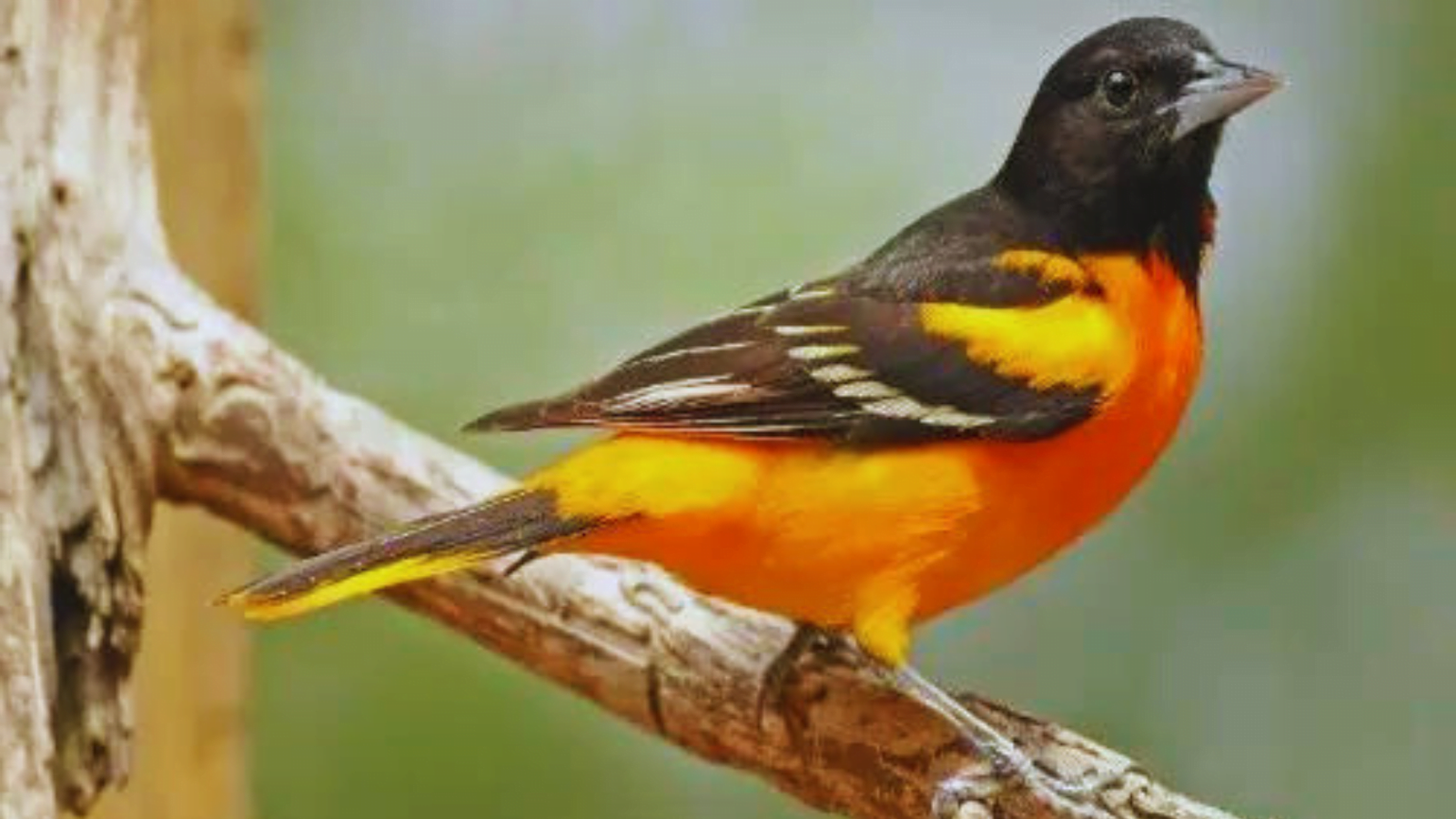
The Baltimore oriole is the bird most people mean when they ask, “What bird is orange and black?” In the United States, the adult male has bright orange underparts, a black head and back, black wings, and white wing bars.
Still, several U.S. birds can look orange and black. The best match depends on the bird’s size, location, season, pattern, and behavior. Western birders may be seeing a Bullock’s oriole, while people in forests may find a black-headed grosbeak, American redstart, or blackburnian warbler.

The Baltimore Oriole Is the Most Likely Answer
The Baltimore oriole (Icterus galbula) is the classic orange-and-black bird of the eastern and central United States. The male is easy to spot because his bright orange breast and lower body contrast with a black head, back, wings, and tail.
Look for these field marks:
- Bright orange breast, belly, and shoulder patches
- Black head and upper back
- Black wings with white wing bars
- Orange sides on the lower back and rump
- Pointed, cone-shaped bill
- Long tail
- Body length of about 7 to 9 inches
The female is less sharply marked. She is often yellow-orange underneath with a dull olive or brown back. Young birds can look even paler, so not every Baltimore oriole has the bold black-and-orange pattern of an adult male.
Baltimore orioles breed across much of the eastern and central United States. They often arrive in spring, build hanging nests in tall trees, and leave for Mexico, Central America, or northern South America in fall. Their range can overlap with the Baltimore oriole range map from the Cornell Lab of Ornithology.
You may find one near:
- Flowering trees
- Woodland edges
- Parks and large yards
- River bottoms
- Fruit trees
- Hummingbird-style nectar feeders
A Baltimore oriole’s sharp, whistled song and habit of searching high tree branches can help confirm the ID. Orange halves and sugar water may attract them, but natural food such as insects, flowers, and ripe fruit is also important.

Other Orange-and-Black Birds in the United States
The right identification depends on the bird’s pattern and where you saw it. Use this table as a quick guide.
| Bird | Where it is most likely in the U.S. | Main orange-and-black pattern |
|---|---|---|
| Baltimore oriole | Eastern and central states | Orange body with a black head and wings |
| Bullock’s oriole | Western states | Orange face and body with black crown, eye line, and throat |
| Black-headed grosbeak | Western states and parts of the Southwest | Orange breast with a black head and dark wings |
| American redstart | Most of the United States during migration or summer | Black body with orange patches on the wings and tail |
| Blackburnian warbler | Eastern forests and parts of the upper Midwest | Small black-and-white warbler with a bright orange throat |
| Eastern towhee | Eastern and southeastern states | Black upper body, rusty sides, and white belly |
| Varied thrush | Pacific Northwest and western mountains | Orange breast and wing stripe with a dark body |
| Red-winged blackbird | Across much of the United States | Black body with red-orange shoulder patches |
The Bullock’s oriole is the closest western counterpart to the Baltimore oriole. The male usually has a bright orange face and body, a black crown and throat, and a bold white wing patch. Its face pattern often looks more sharply divided than that of a Baltimore oriole.
The black-headed grosbeak has a thick bill and a stockier shape. The male’s orange breast, black head, and dark wings may look similar to an oriole from a distance. The grosbeak is mainly a western bird, although it can occur in other areas during migration.
The American redstart is much smaller and more active. Instead of having an orange body, it has orange patches on the sides, wings, and tail. It often spreads and flicks its tail while catching insects.

How to Identify an Orange and Black Bird
Start with the bird’s location and overall shape. Color alone can mislead you, especially in shade or during sunrise and sunset.
1. Check your region
Your state can remove several possibilities at once.
- Eastern and central United States: Baltimore oriole, American redstart, eastern towhee, and blackburnian warbler are possible.
- Western United States: Bullock’s oriole, black-headed grosbeak, and varied thrush become more likely.
- Pacific Northwest: Varied thrush deserves special attention.
- Southeast and parts of the East: Eastern towhee is common in brushy areas.
- Across much of the country: Red-winged blackbirds may show orange-red shoulder patches.
Range is not absolute. Birds migrate, young birds disperse, and unusual records do occur. Treat location as a strong clue, not final proof.
2. Estimate the size
Compare the bird with familiar species.
- Robin-sized: Baltimore oriole, Bullock’s oriole, black-headed grosbeak, or varied thrush
- Sparrow-sized: American redstart or blackburnian warbler
- Larger, crow-like flock bird: Red-winged blackbird may be possible
A small bird with orange flashes is usually not an oriole. A large bird with orange sides and a black body may be an eastern towhee.
3. Look at where the orange appears
The position of the orange is often more useful than the color itself.
- Orange belly and shoulders: Baltimore oriole
- Orange face and lower body: Bullock’s oriole
- Orange breast with a thick bill: Black-headed grosbeak
- Orange wing and tail patches: American redstart
- Orange throat: Blackburnian warbler
- Rusty-orange sides: Eastern towhee
- Red-orange shoulder patch: Red-winged blackbird
- Orange breast and wing bar: Varied thrush
4. Watch the behavior
Behavior can confirm what color suggests.
Baltimore and Bullock’s orioles often forage high in trees. They search flowers, bark, and leaves for insects and may visit fruit or nectar.
American redstarts make quick, sudden movements. They fan their tails and flash orange patches to disturb insects.
Eastern towhees spend more time near the ground. They scratch through leaf litter and favor brush, woodland edges, and dense shrubs.
Blackburnian warblers stay high in mature trees. A glimpse may last only a few seconds, so binoculars and a clear view of the throat are useful.
5. Listen to the call or song
Sound is helpful, but it should support visual evidence rather than replace it.
The Baltimore oriole has a rich, whistled song. The eastern towhee often gives a clear “drink-your-tea” song. The red-winged blackbird has a familiar, harsh “conk-a-ree” call.
For difficult sightings, record the sound if possible. Bird identification apps can offer suggestions, but check the result against range, shape, behavior, and field marks.

Orange and Black Birds by U.S. Region
Eastern United States
The Baltimore oriole is the leading choice in the East, especially in spring and summer. It favors tall trees, open woodland, parks, and backyards with mature vegetation.
In forest interiors, a tiny orange-throated bird may be a blackburnian warbler. In brush and woodland edges, an eastern towhee is more likely. During migration, an American redstart may appear almost anywhere with trees and insects.
Central United States
The central states can host Baltimore orioles, red-winged blackbirds, eastern towhees, and migrating warblers. The bird’s height matters:
- High in a tree with a hanging nest: likely an oriole
- On the ground in leaves: likely an eastern towhee
- Flicking orange tail patches: likely an American redstart
- In wetlands or fields with other blackbirds: possibly a red-winged blackbird
Western United States
The Bullock’s oriole is usually the first species to check in the West. The black-headed grosbeak is another strong possibility, especially in wooded habitats and mountain regions.
In the Pacific Northwest, an orange-breasted bird with a dark back and a distinct breast band may be a varied thrush. This species often stays in shaded forests and may forage on the ground.
Southern United States
Birds in the South can include Baltimore orioles during migration, eastern towhees year-round in some areas, and red-winged blackbirds in wetlands and open fields. Orange-and-black sightings near flowering shrubs may also involve migrating warblers.
Because many species pass through the South, the date of the sighting can be as useful as the location.

Male, Female, and Young Birds May Look Different
A common identification mistake is assuming that every member of a species has the male’s brightest colors. In many orange-and-black birds, males, females, and young birds look different.
Baltimore orioles
Adult males are vivid orange and black. Females are often yellow-orange, olive, or brown, with less contrast. Young birds may lack the adult male’s strong black hood.
Bullock’s orioles
Adult males show the strongest orange and black pattern. Females and immature birds tend to be duller yellow, gray, or brown.
American redstarts
Adult males are mostly black with orange patches. Females and young birds are usually grayish or yellowish, with pale yellow or orange markings.
Black-headed grosbeaks
Adult males have a dark head and rich orange breast. Females and immature birds are brown, buff, and streaked, which can make them look unlike the male.
Eastern towhees
Males have a black head, back, and chest. Females are brown in those areas but still show rusty sides and a pale belly.
If the bird looks orange and brown rather than orange and black, do not dismiss the possibility of a female or immature bird.
Orange and Black Birds That Are Often Confused
Baltimore oriole vs. Bullock’s oriole
These two orioles are the most common source of confusion.
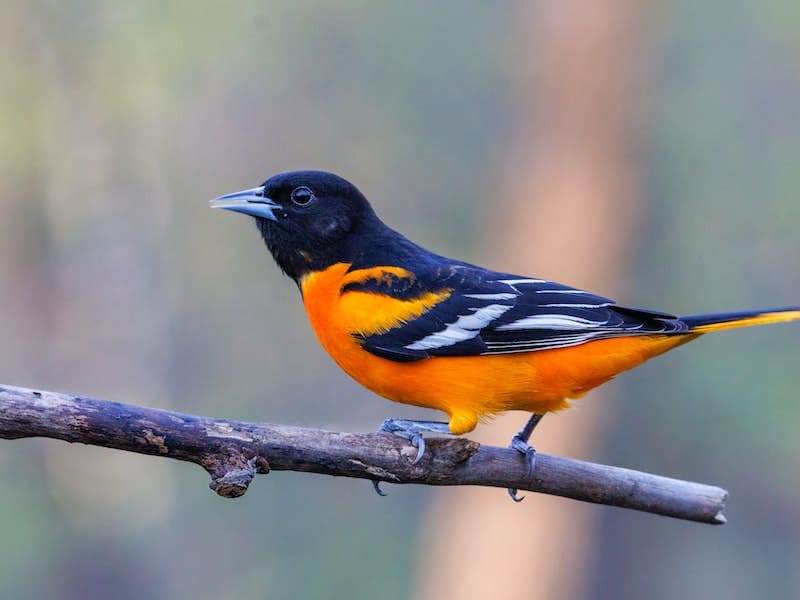
A Baltimore oriole male usually has a fully black head and a broad orange lower body. A Bullock’s oriole male often has orange on the face, a black eye line, and a black throat patch.
Their ranges overlap in parts of the Great Plains and western Great Lakes. In those areas, use several traits together:
- Face color
- Throat pattern
- Wing patch
- Tail pattern
- Geographic location
- Song
Oriole vs. black-headed grosbeak
Both can show orange on the breast and black on the head. The grosbeak has a much thicker, triangular bill. It also tends to look heavier and more compact.
The oriole has a slimmer body and a longer, more pointed bill. It often feeds high in trees, while a grosbeak may forage at different heights and visit seed feeders.
American redstart vs. a small orange bird
A redstart does not have a large orange belly. Its orange color appears as bright flashes on the sides, wings, and tail. It is also smaller and more active than an oriole.
Red-winged blackbird vs. orange-breasted birds
A male red-winged blackbird is almost entirely black. Its red-orange color is usually limited to the shoulder patch, which may be hidden when the wing is folded.
If the whole chest is orange, look first at orioles, grosbeaks, or thrushes instead.

A Simple Identification Checklist
Use this quick process when you see an orange-and-black bird in the United States:
- Record the state or region.
- Note the date and season.
- Estimate the bird’s size.
- Check whether the orange is on the belly, throat, wings, tail, sides, or shoulder.
- Look for a thick bill or a slim pointed bill.
- Watch whether it feeds in trees, shrubs, wetlands, or leaf litter.
- Check the bird’s back, face, and wing pattern.
- Compare the sighting with a trusted field guide or range map.
- Take a photo or note the call if the bird remains uncertain.
A photo with poor lighting can make yellow look orange and dark gray look black. Try to capture the whole bird, not only the brightest patch.
The most reliable identification uses at least three features. For example, “orange belly” alone is weak. “Orange belly, black head, white wing bars, high in a tree, eastern United States” strongly supports a male Baltimore oriole.

Where to Look for These Birds
The habitat often narrows the answer.
- Tall trees and flowering branches: Orioles and warblers
- Woodland edges and dense shrubs: Towhees and redstarts
- Open fields and wetlands: Red-winged blackbirds
- Mountain forests and western woodlands: Black-headed grosbeaks
- Pacific Northwest forests: Varied thrushes
- Fruit-bearing trees: Orioles and thrushes
- Leaf litter under brush: Eastern towhees
Avoid approaching nests or flushing birds repeatedly for a better view. Watch from a distance, keep pets away from nesting areas, and do not use recorded calls near breeding birds for long periods.
If you feed birds, keep feeders clean and remove spoiled fruit. Good habitat matters more than attracting one species. Native trees, shrubs, flowers, and insects support birds throughout the year.

Key Takeaways
- The Baltimore oriole is the most likely orange-and-black bird in the eastern and central United States.
- The Bullock’s oriole is the closest common match in the western United States.
- A thick bill and orange breast suggest a black-headed grosbeak.
- Orange flashes on a small black bird suggest an American redstart.
- An orange throat on a tiny forest bird may identify a blackburnian warbler.
- Rusty sides and a black upper body point toward an eastern towhee.
- Red-orange shoulder patches on an otherwise black bird usually belong to a red-winged blackbird.
- Location, size, pattern, habitat, and behavior are more reliable than color alone.
Frequently Asked Questions
What is the most common orange-and-black bird in the United States?
The Baltimore oriole is the most familiar orange-and-black bird in the eastern and central United States. The Bullock’s oriole fills a similar role across much of the West.
What bird has an orange belly and a black head?
A male Baltimore oriole commonly has an orange belly and a black head. A black-headed grosbeak can look similar, but it has a thicker bill and a stockier body.
What orange-and-black bird has orange wings?
An American redstart has orange patches on its wings and tail. It is smaller and more active than an oriole and often flashes those patches while catching insects.
What bird has a black body with orange shoulders?
A male red-winged blackbird has a mostly black body with red-orange shoulder patches. The patches may appear yellow at the edge or remain hidden when the wings are closed.
Are orange-and-black birds dangerous?
The birds listed here are not dangerous to people. They are wild animals, so observe them without handling them. Do not disturb nests, chicks, or injured birds. For an injured bird, contact a licensed wildlife rehabilitator rather than trying to raise or treat it yourself.
What should I do if I still cannot identify the bird?
Write down the bird’s location, date, size, habitat, colors, bill shape, behavior, and call. Take a photo from a safe distance and compare it with a regional field guide or a trusted bird database such as the Cornell Lab of Ornithology’s All About Birds.
Conclusion
When someone asks what bird is orange and black, start with the Baltimore oriole in the eastern or central United States and the Bullock’s oriole in the West. Then check the bird’s size, orange pattern, bill, habitat, and behavior.
Those clues can separate an oriole from a black-headed grosbeak, redstart, warbler, towhee, thrush, or red-winged blackbird. The next time you see one, note where the orange appears and how the bird moves. That simple habit often turns a quick glimpse into a confident identification.