

Birds use several navigation tools during long-distance flights. These include the Sun, stars, Earth’s magnetic field, landmarks, smell, wind, and memory. Most species do not rely on one cue alone. Instead, they combine signals to choose a direction, stay on course, and find a known breeding or wintering site.
For birds that migrate across the United States, this may mean crossing forests, deserts, oceans, and mountain ranges. A bird such as the Arctic tern may travel between the Arctic and Antarctica, while a ruby-throated hummingbird may cross the Gulf of Mexico. Their routes look precise, but bird navigation is not the same as using a human-made GPS device. It is a flexible system built from senses, instinct, learning, and environmental clues.
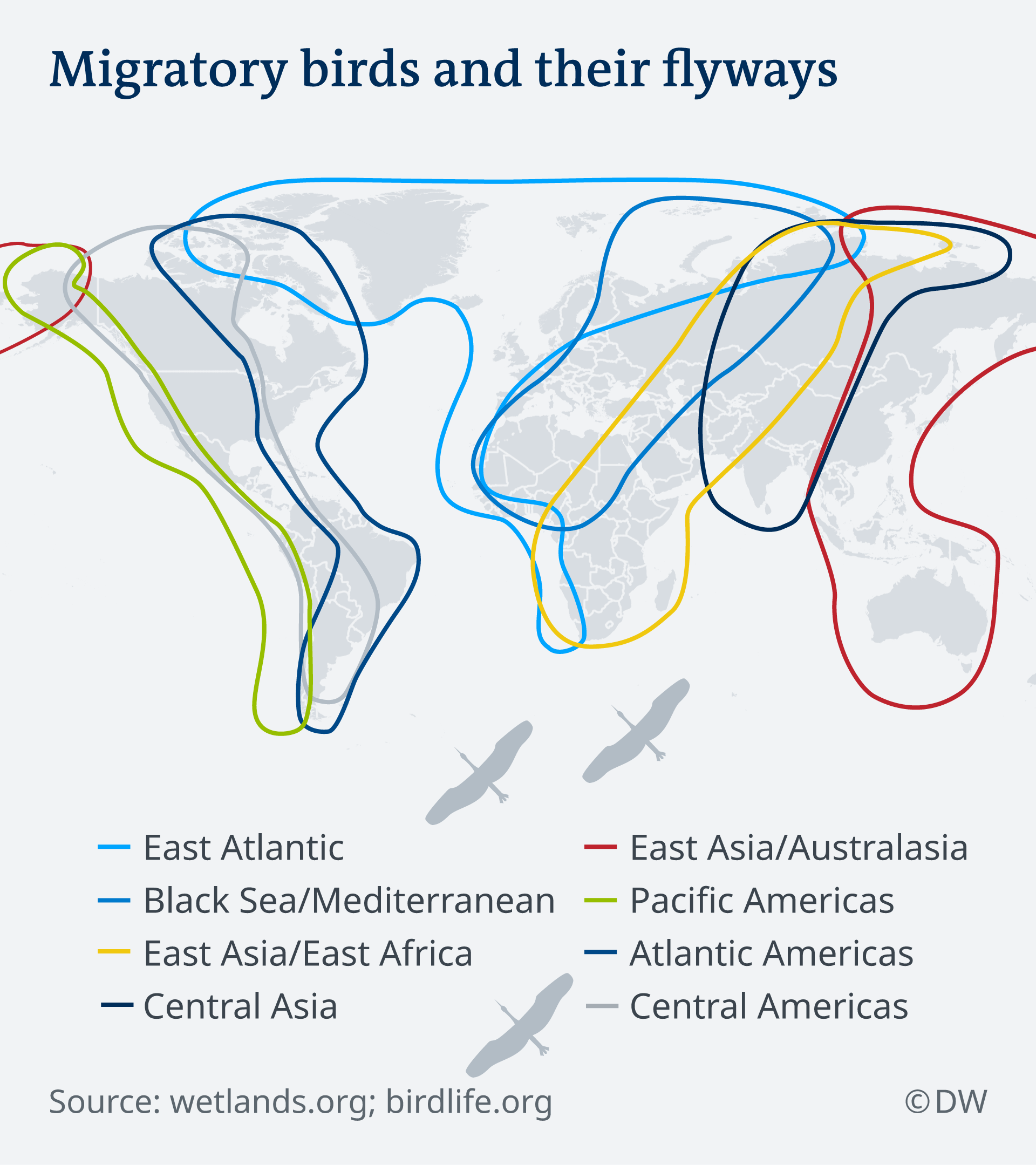
The Main Navigation Tools Birds Use
Birds use the following cues to navigate over long distances:
- The Sun and polarized light
- The stars
- Earth’s magnetic field
- Landmarks and visual memory
- Smells carried by the wind
- Wind direction and weather
- Inherited migration programs and learned route maps
The importance of each cue changes with the species, time of day, weather, age, and location. A daytime migrant may depend more on the Sun and landmarks. A night migrant may use stars and magnetic information. Birds flying over the ocean have fewer visual landmarks, so magnetic, solar, star, smell, and wind cues may become more important.
The best-supported view is that birds use a multi-cue navigation system. If one signal becomes weak or unreliable, another may help fill the gap.

How Birds Use the Sun as a Compass
Birds can use the Sun as a compass because its position changes in a predictable way during the day. A bird can compare the Sun’s position with its internal body clock and use that information to maintain a direction.
This is called a time-compensated sun compass. The bird does not simply fly toward or away from the Sun. It adjusts for the Sun’s movement across the sky.
For example, if a bird learns that south lies to its left when the Sun is in a certain position, it can keep that relationship even as the Sun moves. Its internal clock helps it avoid mistaking the Sun’s daily movement for a change in travel direction.
Polarized light helps when the Sun is hard to see
Birds can also detect patterns of polarized light. These patterns are strongest around the Sun, especially near sunrise and sunset. They may remain visible when clouds or terrain hide the Sun itself.
Polarized light can help a bird determine the general position of the Sun. This gives the bird a useful compass cue during dawn and dusk, when many migratory birds begin or end a flight.
Cloud cover can weaken solar navigation, but it does not always stop migration. Birds can switch to other cues when the Sun is hidden.

How Birds Use the Stars at Night
Many birds migrate at night. For them, the stars provide a large-scale compass.
Young birds do not need to memorize every star. Research suggests that they can learn the pattern of star movement around the celestial pole. In the Northern Hemisphere, stars appear to rotate around a point near Polaris, the North Star. This pattern helps birds identify north and other directions.
A well-known series of experiments by Stephen Emlen found that young indigo buntings raised under different views of the night sky developed different preferred migration directions. Birds raised under a natural starry sky oriented normally. Birds raised under an artificial sky with shifted star patterns changed their orientation to match the new pattern.
This work showed that some birds learn a directional map from the night sky rather than simply following one bright star.
Clouds change the available clues
When thick clouds block the stars, night migrants may rely more on Earth’s magnetic field. Some birds can also adjust their route after clouds clear.
Artificial light creates another problem. Bright city lights can attract or disorient migrating birds, especially during low clouds or fog. The U.S. Fish and Wildlife Service and conservation groups support measures such as reducing unnecessary lights during peak migration periods.

How Earth’s Magnetic Field Guides Birds
Earth’s magnetic field gives birds a global source of directional information. It is present day and night, over land and sea, and in clear or cloudy weather.
Birds may use the magnetic field in at least two different ways:
- As a compass to determine direction.
- As a map to estimate where they are.
A magnetic compass tells a bird which way to travel. A magnetic map may help it recognize a location by detecting features such as magnetic intensity and inclination, which is the angle at which field lines enter Earth.
The magnetic field varies across North America and the rest of the world. These variations may help birds identify broad regions along a migration route.
The magnetic compass may involve vision
Experiments with European robins and other birds show that their magnetic compass can depend on light. This has led researchers to study light-sensitive proteins called cryptochromes in the retina.
One leading model proposes that light activates chemical reactions in cryptochrome molecules. These reactions may form short-lived pairs of molecules whose behavior changes in Earth’s magnetic field. The bird may perceive this information as a visual pattern or directional signal.
This is a strong research area, but the exact sensory process is not fully settled. Scientists continue to study how cryptochrome, the eye, and the nervous system work together.
Magnetite may also play a role
Researchers have found iron-containing particles in bird tissues and have examined whether they can detect magnetic information. Some evidence points to magnetite-based sensing in the beak or other tissues.
However, finding magnetic particles does not by itself prove how a bird uses them. The location, function, and connection to behavior remain subjects of study. It is safest to say that birds detect magnetic information, while the complete biological mechanism is still being resolved.

How Landmarks and Memory Keep Birds on Route
Birds can use visible features to navigate once they have traveled a route before. These features may include:
- Coastlines
- Rivers and lakes
- Mountain ranges
- Forest edges
- Islands
- Roads and other large human-made features
- Familiar feeding and resting sites
Landmarks are especially useful near a bird’s breeding area, stopover sites, and wintering grounds. A bird may recognize a landscape much as a person recognizes a familiar road.
Some birds learn routes from older members of their group. Sandhill cranes, geese, swans, and other social migrants may benefit from following experienced birds. Young birds can also learn the location of food-rich stopover sites over time.
Birds can correct their course
Navigation is not a single decision made before takeoff. Birds can compare their expected position with new information during flight.
If a strong wind pushes a bird east, the bird may adjust its heading west to continue toward its destination. This is called wind compensation. It does not mean the bird flies directly toward the destination at every moment. Instead, it manages drift while moving forward.
A familiar landmark can also help a bird correct an error. If the landscape does not match its memory, the bird may change direction or search for a known feature.

Do Birds Use Smell to Navigate?
Yes. Evidence shows that smell can help some birds navigate over long distances.
Birds may build a map of odors by learning the smell patterns associated with different regions. Winds carry mixtures of natural compounds from forests, soil, vegetation, and the ocean. A bird may compare the smell of the air with its past experience.
Studies of homing pigeons have provided some of the clearest evidence for olfactory navigation. When researchers blocked or altered a pigeon’s ability to smell, its homing performance often changed. These findings suggest that smell can help birds determine location, not just detect food.
Smell may be especially useful near a destination or when visual cues are weak. It is unlikely to be the only navigation system used by most migratory birds.
Researchers continue to debate the exact way birds turn regional odors into a map. Wind direction, local chemistry, experience, and species differences all matter.

How Wind and Weather Affect Migration Routes
Wind does not tell a bird where its breeding or wintering site is, but it strongly affects how the bird gets there. Birds can use wind in several ways:
- Tailwinds increase ground speed and reduce energy use.
- Headwinds slow travel and can make migration more costly.
- Crosswinds push birds off course.
- Thermals help soaring birds gain height with little flapping.
- Weather fronts can create favorable or dangerous flight conditions.
Large birds such as hawks, eagles, and vultures often use rising warm air called thermals. This helps them soar while conserving energy. Their routes may follow mountain ridges, coastlines, and other areas where rising air is common.
Small songbirds may wait for favorable winds before crossing large bodies of water. A bird that leaves at the wrong time may face strong headwinds or become exhausted.
Weather radar used by the National Weather Service can detect large movements of migrating birds. These observations help researchers track migration timing and identify periods when birds are most active.

Do Birds Have an Internal GPS?
Birds do not appear to have a GPS receiver like a smartphone or aircraft. GPS depends on signals from satellites and a receiver that calculates position. Birds use natural signals instead.
Still, the comparison helps explain two different abilities:
- A compass tells a bird which direction to travel.
- A map helps a bird estimate where it is.
Birds may combine magnetic information, smell, landmarks, the Sun, stars, and memory to create a biological navigation system. No single cue appears to explain every migration behavior.
A bird may also use different systems at different stages of a journey. An inherited compass may guide a young bird toward a broad region. Later, landmarks, smell, and memory may help it locate a precise nesting or wintering site.

How Young Birds Know Where to Go
Young birds often begin migration with limited experience. Their first route may depend heavily on inherited instructions.
Some species have a genetically programmed direction and distance. A young bird may be predisposed to fly southwest for a certain period, then change direction. This does not require the bird to know a detailed map.
Other species learn more from parents or flock members. Social learning is common in birds that travel in family groups or follow traditional routes.
Age and experience can improve navigation. Older birds may choose better stopover locations, respond more effectively to weather, and correct errors more quickly. This does not mean young birds cannot migrate successfully. It means experience can make the process more flexible.

What Happens When Navigation Cues Fail?
Bird navigation can be disrupted when natural signals become confusing or unavailable. Common problems include:
- Bright city lights during cloudy nights
- Heavy fog
- Strong crosswinds
- Storms
- Unfamiliar landscapes
- Magnetic disturbances
- Habitat loss at stopover sites
- Noise or light near nesting areas
A bird that becomes disoriented may circle, land in an unsuitable place, or arrive at the wrong time. Exhaustion and poor weather can also increase the risk of collision or predation.
Light pollution is a major concern for night migrants in the United States. Turning off unnecessary outdoor lights during migration periods can reduce one source of confusion. Window collisions are another serious risk, especially in cities. Bird-safe glass treatments, exterior screens, and reduced nighttime lighting can help.
People should not try to capture or handle a disoriented wild bird unless it is injured and local wildlife guidance recommends action. Contact a licensed wildlife rehabilitator for an injured bird.

Navigation Cues at a Glance
The table below summarizes what each cue can do and where it may be most useful.
| Navigation cue | What it provides | Useful conditions | Main limitation |
|---|---|---|---|
| Sun | Directional compass | Daylight, partly clear skies | Hidden by clouds; requires time compensation |
| Polarized light | Sun position clues | Dawn, dusk, thin cloud | Less useful in darkness |
| Stars | Nighttime compass | Clear night sky | Blocked by clouds and city glare |
| Magnetic field | Direction and possible location clues | Day or night; land or sea | Exact sensing mechanism is still studied |
| Landmarks | Position and route memory | Familiar landscapes | Limited over open ocean or unknown terrain |
| Smell | Regional location clues | Airflow carries stable odor patterns | Depends on wind, chemistry, and experience |
| Wind | Speed, drift, and energy information | Favorable weather | Can push birds off course |
| Memory and learning | Precise route decisions | Repeated journeys | Young birds have less experience |
The key point is not that one cue is “best.” A bird’s success comes from combining cues and changing tactics when conditions change.

Common Myths About Bird Navigation
Birds simply follow the leader
Some birds do follow older or more experienced birds, but this is not true for every species. Many young birds migrate alone or with little help from adults. Their inherited orientation program and sensory systems can guide the first journey.
Birds always fly in a straight line
Migration routes often bend around mountains, deserts, storms, coastlines, and areas with poor wind conditions. A curved route may be safer or require less energy than a straight one.
Birds use only Earth’s magnetic field
Magnetic sensing is important, but birds also use sunlight, stars, landmarks, smell, wind, and memory. Removing one cue does not necessarily remove all navigation ability.
Birds can never get lost
Birds can become disoriented. Bad weather, artificial light, habitat changes, and strong winds can interfere with normal navigation. Migration is highly effective, but it is not perfect.
All migrating birds use the same system
Species differ. A soaring hawk, a seabird, a songbird, and a shorebird may use different combinations of cues because they fly at different times, over different habitats, and with different energy needs.

Frequently Asked Questions
How do birds know where to migrate?
Birds use inherited direction programs, Earth’s magnetic field, the Sun, stars, landmarks, smell, wind, and memory. The balance depends on the species and its experience.
Can birds navigate at night?
Yes. Many birds migrate at night using stars, magnetic information, polarized light near dusk or dawn, and possibly odors and sound. Night travel can reduce heat stress and predation for some species.
Can birds navigate over the ocean?
Yes. Seabirds and other migrants can cross oceans. They may use magnetic cues, the Sun, stars, wind, smell, and memory. Islands and coastlines can provide landmarks when they are visible.
Do birds use the Moon to navigate?
The Moon may provide light and visual information in some situations, but it is not considered the main navigation cue for most migrating birds. The Sun, stars, magnetic field, landmarks, smell, and wind have stronger support.
How do birds find the exact same place each year?
Birds may combine a broad inherited compass with learned landmarks, local smells, magnetic features, and memory. Older birds often have more route experience, which can help them return to a specific nesting or wintering area.

Key Takeaways
- Birds use multiple navigation cues, not one built-in GPS.
- The Sun helps provide a daytime compass.
- The stars help many birds set direction at night.
- Earth’s magnetic field works in darkness and across oceans.
- Landmarks, smell, wind, and memory help birds refine their route.
- Young birds may rely more on inherited programs, while older birds benefit from experience.
- Weather, artificial light, and habitat loss can disrupt migration.
Conclusion
Birds navigate long-distance flights with a flexible system that joins instinct and learning. The Sun and stars offer compass clues. Earth’s magnetic field works across large areas. Smell, landmarks, wind, and memory help birds adjust their course and reach familiar places.
The most accurate answer is simple: birds use many natural signals together. That combination allows them to cross the United States, oceans, and continents without a human-made map or satellite receiver.