

Black and orange birds in the northeastern United States include Baltimore Orioles, Eastern Towhees, American Redstarts, Blackburnian Warblers, Orchard Orioles, and Eastern Flickers. The best clue is where the orange appears: on the belly, sides, throat, wings, tail, or underwings.
Color can change with age, sex, season, light, and wear. A female or young bird may look yellow, brown, or gray instead of bright orange. Use habitat, size, behavior, and markings along with color for a reliable identification.

Quick identification table
The table below compares the most likely black and orange birds found in the Northeast.
| Species | Where the orange appears | Usual Northeast habitat | Best clue |
|---|---|---|---|
| Baltimore Oriole | Belly, shoulders, rump, and tail | Open woods, tall trees, parks, yards | Bright orange body with a solid black head |
| Eastern Towhee | Sides and flanks | Brush, forest edges, thickets | Black upper body, white belly, rusty orange sides |
| American Redstart | Wing patches and tail | Deciduous forests and woodland edges | Flicks its black-and-orange tail and wings |
| Blackburnian Warbler | Throat and face | Mature conifer and mixed forests | Adult male has a vivid orange throat |
| Orchard Oriole | Chest, belly, and shoulder | Open woodland, riversides, farms | Smaller, slimmer oriole with chestnut-orange underparts |
| Eastern Flicker | Underwings and tail shafts | Woodlands, lawns, and suburban areas | Orange flashes appear during flight |
The Baltimore Oriole is usually the clearest match for a bird that looks black and orange from a distance. The Eastern Towhee is more likely if the orange is limited to the sides. A bird with orange only in the wings or tail may be an American Redstart or Eastern Flicker.
1. Baltimore Oriole
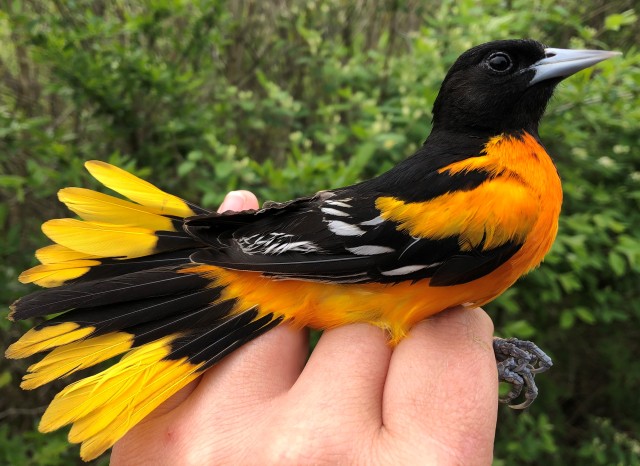
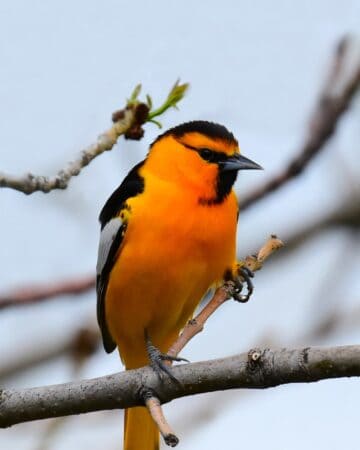
The male Baltimore Oriole is one of the most recognizable black and orange birds in the eastern United States. It has a black head, back, wings, and tail, with strong orange on the underparts, shoulders, and rump.
Adult males often show a bright orange breast and belly. A wide white wing bar can appear on the folded wing. Females and young birds are less sharply marked and may look yellow-orange with olive or gray-brown backs.
Where and when to find it
Baltimore Orioles arrive in the Northeast during spring migration. They breed in many parts of New England, New York, Pennsylvania, New Jersey, and nearby states before leaving for Central America and northern South America in fall.
Look for them in:
- Tall shade trees
- Open woodland
- Forest edges
- Parks and large yards
- River corridors
- Mature trees near fields
They often stay high in the canopy. Their clear, flute-like song may reveal them before you see them.
How to separate it from an Orchard Oriole
Baltimore Orioles are larger and usually show a stronger orange color. Orchard Orioles are slimmer and often look dark chestnut rather than bright orange. A Baltimore Oriole also has a more noticeable orange belly and rump.
The Cornell Lab of Ornithology describes the Baltimore Oriole as a canopy bird that feeds on insects, fruit, and nectar. This behavior explains why it often visits flowering trees and fruiting plants rather than ground-level feeders.
2. Eastern Towhee
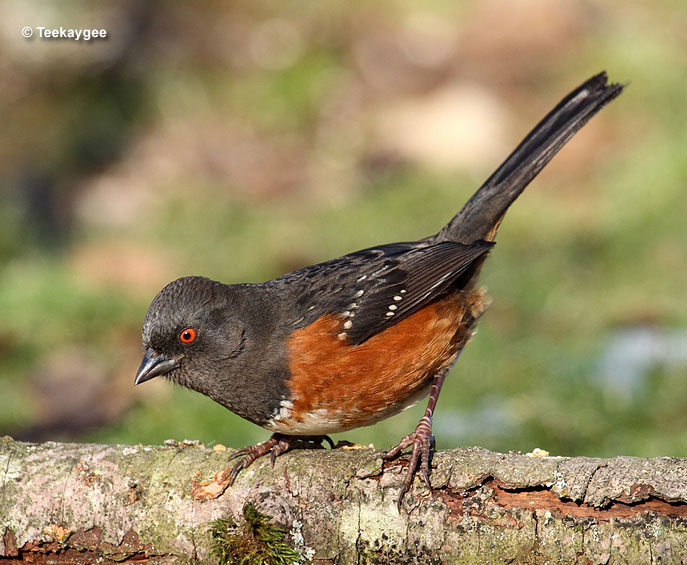
The male Eastern Towhee has a black head, throat, back, and upper breast. Its sides are warm orange or rusty red, while the belly is white. This pattern makes it a common answer when people describe a black and orange bird in the Northeast.
The female has the same pattern but replaces black with warm brown. Young birds are also brown and may show weaker side markings.
Where and when to find it
Eastern Towhees prefer dense, low cover rather than high tree crowns. Search in:
- Shrublands
- Bramble patches
- Forest edges
- Overgrown fields
- Brush piles
- Mountain laurel and blueberry thickets
They often scratch through leaf litter with both feet. Their call sounds like “drink your tea,” followed by a buzzy trill.
Towhees are year-round residents in parts of the southern and coastal Northeast. Birds farther north may migrate south in winter. Their numbers and timing vary by location and weather.
A key identification feature
The white belly helps separate an Eastern Towhee from an oriole. An oriole usually shows orange across much of the underside. A towhee keeps the orange mainly on the sides and shows a clear white center.
3. American Redstart
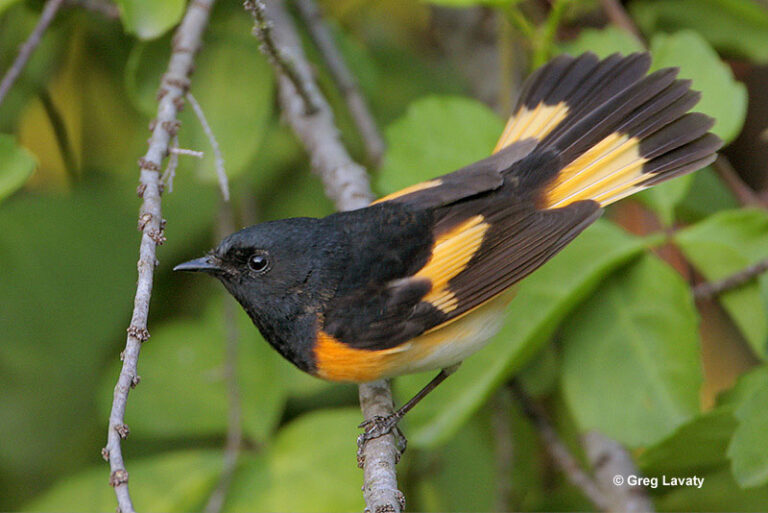
The male American Redstart is mostly black with bright orange patches on the sides, wings, and tail. It is small, active, and often hard to watch for long because it moves quickly through leaves.
The orange patches work like small flags. The bird repeatedly fans or flicks its tail and wings, which may startle insects into motion.
Females and young redstarts are olive-gray with yellow patches instead of black and orange. This difference causes many birders to miss the connection between adult males and other members of the species.
Where and when to find it
American Redstarts breed in leafy forests across much of the Northeast. They favor:
- Moist deciduous woods
- Streamside forests
- Second-growth woodland
- Forest edges
- Shaded parks during migration
They feed mainly on insects and often forage in the middle or lower parts of trees. Watch for quick wing flicks, short flights, and repeated returns to the same perch.
How to tell it from a Blackburnian Warbler
Both birds can show black and orange. The American Redstart has orange on its wings and tail. The Blackburnian Warbler has its strongest orange on the throat and face.
The redstart is also more likely to flick its tail often. The Blackburnian Warbler usually looks more deliberate as it moves through the upper canopy.

4. Blackburnian Warbler
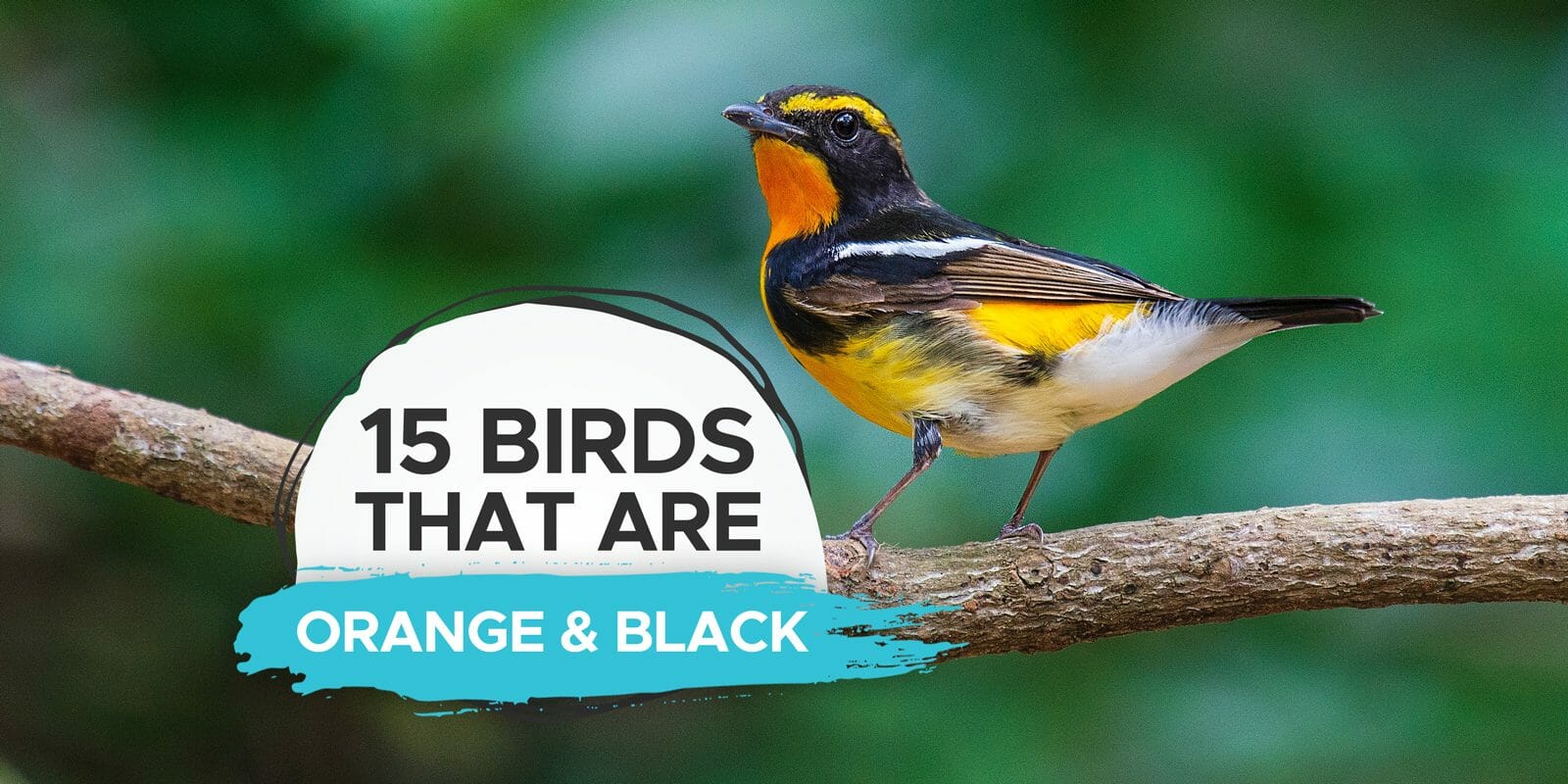
The adult male Blackburnian Warbler has black upperparts, white wing markings, and a striking orange throat. The orange can extend up the face toward the eye, making this one of the most vivid black and orange birds in eastern North America.
Females and immature birds are much less dramatic. They are yellow-green, gray, or olive with pale wing bars. Their throat is usually yellow rather than bright orange.
Where and when to find it
Blackburnian Warblers are linked to mature conifer and mixed forests. In the Northeast, they are especially associated with northern forests and higher elevations, though migration can bring them through many wooded areas.
Look for them:
- In tall spruce and fir trees
- Along mountain slopes
- In mature mixed forests
- During spring and fall migration
They often forage high in the canopy, so binoculars help. Their thin, high song can be difficult to hear in wind or dense foliage.
The orange-throat test
If the bird has a strong orange throat and black face, consider a male Blackburnian Warbler first. If the orange appears mainly on the wings and tail, consider an American Redstart instead.
Because warblers are small and fast, habitat and season matter. A large orange-and-black bird in a shade tree is probably not a Blackburnian Warbler.
5. Orchard Oriole
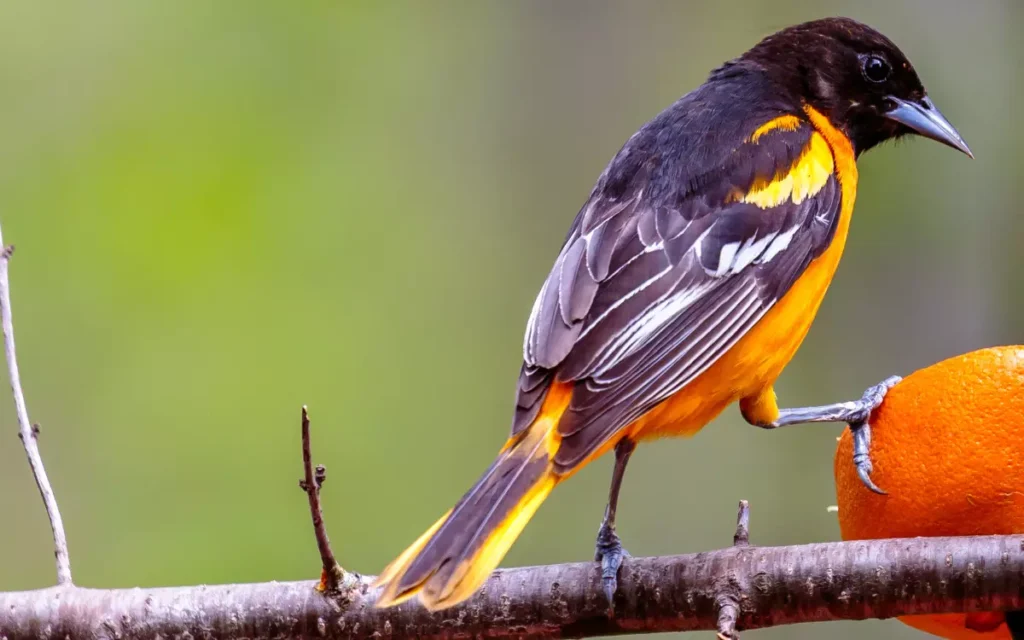
The male Orchard Oriole is dark on the head and back, with chestnut or orange-red underparts. It may look almost black and copper in poor light. It is smaller and more slender than a Baltimore Oriole.
The adult male usually has a black throat and upper chest, dark wings, and chestnut coloring across the lower body. Females are yellow-green and can be mistaken for female Baltimore Orioles.
Where and when to find it
Orchard Orioles favor open habitats with scattered trees. In the Northeast, check:
- Orchards
- Farms
- Park edges
- Riverbanks
- Open woodland
- Large yards with mature trees
They often sit lower than Baltimore Orioles. Their diet includes insects, fruit, and nectar.
Orchard Orioles are less widespread and often less common in the Northeast than Baltimore Orioles. Local habitat and the season can strongly affect the chance of seeing one.
Orchard Oriole or Baltimore Oriole?
Use these differences:
- Size: Orchard Orioles are smaller and slimmer.
- Color: Orchard Orioles are often chestnut or brick-orange; Baltimore Orioles are usually brighter orange.
- Pattern: Orchard Orioles have more dark color across the upper chest.
- Habitat: Orchard Orioles often use open woodland and orchards.
- Female color: Both species can have yellow-green females, so shape and habitat become more useful.
6. Eastern Flicker
The Eastern Flicker is not a black-and-orange bird at first glance. Its back is brown with black bars, and its chest has dark spots. However, orange shafts under the wings and tail flash clearly when it flies.
This hidden color is the key field mark. A flying flicker may suddenly show a bright orange burst that disappears when the bird lands.
Where and when to find it
Eastern Flickers use a wide range of habitats, including:
- Lawns
- Open woods
- Woodland edges
- Suburban neighborhoods
- Parks
- Dead trees and snags
They often feed on the ground, where they search for ants and other insects. Their slightly curved bill helps them probe soil and leaf litter.
The Eastern Flicker also has a bold black crescent on the upper breast, a spotted belly, and a brown-barred back. These features separate it from orioles and warblers.
Orange or yellow underwings?
The Eastern Flicker is the eastern form, which usually shows orange under the wings and tail. Western flickers more often show yellow. In areas where ranges meet, underwing color can be less reliable, so the bird’s location and full pattern should also be considered.
How to identify a black and orange bird in the Northeast
Start with the bird’s size, then find the exact location of the orange. This works better than relying on color alone.
Step 1: Estimate size
Compare the bird with familiar birds:
- Sparrow-sized: American Redstart or Blackburnian Warbler
- Robin-sized: Eastern Towhee
- Robin-sized but slimmer: Orchard Oriole
- Robin-sized or larger: Baltimore Oriole
- Crow-like in flight: Eastern Flicker may appear larger because of its long wings
Size estimates can be difficult at a distance. Use them as a guide, not a final answer.
Step 2: Locate the orange
Ask where the orange appears:
- Belly and shoulders: Baltimore Oriole
- Sides with a white belly: Eastern Towhee
- Wings and tail: American Redstart
- Throat and face: Blackburnian Warbler
- Chest and lower body: Orchard Oriole
- Underwings during flight: Eastern Flicker
Step 3: Study the habitat
Habitat can narrow the choice:
- High in a tall shade tree: Baltimore Oriole
- Low in thick brush: Eastern Towhee
- Fast movement in leafy woodland: American Redstart
- High in spruce or fir: Blackburnian Warbler
- Open farm or orchard: Orchard Oriole
- On a lawn or tree trunk: Eastern Flicker
Step 4: Check behavior and sound
Behavior often confirms what color suggests. A towhee scratches in leaf litter. A flicker feeds on the ground. An oriole stays in the canopy. A redstart flicks its wings and tail while hunting insects.
If you use a birding app, enter the location, date, habitat, and visible marks. Do not choose a result based only on the color label.
Seasonal timing in the Northeast
Season changes the list of likely birds. Many black and orange birds are summer visitors, while others remain through winter.
| Season | Birds most likely to appear |
|---|---|
| Early spring | Migrating orioles, redstarts, Blackburnian Warblers, and towhees |
| Late spring and summer | Breeding Baltimore Orioles, Orchard Orioles, Eastern Towhees, redstarts, and Blackburnian Warblers |
| Fall | Southbound migrants, including warblers and orioles |
| Winter | Eastern Towhees in southern areas; Eastern Flickers and some other species depending on local conditions |
Migration dates are not fixed. Weather, latitude, elevation, and food supply can change when birds arrive or leave.
A bird seen in coastal New Jersey in January may not be as likely in northern Maine during the same month. Local checklists from state wildlife agencies, Audubon chapters, or eBird can help confirm what is realistic for a specific place and date.
Common look-alikes and identification mistakes
Color alone can lead to mistakes. Several birds may look orange because of sunlight, autumn leaves, or warm brown feathers.
Red versus orange
Some birds that look orange may actually be red or chestnut. The Eastern Towhee’s sides are often described as rufous, rusty, or orange-brown. Orchard Oriole feathers may look red-orange rather than pure orange.
Female and young birds
Female Baltimore Orioles, Orchard Orioles, and American Redstarts do not match the bold colors of adult males. Young birds may be even duller.
If a bird has the right shape and habitat but lacks black plumage, do not rule out the species at once. Check the wing bars, tail pattern, bill shape, and behavior.
Sunlight and backlighting
Warm evening light can make brown feathers look orange. Backlighting can hide black areas and make a bird appear less patterned. Wait for the bird to move into even light when possible.
American Robin confusion
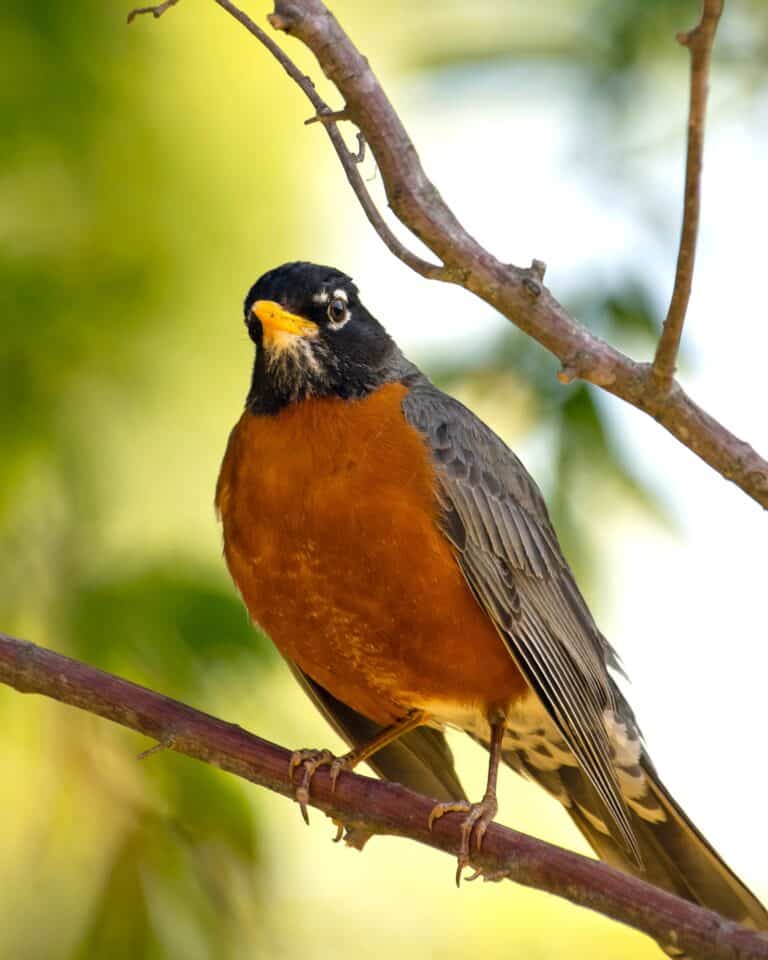
American Robins have orange-red breasts but gray backs, not black backs. A robin seen in shadow may appear darker, but it does not normally show the clean black-and-orange pattern of a Baltimore Oriole or Eastern Towhee.
Red-winged Blackbird confusion
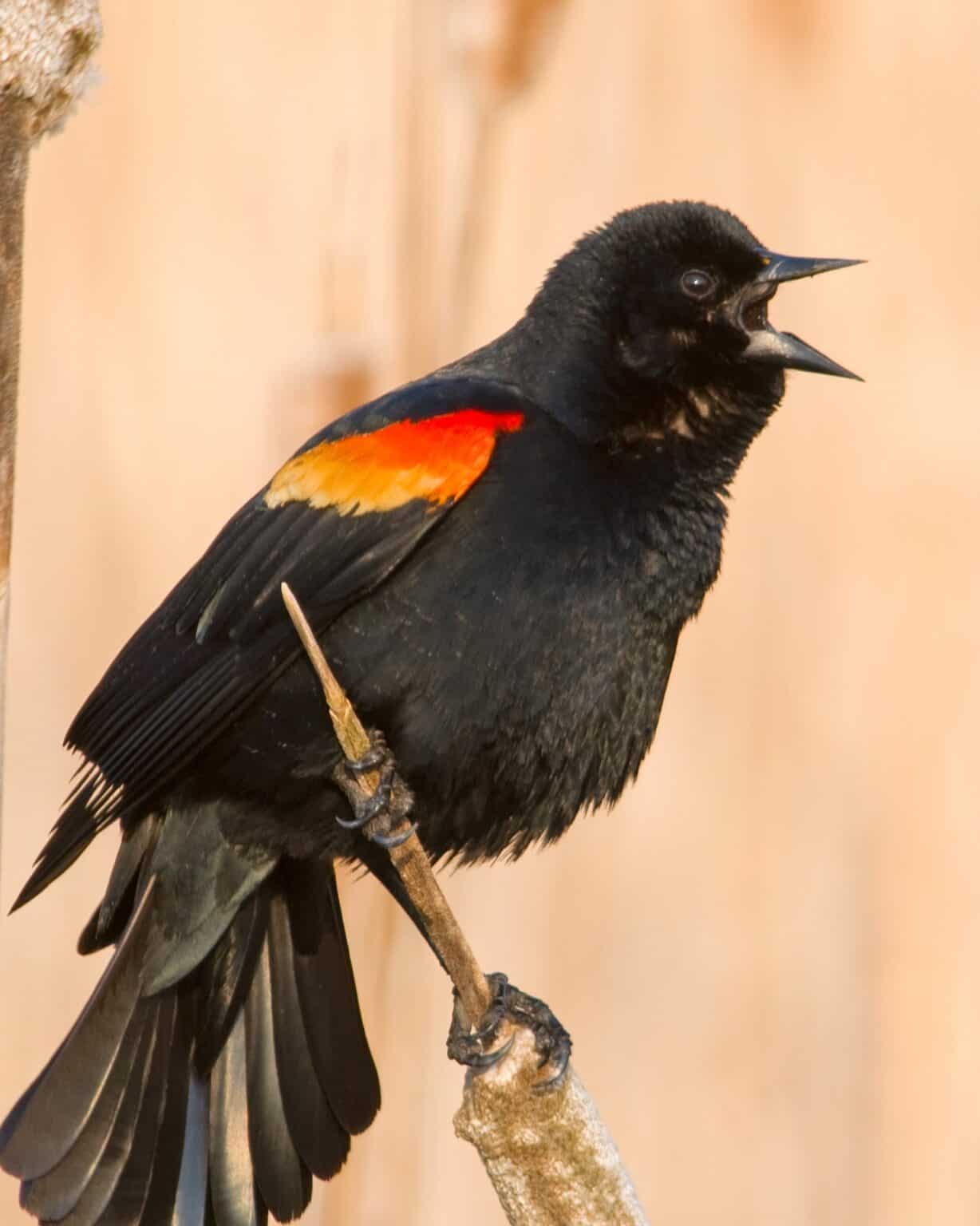
Male Red-winged Blackbirds are mostly black with red and yellow shoulder patches. The yellow edge can look orange at a distance. If the color is limited to a small shoulder patch, consider a Red-winged Blackbird rather than an oriole.
How to watch these birds safely
Birdwatching does not require close contact. Keep a respectful distance and avoid actions that cause a bird to flee, stop feeding, or abandon cover.
Follow these basic practices:
- Use binoculars instead of approaching.
- Stay on marked trails where possible.
- Keep cats indoors or use a secure outdoor enclosure.
- Avoid playing bird calls near nesting birds.
- Do not handle a wild bird unless a licensed wildlife rehabilitator directs you.
- Keep feeders and birdbaths clean.
- Stop feeding temporarily if sick birds gather around a feeder.
- Do not feed birds bread, salty foods, or spoiled fruit.
For an injured or grounded bird, contact a licensed wildlife rehabilitator or state wildlife agency. Young birds on the ground are often still being cared for by their parents, so watch from a distance before taking action.

Research basis and limits
The species descriptions in this guide are based on established field marks, habitat information, and range accounts from the Cornell Lab of Ornithology, the National Audubon Society, and the U.S. Fish and Wildlife Service. These sources support identification features such as plumage patterns, food habits, habitat, and migration.
No single field mark works in every case. Plumage changes with age, sex, season, feather wear, and lighting. Range boundaries also overlap and can shift with local weather and habitat conditions.
For a final identification, record the location, date, size, habitat, behavior, call, and the exact place where orange appears on the bird. A clear photo from a safe distance can then be compared with a regional field guide or submitted to a reputable birding database.

Frequently asked questions
What is the most common black and orange bird in the Northeast?
The Baltimore Oriole is one of the most familiar black and orange birds in the Northeast during spring and summer. It is especially likely in areas with tall trees, open woodland, parks, and mature yards.
Which black bird has orange sides?
The male Eastern Towhee has black upperparts and rusty orange sides. Its white belly and habit of scratching through leaf litter are useful clues.
What bird has an orange throat and black feathers?
A male Blackburnian Warbler has a bright orange throat, black upperparts, and white wing markings. It is a small forest bird that often stays high in mature trees.
Are black and orange birds common in winter in the Northeast?
Some are. Eastern Towhees may remain in the southern and coastal Northeast, while Eastern Flickers can be present in many areas. Baltimore Orioles, Orchard Orioles, and many warblers usually migrate away from the northern Northeast for winter.
How can I identify a bird if the colors are unclear?
Start with size and habitat. Then check the orange location, wing bars, tail shape, bill shape, behavior, and call. If possible, take a photo and compare it with a regional guide using the exact date and location.
Conclusion
The fastest way to identify black and orange birds in the Northeast is to ask three questions: How large is the bird? Where is the orange? What is the bird doing?
A bright orange body and black head point toward a Baltimore Oriole. Orange sides with a white belly suggest an Eastern Towhee. Orange wings and tail fit an American Redstart, while an orange throat suggests a Blackburnian Warbler. Chestnut underparts may indicate an Orchard Oriole, and orange underwings seen in flight often belong to an Eastern Flicker.
Use color as the starting clue, then confirm the bird with habitat, behavior, season, and full plumage pattern.