

In the United States, a bird described as a blackbird with an orange head is most often an oriole, redstart, flycatcher, or another dark bird with orange feathers. No single common U.S. bird matches that description in every region. The best match depends on the bird’s size, habitat, head pattern, wing markings, and location.
The most likely species is the Bullock’s Oriole, especially in the western United States. Other possibilities include the American Redstart, Black-and-orange Flycatcher, Varied Thrush, and some birds with orange bills that may look orange-headed from a distance.
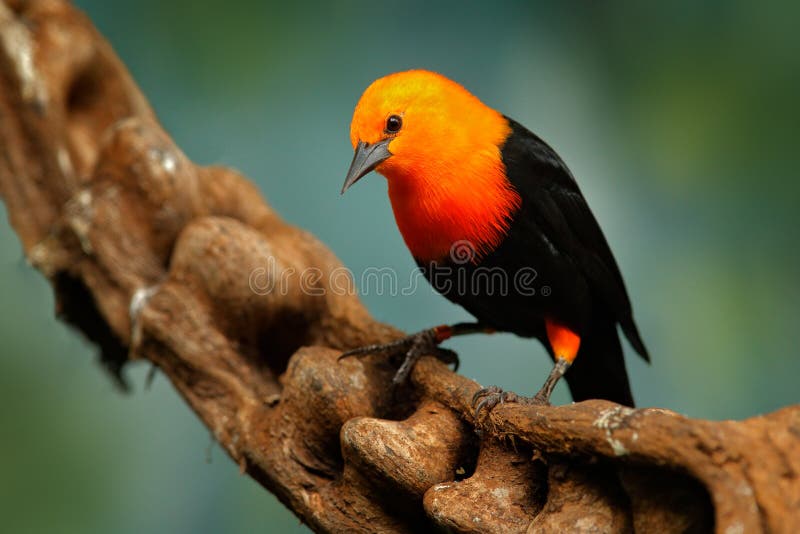
The Most Likely Match: Bullock’s Oriole
The Bullock’s Oriole (Icterus bullockii) is the leading answer for many U.S. sightings of a black bird with an orange head.
Adult males have:
- A black crown, eye line, throat, and back
- A bright orange face and underparts
- White wing patches
- A long, pointed bill
- A slim body and long tail
The orange may look like it covers the whole head when the bird faces away or sits in strong light. In fact, the black crown and eye stripe often divide the orange face from the rest of the head.
Bullock’s Orioles breed mainly in the western half of the United States. They favor open woodland, river groves, parks, farms, and neighborhoods with tall trees. They often hang from branches while searching for insects, fruit, and nectar.
How to tell a Bullock’s Oriole from similar birds
Look for the combination of orange face, black eye line, white wing patch, and slim oriole shape. The bird is usually larger and longer-tailed than a sparrow but smaller and slimmer than a crow.
A male Bullock’s Oriole may also show:
- Orange shoulders
- A black throat patch
- A large white wing bar
- A pointed, slightly curved bill
- A sharp, flute-like song
Females and young birds look much duller. They may be yellow, olive, or gray rather than black and orange. This difference can make it seem as though two unrelated birds are present.

Other U.S. Birds That May Look Black and Orange
Several North American birds can look black with orange on the head or upper body. Use the table below as a quick guide.
| Possible bird | Where it occurs in the U.S. | Orange pattern | Key clue |
|---|---|---|---|
| Bullock’s Oriole | Western states | Orange face and body with black crown and back | White wing patch and long tail |
| American Redstart | Most of the U.S. during migration or breeding | Orange patches on sides, wings, and tail | Fans its tail and flashes orange |
| Black-and-orange Flycatcher | Not a normal wild U.S. species | Orange belly with dark upperparts | Usually points to a mistaken location or ID |
| Varied Thrush | Pacific Northwest and Alaska | Orange eyebrow, wing bars, and belly | Round thrush shape and bold eye stripe |
| Blackburnian Warbler | Eastern and northern forests | Orange throat and dark crown | Very small, active songbird |
| Red-winged Blackbird | Most of the U.S. | Red-orange shoulder patch, not an orange head | Often seen in marshes and fields |
| european Blackbird | Rare or local introduced records in North America | Orange-yellow bill and eye ring | Entire body is dark, but the head is not orange |
American Redstart
The American Redstart is a small warbler with a mostly black body in adult males. It has bright orange patches on the sides, wings, and tail.
It does not have an orange head. However, a quick view of its orange cheek or throat patch can create that impression. The bird often spreads or flicks its tail, making the orange markings flash like small sparks.
American Redstarts live in wooded areas, especially near streams and damp forests. They are much smaller than orioles and move with quick, restless motions.
Varied Thrush
The Varied Thrush is common in parts of the Pacific Northwest. The male has dark blue-gray or blackish upperparts, a rich orange breast, and an orange or rust-colored eyebrow stripe.
From below or in dim forest light, the orange eyebrow can make the bird seem orange-headed. Its body is rounder than an oriole’s, and it often stays low in dense woodland.
The Varied Thrush has a strong, clear song with single, ringing notes. It is most likely if the sighting took place in Washington, Oregon, western British Columbia, or Alaska.
Blackburnian Warbler
The male Blackburnian Warbler has a black crown and back with a brilliant orange throat. The orange is often the first feature people notice.
This bird is tiny and active. It usually stays high in mature trees, where it searches for caterpillars and other insects. It is most common in the eastern and northern United States during the breeding season and migration.
If the bird was very small and moved rapidly through the tree canopy, a Blackburnian Warbler may fit better than an oriole.
Red-winged Blackbird
The Red-winged Blackbird is one of the most common black birds in the United States. Adult males are glossy black with a red and yellow shoulder patch.
The patch can look orange in bright sun or from far away. It is located on the wing, not the head. This bird is common in marshes, wet fields, roadside ditches, and grasslands.
If the bird called loudly from a reed or fence post and showed a red-orange shoulder, it was likely a Red-winged Blackbird.

A Simple Identification Process
You can narrow down the bird by checking five traits: location, size, color placement, habitat, and behavior.
1. Check where you saw it
Location can remove many possibilities.
- Western United States: Bullock’s Oriole is a strong possibility.
- Eastern forests: American Redstart or Blackburnian Warbler may fit.
- Pacific Northwest: Varied Thrush becomes more likely.
- Marshes and wet fields: Red-winged Blackbird is common.
- Desert Southwest: Scott’s Oriole may be worth checking.
- Outside North America: Orange-headed Thrush may be possible.
Range is helpful, but it is not absolute. Birds migrate, young birds wander, and rare visitors can appear far from their usual range.
2. Estimate the size
Try to compare the bird with a familiar species.
- Sparrow-sized: Blackburnian Warbler or American Redstart
- Robin-sized: Varied Thrush
- Robin-sized but longer and slimmer: Bullock’s Oriole
- Larger, heavy-bodied field bird: Red-winged Blackbird
Size estimates can be difficult when the bird is high in a tree. Use the bill and tail as extra clues.
3. Find the orange
Ask where the orange feathers were located.
- Face and lower body: Bullock’s Oriole
- Throat: Blackburnian Warbler
- Sides and tail: American Redstart
- Eyebrow and breast: Varied Thrush
- Shoulder patch: Red-winged Blackbird
- Bill and eye ring: European Blackbird
This step is often more useful than the phrase “orange-headed bird.” A bird’s color pattern is more reliable than a broad color label.
4. Watch the behavior
Behavior can support an identification.
- Hangs upside down or searches flowers and fruit: Oriole
- Flicks the tail and flashes orange: American Redstart
- Moves high in conifers: Blackburnian Warbler
- Walks on the ground in forest shade: Varied Thrush
- Calls from a reed, post, or fence: Red-winged Blackbird
Do not rely on behavior alone. Many birds share the same feeding habits.
5. Listen to the call
A recording is useful, but a call heard once can be misleading.
Bullock’s Orioles often give chattering calls and clear whistles. Red-winged Blackbirds have a distinctive, nasal “konk-a-ree” song. Varied Thrushes produce short, ringing notes. Warblers often give thin, high calls that are harder to hear.
A phone recording, even a poor one, may help an identification app. Treat the app’s result as a suggestion, not proof.

How to Separate a Bullock’s Oriole From a Baltimore Oriole
People often confuse Bullock’s Orioles with Baltimore Orioles. Both are black-and-orange birds, but their ranges and patterns differ.
Bullock’s Oriole
Bullock’s Orioles are most common in the western United States. Males often show:
- An orange face
- A black eye stripe
- A black crown
- A black back
- Large white wing patches
- Orange underparts
Baltimore Oriole
Baltimore Orioles are most common in the eastern United States. Adult males usually have:
- A black head
- A black upper back
- Orange shoulders
- Orange underparts
- White wing bars
- No broad orange face like a Bullock’s Oriole
A bird with an orange face and black eye stripe is more likely to be a Bullock’s Oriole. A bird with a fully black head and orange belly is more likely to be a Baltimore Oriole.
The two species overlap in parts of the Great Plains. In that region, location alone may not solve the identification.
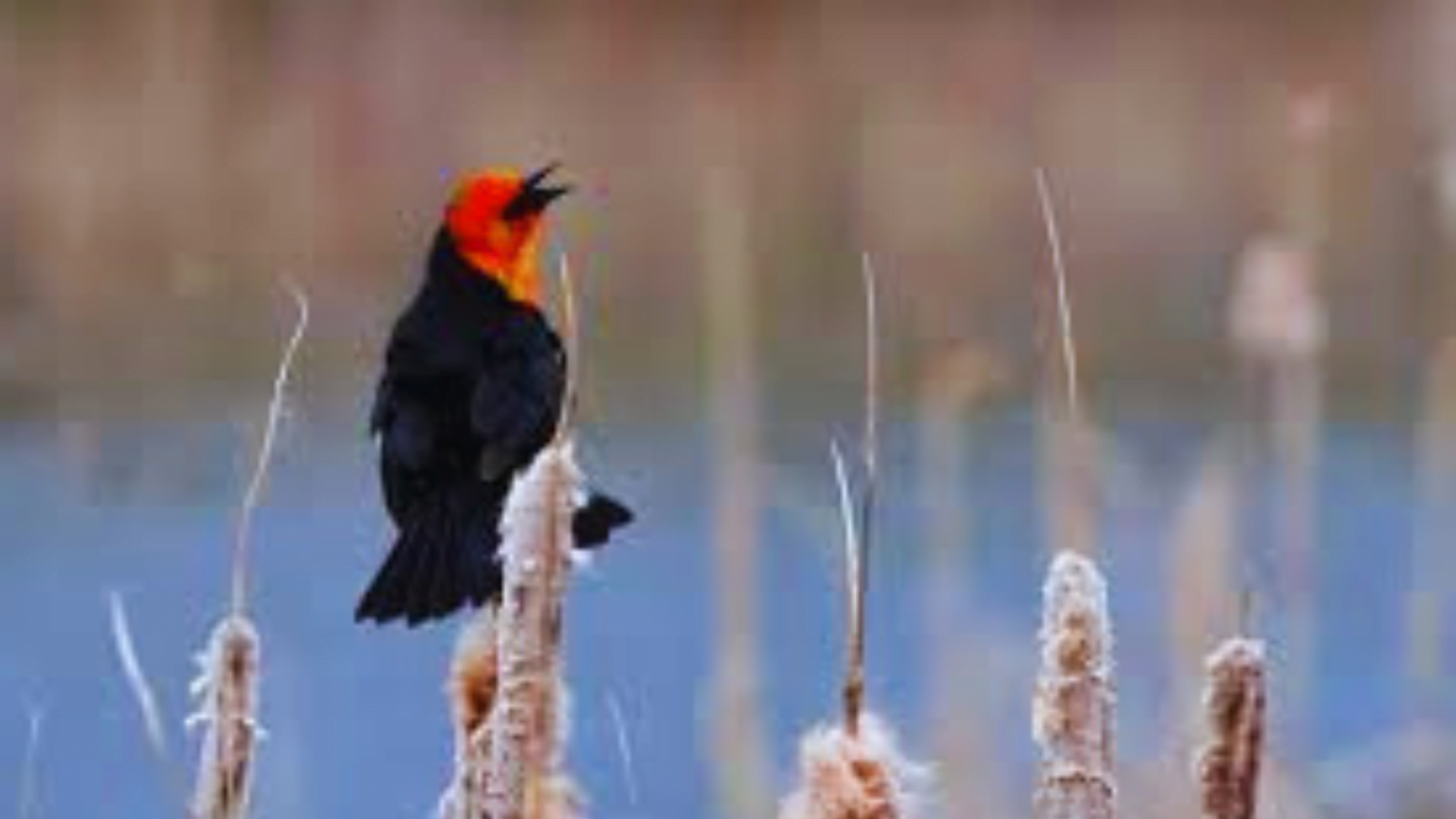
Could It Be an Orange-Headed Thrush?
The Orange-headed Thrush (Geokichla citrina) has an orange head and underparts with dark gray or black wings and back. It is a real species, but it is not a normal wild bird in the United States.
This thrush lives mainly in South and Southeast Asia. A photograph labeled as an American sighting may show:
- A bird in a zoo or aviary
- A captive bird
- A mislabeled image
- A different species
- A sighting outside the United States
This distinction matters because common names can travel across countries. Search results may show the Orange-headed Thrush even when the reader is trying to identify a bird in North America.
For a U.S. sighting, check North American species first. Range is one of the strongest filters in bird identification.

Common Identification Mistakes
Mistaking an orange bill for an orange head
Some dark birds have orange or yellow bills. Light can spread that color across the face in a poor photo. The European Blackbird, common in Europe, is a good example: the male has a dark body with a yellow-orange bill and eye ring.
The head itself is black. Look closely at the feathers, not just the bill.
Confusing red, orange, and yellow
Color changes with light, distance, camera settings, and feather wear. A Red-winged Blackbird’s red shoulder may appear orange. A yellow bird may look orange in warm evening light.
Use the location of the color and the bird’s shape along with the shade.
Trusting one feature
A black back and orange patch do not prove an oriole. Several birds share that basic pattern. Check at least three features before settling on an identification:
- Range
- Size and shape
- Exact location of the orange
Using an image app without checking the result
Identification apps can confuse similar species, especially when:
- The photograph is blurry
- The bird is partly hidden
- The species is outside the app’s strongest region
- The image shows a juvenile or female
- The background affects color
Use the app to create a short list. Then compare the bird with a trusted field guide or a reputable bird database.

What to Record for a Reliable Identification
Write down the details as soon as possible. Small clues fade quickly from memory.
Record:
- Date and time
- State or region
- Habitat
- Approximate size
- Head color
- Wing markings
- Tail shape
- Bill shape
- Movement
- Song or call
- Whether the bird was alone or in a flock
Take several photos if you can do so without disturbing the bird. Keep a respectful distance. Do not chase, corner, handle, or feed a wild bird for a better photograph.
For U.S. bird identification, useful references include:
- Cornell Lab of Ornithology: All About Birds
- National Audubon Society Bird Guide
- U.S. Fish & Wildlife Service Migratory Bird Program
These sources provide species ranges, photos, calls, habitat details, and seasonal information.
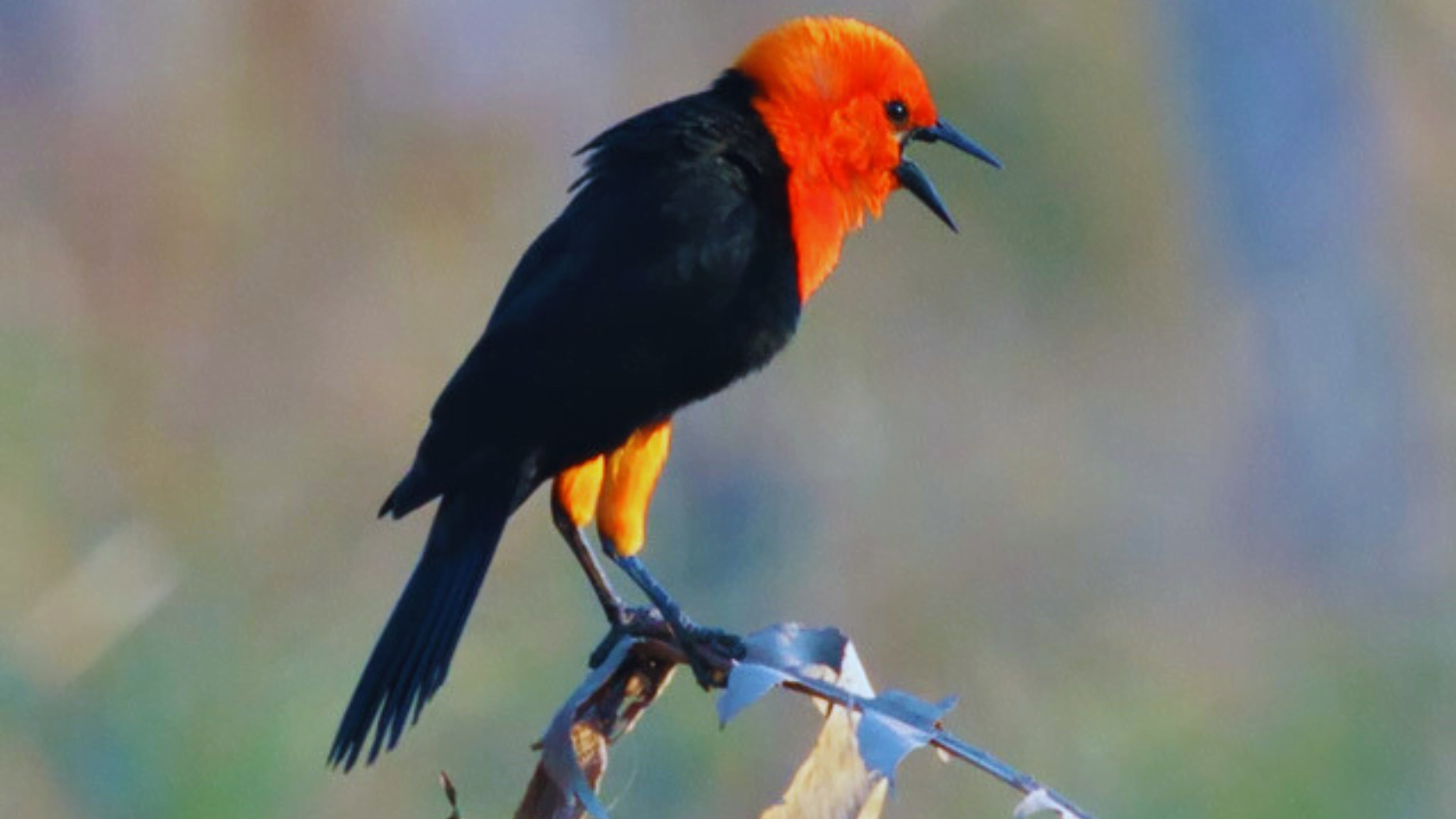
Quick Identification Checklist
Use this short guide when reviewing a sighting:
- Orange face, black eye stripe, white wing patch: Bullock’s Oriole
- Black head, orange belly, eastern U.S.: Baltimore Oriole
- Orange flashes on tail and sides: American Redstart
- Orange throat, tiny bird in tall trees: Blackburnian Warbler
- Orange eyebrow and breast, Pacific Northwest: Varied Thrush
- Red-orange shoulder patch in a marsh: Red-winged Blackbird
- Orange head and dark wings outside North America: Orange-headed Thrush
The strongest first choice for a U.S. sighting is usually the Bullock’s Oriole, but the details of the encounter should confirm or reject that guess.
Frequently Asked Questions
What is the most common black bird with an orange head in the United States?
The Bullock’s Oriole is one of the best matches, especially in the western United States. Adult males have an orange face and body with black on the crown, eye line, throat, and back.
Is a Red-winged Blackbird’s head orange?
No. A male Red-winged Blackbird has a black head and body. Its red-orange marking is on the shoulder, where the wing meets the body.
Are Baltimore Orioles black and orange?
Yes. Male Baltimore Orioles have black heads and backs with orange shoulders, breasts, and lower bodies. Their faces are usually not as orange as those of male Bullock’s Orioles.
What bird has an orange throat and a black head?
A male Blackburnian Warbler has a bright orange throat, a black crown and back, and dark wings. It is much smaller than an oriole and often stays high in trees.
Is the Orange-headed Thrush found in the United States?
The Orange-headed Thrush is native to parts of Asia, not the regular wild bird list of the United States. A U.S. report would need strong documentation and careful review.
Conclusion
A “blackbird with an orange head” is not one fixed species name. In the United States, the Bullock’s Oriole is the most likely match when the bird has an orange face, black crown, black back, and white wing markings.
Check the bird’s range, size, habitat, and the exact place where the orange appears. Those clues can separate an oriole from a redstart, warbler, thrush, or Red-winged Blackbird.