
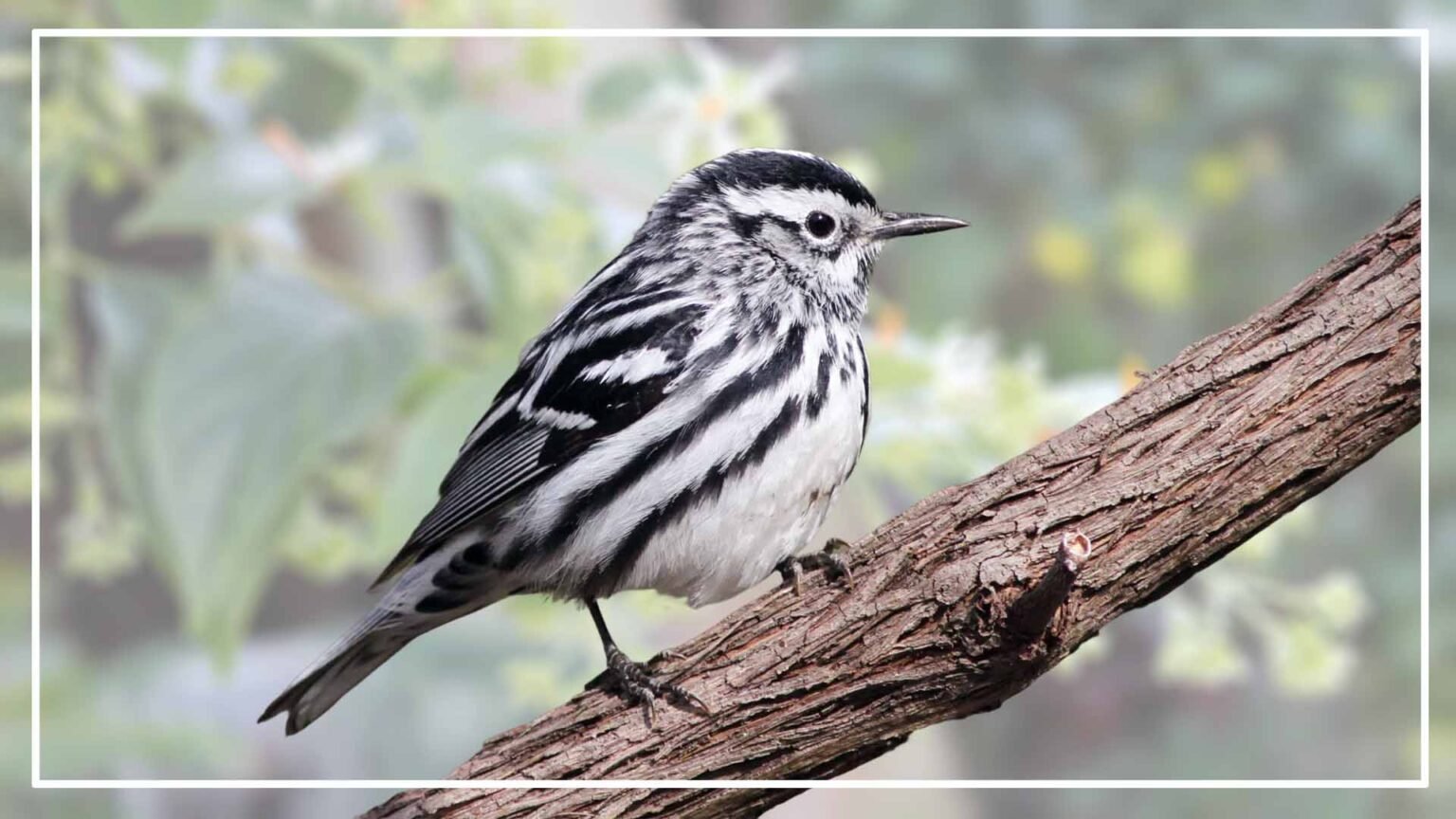
The Northern Mockingbird is the bird most often described as having a black-and-white striped tail in the United States. Its tail is mostly dark, but the outer feathers have bold white areas. When the bird spreads or flicks its tail, those white patches can look like black-and-white stripes.
Still, the description is not unique to one bird. A Cooper’s Hawk, Sharp-shinned Hawk, or Northern Flicker may also show a barred or striped-looking tail. The bird’s size, shape, habitat, and flight style can help you make a correct ID.
Quick Answer: The Northern Mockingbird
The Northern Mockingbird (Mimus polyglottos) is the best match when you see a medium-sized gray bird with a long tail that flashes black and white.
Look for these key traits:
- Gray back and pale gray underside
- Dark wings with two white wing bars
- Long tail with white outer feathers
- White flashes when the bird flies or spreads its tail
- Upright posture
- Frequent singing from a high perch
- Behavior that includes chasing other birds away
Northern Mockingbirds live across much of the United States. They are common in towns, suburbs, farms, open woodland, and desert edges. They often sit on fences, rooflines, utility wires, and the tops of shrubs.
The tail does not usually show neat, even bands from base to tip. Instead, the white outer tail feathers contrast with the darker central feathers. From a distance, that pattern may look striped.
How to Tell a Northern Mockingbird From Other Birds
The tail pattern alone is not enough for a reliable identification. Check the whole bird.
| Feature | Northern Mockingbird |
|---|---|
| Size | About the size of an American robin |
| Body color | Gray above and pale below |
| Tail | Long, dark, with white outer feathers |
| Wings | Dark with clear white patches |
| Shape | Slim body and long tail |
| Habitat | Yards, towns, open areas, scrub |
| Behavior | Sings often and may chase birds |
| Flight | White flashes show in the wings and tail |
A Northern Mockingbird often raises its wings or spreads its tail during display. This makes the white markings easier to see. In flight, the bird may look black and white even though its body is mainly gray.
The Cornell Lab of Ornithology describes the Northern Mockingbird as a gray bird with white wing patches and white outer tail feathers. Its species profile is a useful reference for comparison.
Common confusion: Northern Mockingbird or Loggerhead Shrike?
A Loggerhead Shrike can also look gray, black, and white. It has a black mask through the eyes, a hooked bill, and white patches in the wings and tail.
The main differences are:
- A shrike has a thicker, hooked bill.
- A shrike often shows a strong black face mask.
- A mockingbird has a longer, slimmer shape.
- Mockingbirds are much more common in suburban yards.
- Mockingbirds are famous for copying the songs of other birds.
If the bird has a clear black eye mask and a heavy bill, consider a Loggerhead Shrike instead.

Birds With a Truly Banded or Barred Tail
If you mean a tail with repeated dark and light bands, a Cooper’s Hawk may be a better match than a Northern Mockingbird.
Cooper’s Hawk
The Cooper’s Hawk has a long, rounded tail with several dark bands. The tail often ends in a narrow white band. Adults usually have:
- Blue-gray upperparts
- Warm reddish barring on the chest
- A large head
- Broad wings
- A long, rounded tail
- Dark bands across the tail
Cooper’s Hawks hunt birds and small mammals. They often move quickly through trees and shrubs. In suburban areas, they may appear near bird feeders because feeders attract prey.
A Cooper’s Hawk is larger and more powerful than a Northern Mockingbird. It also has a hooked bill and yellow legs. Young birds are brown rather than blue-gray and may have a more strongly streaked chest.
Sharp-shinned Hawk
The Sharp-shinned Hawk also has a long, banded tail. It is smaller and more delicate than a Cooper’s Hawk.
Key clues include:
- Small head
- Short, rounded wings
- Long tail with dark bands
- Thin legs
- Quick movement through dense cover
- Blue-gray adult back
- Orange-barred adult chest
Size can be hard to judge in the field. A Sharp-shinned Hawk may look larger when viewed alone. A bird feeder, fence, or familiar songbird can help provide scale.
How to separate the two hawks
Use shape rather than color alone.
| Feature | Cooper’s Hawk | Sharp-shinned Hawk |
|---|---|---|
| Overall size | Larger | Smaller |
| Head | Large, often projects beyond wings | Small, less prominent |
| Tail | Broad and rounded | Narrower and more square-looking |
| Body | Heavier | Slender |
| Habitat | Wood edges, suburbs, parks | Dense woods and brush |
| Flight | Strong, steady wingbeats | Quick bursts and glides |
Both hawks can show a black-and-white or gray-and-white banded tail. Neither is likely to perch and sing like a mockingbird.
Could It Be a Northern Flicker?
A Northern Flicker is another possible answer, especially if the bird is seen on the ground or climbing a tree.
Northern Flickers have:
- Brown, black, and tan markings on the back
- A black crescent on the upper chest
- Spotted underparts
- A white rump that shows in flight
- Long, pointed wings
- A long tail
- Yellow or salmon-colored wing and tail shafts, depending on location
Northern Flickers do not usually have a clean black-and-white striped tail. Their back has strong black bars, and their tail can look patterned when the bird moves. In the eastern United States, the undersides of the flight and tail feathers often show yellow. In the West, those feathers usually show orange or salmon tones.
A flicker also behaves differently from a mockingbird. It often feeds on the ground, searches for ants, and drums on trees or buildings. Its curved bill and woodpecker shape are useful clues.
Other U.S. Birds That May Look Black and White
Several birds can create a black-and-white tail impression under the right light or viewing angle.
American Robin
The American Robin has a dark tail with white corners. Those corners may show as white flashes during flight. The robin’s orange breast is the easiest clue.
Eastern Kingbird
The Eastern Kingbird has a dark body, a white-tipped tail, and a white band at the end of the tail. It often hunts insects from exposed perches. Its tail looks tipped in white rather than evenly striped.
Eastern Phoebe
The Eastern Phoebe has a dark tail and gray-brown body. It often wags its tail while perched. It lacks the strong white tail pattern of a mockingbird.
Blue Jay
A Blue Jay has a blue, black, and white pattern. Its tail has dark bars and white spots. The crest, blue wings, and larger bill make it easy to separate from a mockingbird.
White-breasted Nuthatch
The White-breasted Nuthatch has a short tail, a white face, and a blue-gray back. It often moves headfirst down tree trunks. Its tail is not long or strongly striped.
The most useful question is not only “What color is the tail?” Ask how long the tail is, whether the bird has wing bars, and how it moves.

A Simple Field Identification Method
Use this short process when you see a bird with a black-and-white tail.
1. Check the bird’s size
Compare it with familiar birds:
- Smaller than a robin: consider a sparrow, phoebe, or small hawk.
- About robin-sized: consider a mockingbird or flicker.
- Larger than a robin: consider a Cooper’s Hawk, jay, or shrike.
Size can be misleading when a hawk is far away. Use body shape as well.
2. Look at the tail shape
Tail shape is one of the best clues.
- Long and narrow: Northern Mockingbird
- Long and rounded with dark bands: Cooper’s Hawk
- Long and narrow on a small hawk: Sharp-shinned Hawk
- Long and pointed with a woodpecker body: Northern Flicker
- Short and square: Phoebe or nuthatch
3. Watch the behavior
Behavior often solves the mystery.
- Singing from a roof or wire suggests a Northern Mockingbird.
- Chasing other birds suggests a Northern Mockingbird or shrike.
- Hunting near a bird feeder suggests a Cooper’s Hawk or Sharp-shinned Hawk.
- Feeding on ants on the ground suggests a Northern Flicker.
- Flying out from a perch to catch insects suggests a kingbird or phoebe.
4. Check the habitat
Northern Mockingbirds favor open spaces with shrubs, lawns, and human buildings. Cooper’s Hawks favor wooded areas but also visit neighborhoods. Flickers often use mature trees, dead limbs, lawns, and open woodland.
5. Note the exact location
Range can help, but it should not be the only clue. The Northern Mockingbird occurs across much of the continental United States. Cooper’s Hawks and Sharp-shinned Hawks also have broad ranges. Local checklists from a state wildlife agency or Audubon chapter can confirm which species are likely in your area.

Why Tail Patterns Are Easy to Misread
Bird tails can look different because of light, distance, movement, and feather position.
A bird with white outer feathers may look striped when the tail is spread. A hawk with dark bands may look black and white from below. A bird in shadow may lose its gray, brown, or blue tones and appear only black and white.
The tail may also change with age and wear. Fresh feathers usually show sharper edges. Worn feathers can look pale, uneven, or ragged. Juvenile birds may have different colors and patterns from adults.
For a stronger identification, record at least three traits:
- Tail pattern
- Body shape
- Behavior or habitat
A single feature can suggest a species. Several matching features make the identification much more reliable.
What to Do If You Still Cannot Identify the Bird
Take notes as soon as you see the bird. Write down:
- Date and time
- State or general region
- Habitat
- Approximate size
- Tail shape
- Wing markings
- Bill shape
- Song or call
- Flight pattern
A photograph can help, but avoid chasing or disturbing the bird. Use a phone camera with a zoom feature if available. A short video may show tail movement, wing flashes, or flight style better than one still image.
For help, compare the bird with trusted identification guides from:
- Cornell Lab of Ornithology: All About Birds
- National Audubon Society Bird Guide
- U.S. Fish & Wildlife Service
These sources provide range maps, images, sounds, and species descriptions. Local bird clubs and state wildlife agencies can also help with unusual sightings.
Do not handle a wild bird to inspect its feathers. If a bird appears injured, contact a licensed wildlife rehabilitator rather than trying to treat it yourself.

Frequently Asked Questions
Is a Northern Mockingbird’s tail really striped?
Not in the same way as a hawk’s tail. A Northern Mockingbird has dark central tail feathers and white outer feathers. When the tail spreads or moves, the contrast can look like black-and-white stripes.
What hawk has a black-and-white striped tail?
A Cooper’s Hawk or Sharp-shinned Hawk may have a strongly banded tail. Cooper’s Hawks are larger and have a broader tail. Sharp-shinned Hawks are smaller and more slender.
What bird has a black-and-white tail and sings many songs?
The Northern Mockingbird is the strongest match. It can copy sounds from other birds, animals, and human-made sources. It often sings from a high, exposed perch.
Do Northern Flickers have striped tails?
Northern Flickers have barred backs and patterned feathers, but their tails are not usually cleanly black and white striped. Look for a woodpecker shape, a spotted belly, and a white rump in flight.
What should I look at first when identifying the bird?
Start with size and shape. Then check the tail pattern, bill, habitat, and behavior. The tail is helpful, but it should not be used alone.
Conclusion
The Northern Mockingbird is the most likely answer to “what bird has a black and white striped tail” in the United States, especially when the bird is gray, slim, long-tailed, and seen in a yard or open neighborhood.
If the tail has clear repeated bands, consider a Cooper’s Hawk or Sharp-shinned Hawk. If the bird has a woodpecker shape and bold back markings, consider a Northern Flicker. Compare the full bird, not just the tail, before making a final identification.