

Introduction
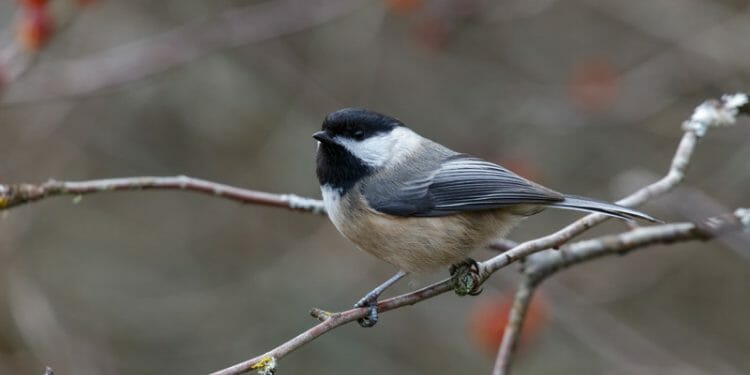
In the United States, the bird most often described as having a black head and white chest is the Black-capped Chickadee (Poecile atricapillus). It has a black cap, black throat patch, white cheeks, a pale chest, gray wings, and a long gray tail.
This small backyard bird is common across much of the northern and western United States. However, several other U.S. birds can look similar. The location, bird shape, behavior, and chest pattern can help you make a sure identification.

The Black-Capped Chickadee Is the Most Likely Answer
The Black-capped Chickadee is the best match for a small bird with a black head and white chest. It is a common visitor to feeders, wooded yards, parks, and forest edges.
Key field marks
Look for these traits:
- Black cap: The black crown extends from the bill to the back of the head.
- Black throat bib: A small black patch sits below the bill.
- White cheeks: The cheeks stand out between the black cap and throat.
- White or pale chest: The upper breast is usually light gray to white.
- Gray back and wings: The back lacks strong color.
- Small, rounded body: The bird often looks compact and round.
- Short, pointed bill: The bill is smaller than the bill of a nuthatch or finch.
The black cap and white cheeks can look like a small helmet and mask. The black bib is the main clue that the chest is not fully white.
The Cornell Lab of Ornithology lists the Black-capped Chickadee as a year-round bird across much of Alaska, Canada, and the northern United States. Its range also extends into parts of the western mountains and the Appalachian region. See the Cornell Lab species account.
Where you may see one
In the United States, Black-capped Chickadees often live in:
- Mixed forests
- Birch and aspen stands
- Suburban yards
- City parks
- Woodland edges
- Backyard feeding stations
- Areas with shrubs and mature trees
They often visit sunflower seed feeders. They may also cling to small branches while searching for insects, eggs, and spiders.
How it behaves
A Black-capped Chickadee may:
- Take one seed from a feeder.
- Fly to a nearby branch.
- Hold the seed with its feet.
- Hammer it open with its bill.
- Return for another seed.
The bird may also hang upside down while checking bark and twigs for food. Its common call sounds like “chick-a-dee-dee-dee.” A clear two-note “fee-bee” whistle is another useful clue.

Birds That Can Look Similar
Several North American birds have dark heads and pale fronts. A black head alone is not enough for a positive identification.
| Bird | Main look | U.S. range clue | Best way to tell it apart |
|---|---|---|---|
| Black-capped Chickadee | Black cap, white cheeks, pale chest, black bib | Northern and western areas; parts of Appalachia | Small size and “chick-a-dee” call |
| Carolina Chickadee | Black cap, white cheeks, pale chest, black bib | Southeast and parts of the Mid-Atlantic | Often slightly smaller; call and range help |
| Mountain Chickadee | Black cap, white cheeks, pale chest | Mountain West | distinct white eyebrow above the eye |
| White-breasted Nuthatch | Black crown, white face and chest, gray back | Much of the United States | Long bill, short tail, and head-down climbing |
| Eastern Towhee | Black head and upper body, white belly | Eastern United States | Larger body, rusty sides, and long tail |
| Dark-eyed Junco | Dark head and upper body, pale belly | Widespread, especially in winter | Round finch shape and pink bill |
| Tufted Titmouse | Gray crest, pale face and chest | Eastern and southeastern United States | Crest is gray, not black |
Carolina Chickadee
The Carolina Chickadee is the closest look-alike. It lives mainly in the Southeast and parts of the Mid-Atlantic. It has the same basic pattern: a black cap, white cheeks, black bib, and light chest.
Range is helpful, but it is not perfect. Black-capped and Carolina chickadees can overlap in parts of the Mid-Atlantic. They can also form mixed pairs and hybrids in some overlap zones. A photograph, clear call, and exact location can help, but some birds cannot be identified with confidence from a quick view.
The National Audubon Society guide to the Carolina Chickadee provides additional range and identification details.
Mountain Chickadee
The Mountain Chickadee is common in conifer forests of the western mountain states. Its most useful mark is a white eyebrow, or white stripe above the eye.
If you see a black-capped chickadee with a clear white line over the eye in Colorado, Utah, Wyoming, Idaho, Montana, or nearby mountain areas, consider Mountain Chickadee. The habitat also matters. Mountain Chickadees favor pine, fir, spruce, and other mountain conifers.
White-breasted Nuthatch
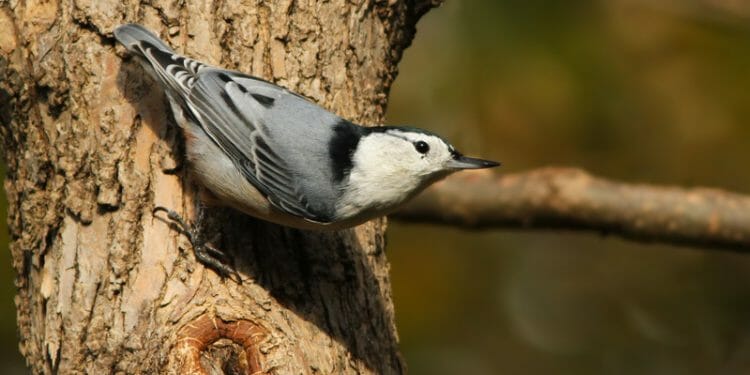
A White-breasted Nuthatch may appear to have a black head and white chest. It has a black crown and a mostly white face and underside.
Its shape is very different from a chickadee. It has:
- A longer, pointed bill
- A short tail
- A larger, longer body
- Strong claws for climbing
- A habit of moving headfirst down tree trunks
This bird often searches under loose bark. It may visit the same feeders as chickadees, but its climbing style gives it away.
How to Identify the Bird Step by Step
Use more than one feature when identifying a bird. Color can change with shade, distance, age, and feather wear.
Step 1: Check the size
A Black-capped Chickadee is small. It is much smaller than an Eastern Towhee and slimmer than many sparrows.
If the bird is tiny and compact, a chickadee is likely. If it is large with a long tail, look at towhees or other black-and-white birds.
Step 2: Look at the face
Ask these questions:
- Are the cheeks bright white?
- Does the black cap reach the back of the head?
- Is there a black patch under the bill?
- Is there a white eyebrow?
White cheeks plus a black bib strongly suggest a chickadee. A white eyebrow points more toward a Mountain Chickadee.
Step 3: Study the bill and tail
The bill helps separate similar species.
- Short, small bill: Chickadee
- Long, pointed bill: White-breasted Nuthatch
- Thick, seed-cracking bill: Junco or sparrow
- Long tail and larger frame: Eastern Towhee
A chickadee usually has a balanced, rounded shape. A nuthatch looks longer and more angular.
Step 4: Watch how it moves
Behavior can be as useful as color.
A chickadee often makes quick hops through branches. It may hang upside down and carry seeds away. A nuthatch commonly walks down a tree trunk headfirst. A junco often feeds on the ground.
Step 5: Use the bird’s location
Location can narrow the answer:
- New England, Great Lakes, northern Plains, or Pacific Northwest: Black-capped Chickadee is likely.
- Southeast or southern Mid-Atlantic: Carolina Chickadee is likely.
- Rocky Mountain or high-elevation western forest: Mountain Chickadee is possible.
- Open ground in winter: Dark-eyed Junco may be a better match.
- Tree trunk with head pointing down: White-breasted Nuthatch is likely.
Range is a clue, not proof. Birds can move outside their usual range, especially during migration, winter, storms, or unusual weather.
Step 6: Listen to the call
The Black-capped Chickadee’s name comes from its familiar call. The call often has several “dee” notes at the end.
The number and pitch of the notes can change. Do not reject a chickadee because the call does not sound exactly like a recording. Wind, distance, and nearby noise can alter what you hear.
Black-Capped Chickadee vs. Carolina Chickadee
The two species can be hard to separate in areas where their ranges meet. Size and color alone may not solve the problem.
| Feature | Black-capped Chickadee | Carolina Chickadee |
|---|---|---|
| Main range | Northern U.S., Alaska, western mountains, Appalachians | Southeastern U.S. and parts of the Mid-Atlantic |
| Overall pattern | Black cap, white cheeks, black bib | Nearly the same pattern |
| Usual size | Slightly larger on average | Slightly smaller on average |
| Habitat | Mixed woods, northern forests, yards | Deciduous woods, pine woods, parks, yards |
| Call | Often slower and more clearly spaced | Often faster and higher in pitch |
| Identification limit | Can overlap with Carolina Chickadee | Can overlap with Black-capped Chickadee |
These differences are useful but not absolute. The birds vary by individual, and sound recordings can be difficult to compare in the field.
In the contact zone, a photo with a known location may still receive a cautious identification. A trained local birder or a bird identification app can help, but app results should be checked against the bird’s range and visible features.

Why the Chest May Not Look Pure White
A bird described as having a white chest may show cream, pale gray, or dull white feathers. This can happen because of:
- Low light
- Wet feathers
- Shadow from branches
- Feather wear
- Dirt or dust
- A young bird’s less clear markings
- A camera that changes color balance
The Black-capped Chickadee’s lower body can look gray rather than white. Its black throat bib may also make the pale chest appear brighter by contrast.
Do not identify the bird from chest color alone. The combination of a black cap, white cheeks, black bib, small body, and chickadee behavior is much more reliable.

What to Do If You See One at a Feeder
Black-capped Chickadees are common feeder birds, but clean feeding practices protect them and other birds.
Use suitable food
Good choices include:
- Black-oil sunflower seed
- Striped sunflower seed
- Peanut pieces made for wild birds
- Commercial suet without unsafe additives
Avoid moldy, wet, or spoiled food. Do not offer salty snacks, seasoned food, chocolate, alcohol, or foods containing artificial sweeteners.
Keep feeders clean
Clean feeders on a regular schedule, and clean them sooner if food becomes wet or moldy. Remove old seed from the ground when it builds up.
Dirty feeding areas can help spread disease among birds. If you see several sick or dead birds near a feeder, pause feeding and contact a local wildlife agency or follow guidance from the U.S. Geological Survey’s National Wildlife Health Center.
Provide natural cover
Shrubs and native trees give chickadees places to rest and hide. Dead trees, when safe to keep, can provide insects and nest sites.
Do not disturb a nest or attempt to handle a chickadee. If you find a young bird on the ground, watch from a distance unless it is in immediate danger. Contact a licensed wildlife rehabilitator when an injured bird needs help.

Common Identification Mistakes
Mistake 1: Calling every black-headed bird a chickadee
A black hood can also belong to an Eastern Towhee, junco, nuthatch, or another species. Check the body size, bill, tail, and behavior.
Mistake 2: Ignoring the white eyebrow
A white eyebrow is a strong clue for Mountain Chickadee. Black-capped and Carolina chickadees usually do not show that bold eyebrow.
Mistake 3: Using range as the only clue
Range maps show where a species commonly occurs. They do not prevent a bird from appearing elsewhere. Weather, habitat change, and seasonal movement can affect sightings.
Mistake 4: Confusing a nuthatch with a chickadee
A bird moving headfirst down a tree is likely a nuthatch. Chickadees may cling to bark, but they usually move with quick hops through branches.
Mistake 5: Trusting a blurry photo
A distant image can hide the bill, eyebrow, bib, and tail. Take several photos if possible, but do not chase or stress the bird. Record the location, date, habitat, and behavior.

Quick Identification Checklist
Use this short checklist when you see a bird with a black head and white chest:
- Is it small and round?
- Does it have white cheeks?
- Does it have a black throat bib?
- Is the bill short?
- Does it move quickly through branches?
- Does it visit a feeder and carry seed away?
- Does it call “chick-a-dee-dee-dee”?
- Is there no strong white eyebrow?
If most answers are yes, the bird is probably a Black-capped Chickadee.
If it is in the Southeast, compare it with a Carolina Chickadee. If it has a white eyebrow in the western mountains, consider a Mountain Chickadee. If it walks headfirst down a tree, check for a White-breasted Nuthatch.

Frequently Asked Questions
What is the most common bird with a black head and white chest?
The Black-capped Chickadee is one of the most common matches in the United States. It has a black cap and throat, white cheeks, and a pale chest.
Is a Black-capped Chickadee rare?
No. It is common in many parts of the northern and western United States. Local numbers still depend on habitat, season, weather, and food supply.
What bird has a black head, white cheeks, and a gray body?
A Black-capped Chickadee often has this pattern. A Carolina Chickadee has a similar look in the Southeast. A Mountain Chickadee adds a white eyebrow.
What bird has a black head and white chest in the Southeast?
A Carolina Chickadee is often the best match in the Southeast. In some areas, it may overlap with the Black-capped Chickadee, so location and call can be useful.
How can I tell a chickadee from a nuthatch?
A chickadee is small, round, and has a short bill. A White-breasted Nuthatch has a longer bill, a short tail, and often moves headfirst down tree trunks.
Conclusion
The Black-capped Chickadee is the most likely answer to “what bird has a black head and white chest?” Its key marks are a black cap, white cheeks, black throat bib, pale chest, gray back, and small body.
For a confident identification, also check the bird’s range, call, bill, movement, and any white eyebrow. In the Southeast, compare it with a Carolina Chickadee. In western mountain forests, compare it with a Mountain Chickadee.
The best next step is to note the bird’s location, take a respectful photo, and compare several field marks rather than relying on one color.