
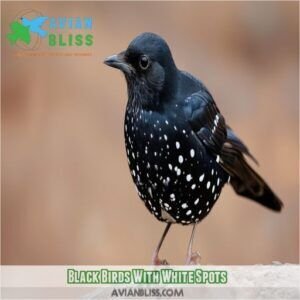
In the United States, the bird most often described as having black wings with white spots is a woodpecker, especially a Downy Woodpecker or Hairy Woodpecker. These birds have black-and-white wings, white spots or bars on the back, and a bold white stripe down the center of the back.
The exact answer depends on where and how you saw the bird:
- On a tree or feeder: likely a Downy or Hairy Woodpecker
- Flying at dusk: possibly a Common Nighthawk
- Covered in small white speckles: possibly a European Starling
- Large bird with a bold white wing patch: possibly a Northern Flicker or another black-and-white bird
Size, flight pattern, habitat, and the bird’s head markings can help separate these species.

Birds That Can Have Black Wings With White Spots
Several birds in the United States show black wings with white marks. The pattern may look different depending on the bird’s posture, light, and distance.
| Bird | Wing pattern | Best clue | Usual setting |
|---|---|---|---|
| Downy Woodpecker | Black wings with white bars and spots | Small size and short bill | Backyards, trees, feeders |
| Hairy Woodpecker | Black wings with white bars and spots | Larger body and longer bill | Mature woods and yards |
| Common Nighthawk | Dark wings with bright white patches | Erratic flight at dusk | Open skies, cities, fields |
| European Starling | Dark wings with pale speckles | Speckles cover much of the body | Lawns, farms, towns |
| Northern Flicker | Brown-barred wings with black markings | White rump and spotted belly | Open woods, yards |
| Black-and-white Warbler | Black-and-white barred wings | Striped head and body | Forests during migration |
The Downy Woodpecker is usually the best match when the bird is clinging to a tree trunk or visiting a suet feeder. The Common Nighthawk is a better match when the bird is high in the sky and shows large white patches on its wings.
Downy Woodpecker: The Most Likely Backyard Match
The Downy Woodpecker is a small black-and-white woodpecker found across much of the United States. Its wings appear black with narrow white bars. When the bird folds its wings, the white marks can look like small spots.
Key identification features include:
- A small body, about the size of a sparrow
- A short, straight bill
- A white back
- Black wings with white bars
- A black-and-white striped face
- A black tail with white outer tail feathers
- A red patch on the back of the male’s head
Downy Woodpeckers often climb tree trunks and branches. They may also hang from suet feeders, especially in fall and winter.
A useful clue is the bill. The bill of a Downy Woodpecker is short and delicate. It is much smaller than the bill of a Hairy Woodpecker, even though the two species look very similar.

Hairy Woodpecker: A Larger Look-Alike
The Hairy Woodpecker has nearly the same black-and-white pattern as the Downy Woodpecker. Its wings are black with white bars, and its back has a bold white stripe.
The main difference is size:
- Downy Woodpecker: small, compact, short bill
- Hairy Woodpecker: larger, longer bill, more powerful appearance
Hairy Woodpeckers are common in mature forests, wooded parks, and some suburban areas. They may visit feeders, but they often seem less tame and less common around small urban yards than Downy Woodpeckers.
The bill is the safest feature to use when comparing the two. On a Hairy Woodpecker, the bill is roughly as long as the distance from the front of the bird’s head to its eye. On a Downy Woodpecker, the bill looks much shorter.
Size can be hard to judge without a nearby object. A feeder, suet cage, or tree branch can provide a useful comparison.
Common Nighthawk: The Best Match for a Flying Bird at Dusk
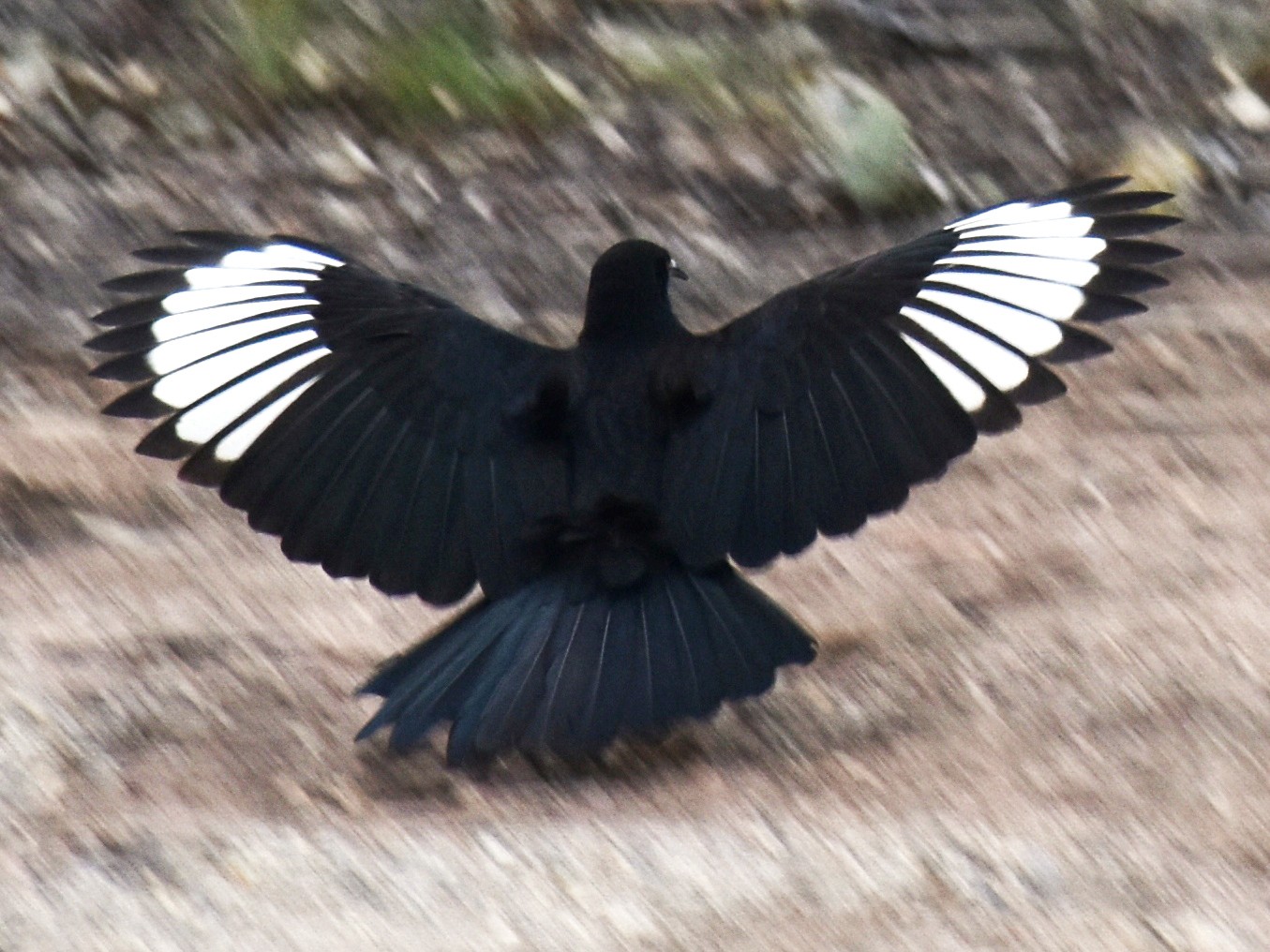
The Common Nighthawk has dark wings with large white patches. These patches are not small spots, but they may look spotted or broken when the bird is far away or moving quickly.
Common Nighthawks are often seen:
- At dusk or dawn
- Flying over fields, lakes, parking lots, and cities
- Catching insects in the air
- Making quick turns and dives
- Flying with long, pointed wings
A Common Nighthawk does not usually perch in an upright pose like a songbird. Its flight is loose and erratic. It may suddenly twist, rise, or drop as it chases flying insects.
The white wing patches are one of its strongest field marks. They appear near the outer part of each wing and can flash brightly as the bird changes direction.
The bird’s plumage is mostly brown, gray, and black. It often blends into pavement, gravel, or tree bark when resting during the day.

European Starling: A Dark Bird With White Speckles
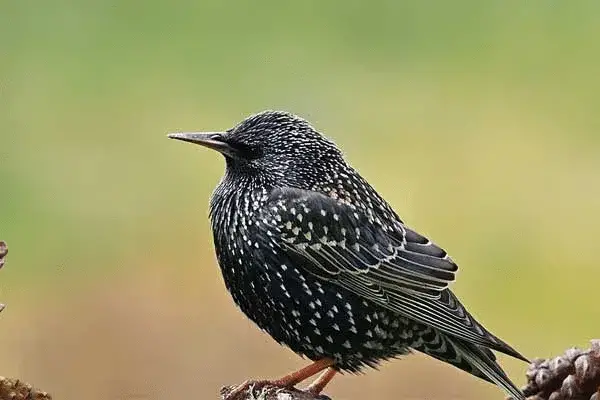
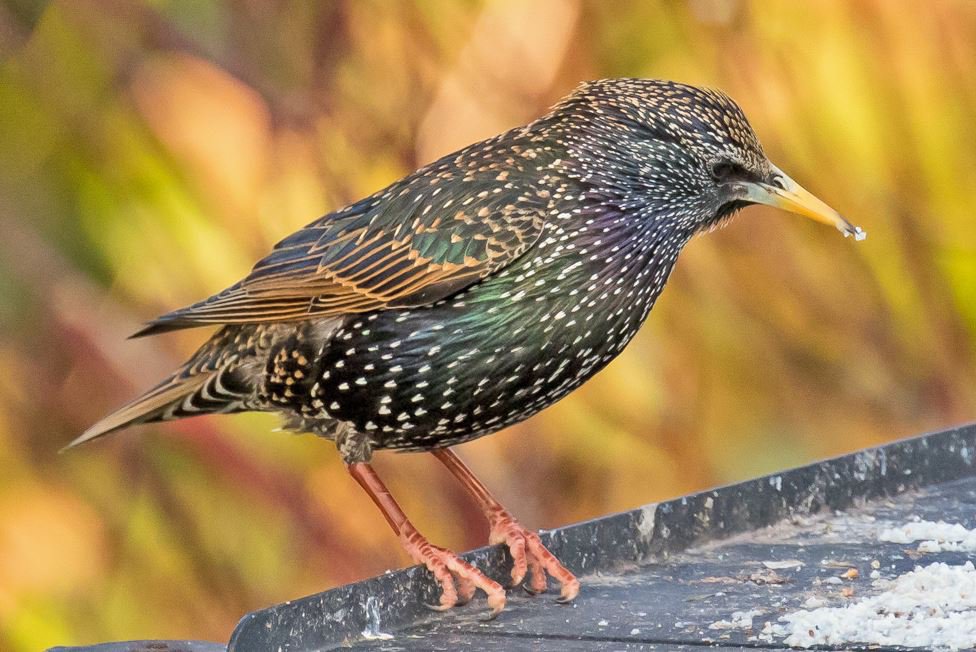
A European Starling may be the answer if the bird looked black overall and had many small white spots across its body.
Adult European Starlings can show:
- Dark, glossy feathers
- White or cream-colored tips on the feathers
- A pointed yellow bill during the breeding season
- Short, triangular wings
- A stocky body
- A quick, direct flight
The white marks on a starling are usually not limited to the wings. They may appear on the back, breast, and belly as well.
Starlings are common in cities, suburbs, farms, and open country throughout the United States. They often feed on lawns and gather in large flocks. Their dark feathers can look black from a distance, although close views may show purple, green, or blue shine.
A starling usually has a pointed bill and a smoother body shape than a woodpecker. It also does not cling vertically to tree trunks in the way a woodpecker does.
Northern Flicker: A Spotted Bird With Dark Wing Markings
The Northern Flicker is a large woodpecker with a different pattern from the Downy and Hairy Woodpeckers. Its back is brown with black bars, and its belly has dark spots. The wings can look dark when the bird flies, but they are usually barred rather than solid black.
Look for these clues:
- A white patch on the rump
- A spotted belly
- A brown, barred back
- A long, slightly curved bill
- A black crescent on the upper chest
- Yellow or red color under the wings and tail, depending on the region
Northern Flickers often feed on the ground. They search for ants and other insects on lawns, along forest edges, and around tree bases.
In the eastern United States, the undersides of the wings and tail often show yellow. In the West, they commonly show red. This color may be visible only when the bird takes off.
Black-and-White Warbler: Striped Rather Than Spotted
The Black-and-white Warbler has black-and-white wings, but its pattern is usually made of narrow bars and stripes rather than round spots.
It is a small songbird with:
- A striped black-and-white head
- A white eyebrow stripe
- A black-and-white body
- Thin bars on the wings
- A habit of creeping along tree trunks and large branches
This warbler is most often seen during migration or in wooded areas during the breeding season. It moves like a small nuthatch or woodpecker as it searches tree bark for insects.
A Black-and-white Warbler is much smaller than a flicker and does not have the heavy bill of a woodpecker. It also lacks the red head patch seen on male Downy and Hairy Woodpeckers.
How to Identify the Bird You Saw
Use the bird’s behavior first. Shape and movement often provide better clues than color alone.
1. Check where the bird was
- Tree trunk: Downy Woodpecker, Hairy Woodpecker, or Black-and-white Warbler
- Suet feeder: Downy or Hairy Woodpecker
- Ground: Northern Flicker or European Starling
- Open sky at dusk: Common Nighthawk
- Lawn or parking lot: European Starling or Northern Flicker
2. Estimate the size
Compare the bird with familiar birds:
- Sparrow-sized: Downy Woodpecker or Black-and-white Warbler
- Robin-sized: European Starling or Common Nighthawk
- Larger than a robin: Hairy Woodpecker or Northern Flicker
Distance can distort size, so use this clue with behavior and shape.
3. Look at the bill
The bill can quickly narrow the choices:
- Short, chisel-like bill: Downy Woodpecker
- Long, strong chisel-like bill: Hairy Woodpecker
- Long, slightly curved bill: Northern Flicker
- Thin, pointed bill: European Starling
- Small, narrow bill: Black-and-white Warbler
4. Watch the flight
Flight pattern is especially useful:
- Strong, bounding flight between trees: Woodpecker
- Erratic, twisting flight at dusk: Common Nighthawk
- Direct flight with quick wingbeats: Starling
- Undulating flight with flashes of yellow or red: Northern Flicker
5. Find the white mark
Ask what the white marking looked like:
- Small bars across black wings: Downy or Hairy Woodpecker
- Large white patch near the wingtip: Common Nighthawk
- Fine spots across the whole body: European Starling
- White rump visible in flight: Northern Flicker
- Thin stripes on the head and body: Black-and-white Warbler
Quick Comparison: Downy vs. Hairy Woodpecker
Downy and Hairy Woodpeckers cause many identification mistakes because they share nearly the same colors and markings.
| Feature | Downy Woodpecker | Hairy Woodpecker |
|---|---|---|
| Overall size | Small | Medium to large |
| Bill | Short and fine | Long and strong |
| Common habitat | Backyards and smaller trees | Mature woods and large trees |
| Wing pattern | Black with white bars | Black with white bars |
| Male marking | Red patch on the head | Red patch on the head |
| Feeder behavior | Common visitor | Less common but regular in wooded areas |
The most reliable clue is the bill-to-head relationship. A Hairy Woodpecker’s bill looks noticeably longer and heavier. If the bird is far away, compare it with the feeder, tree bark, or nearby birds rather than relying on memory.
Do not use the word “spotted” alone to identify the bird. Woodpecker wing patterns often look like spots when the feathers overlap.
Why Lighting Can Change the Pattern
Black feathers do not always look pure black. Sunlight may reveal blue, green, gray, or brown tones. Shadow can hide white bars and make a bird appear darker than it is.
A bird’s posture also changes the view:
- Open wings reveal bars and patches.
- Folded wings may turn bars into spots.
- A bird facing away may show its back but hide its breast.
- A bird in flight may reveal white wing patches that are invisible when perched.
For this reason, a short description such as “black wings with white spots” is useful but not always enough for a certain identification.
A photograph taken from the side, back, and underside can make identification much easier. Avoid approaching or disturbing the bird to obtain a closer view.
Common Identification Mistakes
Mistaking white wing bars for spots
Many birds have narrow white bars across dark feathers. When the wing is folded, those bars may appear as separate white spots.
Calling every dark bird a starling
European Starlings are common, but not every black bird with white marks is a starling. A starling usually has a pointed bill and speckles over much of the body.
Confusing a nighthawk with a swallow
Both birds can fly over open areas and catch insects. A Common Nighthawk has broader, more angular wings and clear white wing patches. Swallows usually have slimmer bodies and more controlled, gliding flight.
Using color without behavior
Color fades in poor light and changes with distance. A bird’s habitat, movement, bill shape, and body form often provide stronger evidence.
Assuming a red patch means the same species
Male Downy and Hairy Woodpeckers both may have a red patch on the back of the head. Size and bill shape are needed to tell them apart.
Is a Bird With Black Wings and White Spots Dangerous?
These birds are not dangerous to people when observed outdoors. Woodpeckers may make loud calls or drum on buildings, but they normally avoid humans.
Do not handle a wild bird unless it is clearly injured and you have received guidance from a licensed wildlife rehabilitator. Birds can become stressed or injured when people try to catch them. Keep pets away from an injured bird and contact a local wildlife agency or rehabilitation center for instructions.
If a bird repeatedly strikes a window, reduce reflections with exterior window markers, screens, or temporary coverings. Do not place feeders directly beside a window or far across an open flight path without considering collision risk.

What to Do If You Want a Certain Identification
Record four details as soon as you can:
- Location: state, city, habitat, or nearby landmark
- Time: morning, afternoon, dusk, or night
- Behavior: tree climbing, ground feeding, flocking, or flying
- Features: size, bill, tail, wing marks, and body colors
A clear photo is helpful, but a written description can also work. Note whether the bird was alone or in a flock. If possible, include what the bird was doing before it flew away.
For a U.S. identification, compare the bird with reliable field resources such as the Cornell Lab of Ornithology’s All About Birds species accounts, the National Audubon Society’s bird guide, or a regional birding guide. These resources provide range maps, calls, photos, and seasonal information.
Do not rely on one feature alone. The strongest identification combines at least three clues, such as size, behavior, and wing pattern.
Frequently Asked Questions
What is a black bird with white spots found in a backyard?
A European Starling is a common possibility if the bird has white speckles across its dark body. If it is climbing a tree or visiting a suet feeder, a Downy or Hairy Woodpecker is more likely.
What bird has black wings with white patches while flying?
A Common Nighthawk has dark wings with large white patches near the outer wing. It is most often seen flying at dusk or dawn over open areas.
Do Downy Woodpeckers have white spots on their wings?
Yes. Downy Woodpecker wings are black with white bars. When the wings are folded, the bars can look like rows of white spots.
How can I tell a Downy Woodpecker from a Hairy Woodpecker?
Look at the bill and body size. A Downy Woodpecker is smaller and has a short bill. A Hairy Woodpecker is larger and has a noticeably longer, heavier bill.
What bird has black-and-white wings and climbs tree trunks?
A Downy Woodpecker, Hairy Woodpecker, or Black-and-white Warbler may climb tree trunks. Woodpeckers have stronger bills and a more upright, braced posture. The warbler is smaller and has narrow black-and-white stripes.
Conclusion
The Downy Woodpecker is the most likely answer when a small backyard bird has black wings with white spots or bars. A Hairy Woodpecker looks similar but is larger and has a longer bill.
If the bird was flying at dusk, look for a Common Nighthawk with large white wing patches. If white speckles covered the whole dark body, consider a European Starling. The best identification comes from combining the wing pattern with size, bill shape, habitat, and behavior.