
The Snow Goose is the most likely bird with a white body and black wings. In the United States, it is easy to spot in flight because its white body contrasts with dark black wing tips. Large flocks often gather in wetlands, farm fields, lakes, and coastal marshes during migration and winter.
However, several other U.S. birds can look white and black from a distance. Size, habitat, flight style, and the pattern on the wings can help you identify the right species.
Introduction: The Most Likely Answer Is the Snow Goose
The Snow Goose (Anser caerulescens) has a bright white body, white head, pink bill, and black primary flight feathers. The black feathers show most clearly when the bird flies. From below, the wings may look mostly white with dark tips. From above, the dark outer wing feathers are easier to see.
Snow Geese are common across much of the United States during migration and winter. They breed in the Arctic and travel south in large numbers. Some spend the winter in the Central Valley of California, the Gulf Coast, the Atlantic Coast, and major inland wetlands.
There is one key detail: not every Snow Goose is white. The species also has a dark “blue” color phase. That form has a dark gray-brown body and a white head. Young Snow Geese may also look duller than adults.
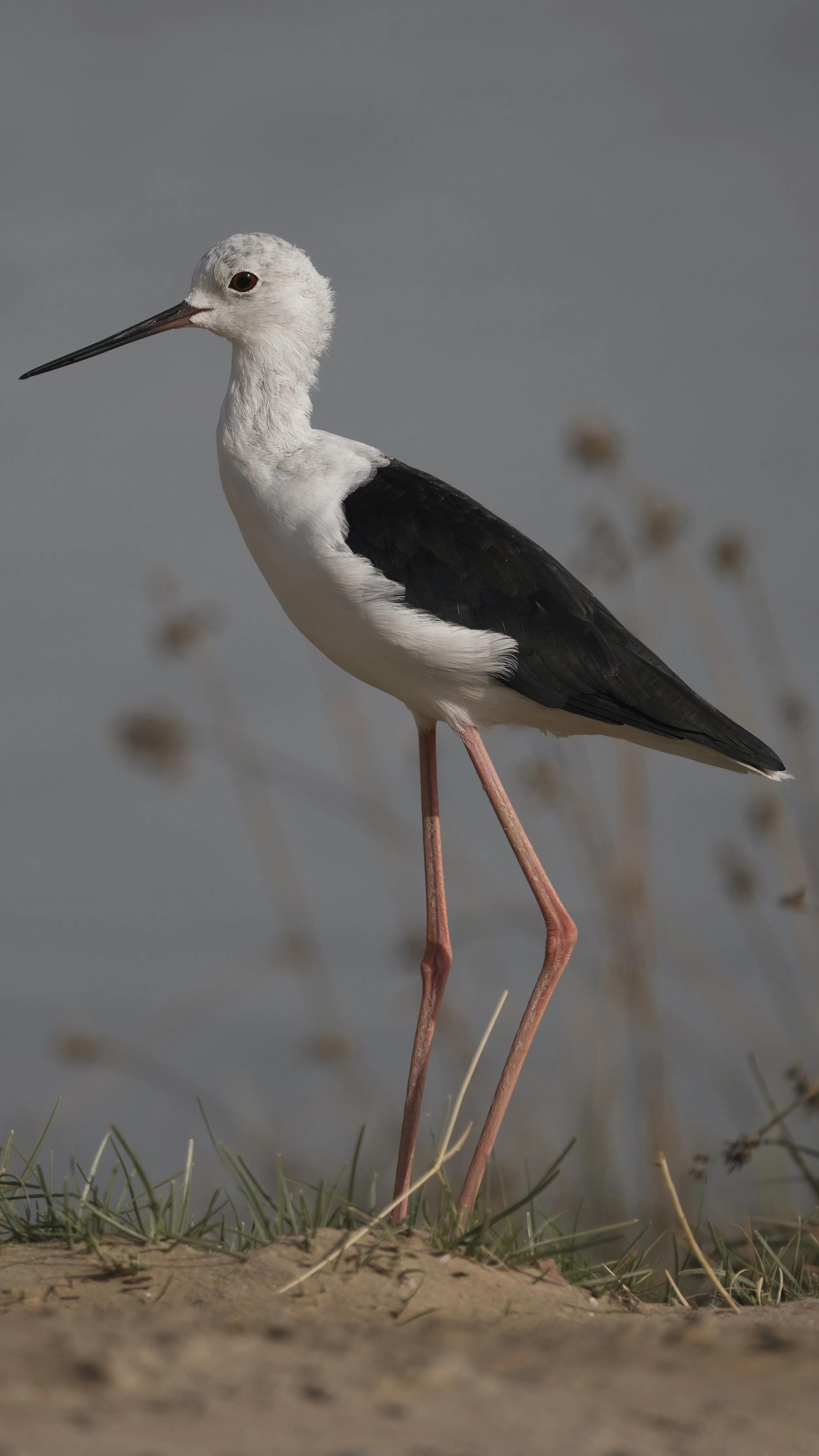
How to Identify a Snow Goose
A Snow Goose is usually easy to identify when you check several features at once. Do not rely on wing color alone, since light, distance, and flight angle can change how the bird looks.
Look for these field marks:
- White body: Adults in the white color phase are nearly all white.
- Black wing tips: The outer flight feathers are black.
- Pink bill: The bill is pink or rose-colored.
- Black “grin patch”: A dark mark often appears along the sides of the bill.
- Short neck: The neck is shorter and thicker than that of a swan.
- Medium-to-large size: The bird is much larger than a goose such as a Canada Goose.
- Strong, direct flight: Snow Geese often fly in long lines or large V-shaped groups.
- Loud calls: Flocks can be noisy, with repeated honking sounds.
The black wing tips are not separate patches painted onto the wings. They are the bird’s dark primary feathers, which are used for flight. The rest of the wing is mostly white.
Snow Goose vs. Ross’s Goose
Ross’s Goose looks very similar to a small Snow Goose. It also has a white body, black wing tips, a pink bill, and a black mark near the bill.
Use size and bill shape as your first clues:
| Feature | Snow Goose | Ross’s Goose |
|---|---|---|
| Body size | Larger | Smaller and more compact |
| Bill | Longer and heavier | Shorter and smaller |
| Bill mark | Often a broad dark grin patch | Usually smaller or less obvious |
| Head shape | Less round | Rounder head |
| Flock behavior | Often forms huge flocks | May mix with Snow Geese |
Size can be hard to judge when the birds are alone. Compare the bird with nearby geese, ducks, or shorebirds when possible.

Other U.S. Birds With White Bodies and Dark Wings
The Snow Goose is the best match, but it is not the only possibility. A bird may appear white and black because of its wing pattern, body angle, or bright sunlight.
American White Pelican
The American White Pelican has a large white body and black primary feathers. The dark wing tips are clear when it spreads its wings or flies overhead.
It is much larger than a Snow Goose. It also has a very long bill, a large pouch, and broad wings. White Pelicans often soar in groups over lakes, rivers, and reservoirs.
If the bird has a huge wingspan and a long, flat bill, it may be an American White Pelican rather than a goose.
American Oystercatcher
The American Oystercatcher has a white underside, black head and back, and dark wings. It does not have an all-white body, but the white belly can look prominent when the bird flies over a beach.
This coastal bird has a long, bright orange-red bill and pink legs. It usually stays near beaches, shell beds, mudflats, and salt marshes.
Ring-billed Gull
A Ring-billed Gull has a white body, gray back, and black wing tips. From far away, its gray wings may look black, especially in low light.
It is common around lakes, parking lots, beaches, landfills, and city waterfronts. Its bill has a black ring near the tip, which helps separate it from many other gulls.
Black Skimmer
The Black Skimmer has a white underside and dark upper wings. Its body pattern can look black and white in flight, but it is not an all-white bird.
The most useful clue is its unusual bill. The lower bill extends beyond the upper bill. Black Skimmers fly low over water, using the lower bill to skim the surface for fish.
White Ibis
The White Ibis has a mostly white body with black wing tips. Adults also have a long, curved red bill and red or pink legs.
This bird is common in parts of the southeastern United States, especially Florida and the Gulf Coast. It often feeds in shallow water, lawns, wet fields, and marshes.

Quick Comparison: Which Bird Did You See?
Use this table to narrow down the identification. It compares the main birds that may look white with black wings in the United States.
| Bird | Main white-and-black pattern | Best clue | Common U.S. habitat |
|---|---|---|---|
| Snow Goose | White body with black wing tips | Pink bill and large flocks | Wetlands, fields, lakes |
| Ross’s Goose | White body with black wing tips | Small size and short bill | Wetlands and agricultural fields |
| American White Pelican | White body with black primary feathers | Huge size and long bill | Lakes, rivers, reservoirs |
| Ring-billed Gull | White body, gray wings, black tips | Black ring on yellow bill | Coasts, lakes, cities |
| American Oystercatcher | White belly with black back and wings | Long orange-red bill | Beaches and salt marshes |
| White Ibis | White body with dark wing tips | Curved red bill | Marshes, lawns, wetlands |
| Black Skimmer | White underside with dark upper wings | Unequal-length bill | Beaches, bays, coastal lagoons |
The most useful question is not simply, “Are the wings black?” Ask instead:
- Is the whole body white or only the underside?
- Is the bird goose-sized, gull-sized, or much larger?
- Does it have a pink, yellow, orange, or red bill?
- Is it near fresh water, the coast, a field, or a city?
- Is it flying in a large flock or alone?
These clues work better together than any single color.

Where and When You May See a Snow Goose
Snow Geese occur across North America, including many parts of the United States. Their numbers and locations change with the season.
During migration, large flocks may stop in wetlands, river valleys, reservoirs, and agricultural fields. In winter, they are common in parts of the Central Valley, the Gulf Coast, the southern Great Plains, and the Atlantic Flyway.
Some well-known U.S. areas for Snow Goose viewing include:
- Sacramento Valley and the Central Valley of California
- Texas and Louisiana coastal marshes
- The Platte River region of Nebraska
- Missouri and Arkansas wetlands
- The Chesapeake Bay region
- Coastal and inland areas along the Atlantic Flyway
Snow Geese often feed in open fields during the day. They may rest on water or sandbars. At sunrise and sunset, large groups may move between feeding and resting areas.
A flock can contain hundreds or thousands of birds. The sound of the flock may help you find it before you see it.
How to Confirm the Identification
A clear photo is the best way to check a distant bird. Try to capture the bird from more than one angle, if possible.
When the bird is on the ground
Check the bill, body shape, and size. A Snow Goose should have a pink bill and a fairly heavy goose-shaped body. Look for a black grin patch beside the bill.
When the bird is flying
Focus on the wing pattern and flock shape. A white bird with dark outer wing feathers is a strong Snow Goose candidate. Notice whether the bird has a long neck, a very large wingspan, or a gull-like body.
When the bird is near the coast
Consider gulls, oystercatchers, skimmers, and pelicans. A coastal setting does not rule out Snow Goose, but it changes the list of likely birds.
Use a trusted bird guide
Compare the bird with current range maps and photographs from reliable sources such as:
Photos can be misleading if they show a rare color phase, a juvenile bird, or a bird in unusual light. Range maps also show broad patterns, not a guarantee that a species is present at every location.

Common Identification Mistakes
The most common mistake is calling every white bird with dark wings a Snow Goose. Several birds share that basic color pattern.
Mistaking a gull for a goose
Gulls have slimmer bodies, pointed wings, and a different flight style. They often glide and flap in short bursts. Snow Geese usually have a heavier body and a longer neck.
Mistaking an American White Pelican for a goose
White Pelicans are much larger. Their broad wings and long bills are visible even at a distance. They often soar rather than flap steadily like geese.
Missing the blue color phase
A dark Snow Goose may be mistaken for another goose. Its white head, dark body, pink bill, and flock behavior can help identify it.
Using color without checking shape
Color changes with shade, distance, and camera exposure. Shape is often more reliable. Check the bill, neck, wing form, and body size before making a final identification.
Getting too close to a flock
Snow Geese can become stressed when people, dogs, or vehicles approach. Watch from a distance and avoid pushing birds away from food or resting areas. On public land, follow posted wildlife-viewing rules.
Key Takeaways
- The Snow Goose is the most likely answer to “what bird has a white body and black wings?”
- Its black wing tips are most visible in flight.
- A pink bill and black grin patch support the identification.
- Ross’s Goose looks similar but is smaller and has a shorter bill.
- American White Pelicans, gulls, White Ibises, oystercatchers, and skimmers can also look white and black.
- Use size, bill shape, habitat, and flight pattern along with color.
Frequently Asked Questions
What bird has a white body and black wing tips?
The Snow Goose is the most common answer in the United States. Adult white-phase Snow Geese have white bodies and black primary feathers at the outer edges of their wings.
Is a Snow Goose the same as a Canada Goose?
No. They are different species. A Canada Goose has a brown body, black head and neck, and a white cheek patch. A Snow Goose is mostly white in its white color phase and has a pink bill.
What small bird looks like a white Snow Goose?
Ross’s Goose is the closest small look-alike. It has a white body and black wing tips, but it is smaller, with a shorter and more compact bill.
What large white bird has black wings?
The American White Pelican is a large white bird with black primary feathers. Its huge size and long bill separate it from a Snow Goose.
Can a Snow Goose have a dark body?
Yes. The species has a dark, or “blue,” color phase. These birds have dark gray-brown bodies and white heads. Young birds may also look less bright than adults.
How can I identify the bird without seeing its bill?
Start with body size, wing shape, habitat, and flock behavior. A large flock of medium-sized white birds with dark wing tips is likely to include Snow Geese. A single huge bird that soars may be an American White Pelican.
Conclusion
If you saw a bird with a white body and black wings in the United States, begin with the Snow Goose. Its white plumage, dark wing tips, pink bill, and habit of gathering in large flocks make it the strongest match.
To confirm it, compare the bird’s size, bill, habitat, and flight pattern. If it is very large, has a long bill, or shows a different body pattern, consider an American White Pelican, gull, White Ibis, American Oystercatcher, or Black Skimmer instead.