

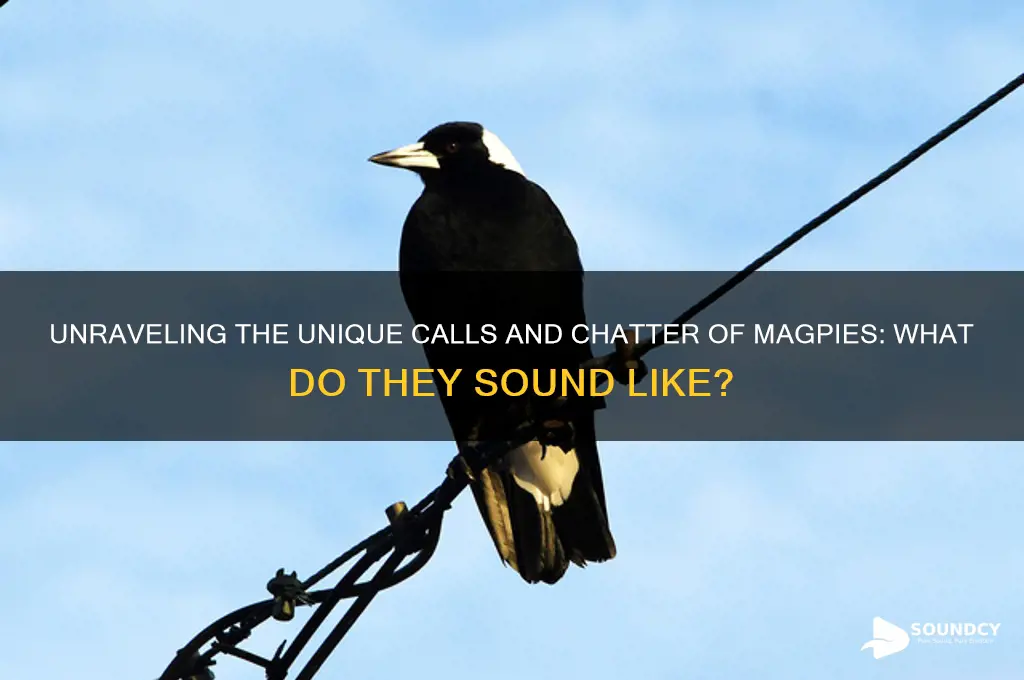
In the United States, a magpie usually sounds like a fast, harsh chatter rather than a clear song. The familiar Black-billed Magpie often gives a rough series of “chack-chack” or “yak-yak” notes. Its call may also sound like a dry rattle, croak, squeak, or short whistle.
The exact sound depends on the species, the bird’s mood, and what it is doing. A magpie may call to warn other birds, defend its nest, contact a mate, or gather near food. Its voice is often loud enough to stand out across an open yard, farm, park, or mountain valley.

What a magpie call sounds like
A magpie call is usually rough, nasal, and chattering. It does not have the smooth, musical quality linked with many songbirds.
The Black-billed Magpie, the main magpie species across much of the western United States, commonly makes:
- Fast, repeated “chack” or “yak” notes
- Harsh rattles
- Low croaks
- Short squeaks
- Nasal calls with a grating tone
- Softer contact sounds between mates or family members
A simple written version might look like:
“Chack-chack-chack!”
“Yak-yak-yak!”
“Krrr-aak!”
These spellings are only rough guides. Bird calls do not translate neatly into human words. The best way to recognize the sound is to notice its rhythm, pitch, and texture.
A magpie often sounds as if several dry notes are being pushed together. The call may begin with one sharp note, speed up, and then stop suddenly. In other cases, the bird gives a longer rattle or a low, throaty sound.
Why magpie calls can sound harsh
Magpies belong to the crow family, Corvidae. Like crows, ravens, and jays, they have strong voices and a wide range of calls.
Their calls can sound harsh for several reasons:
-
The sound is rich in rough tones.
Roughness comes from fast changes and overlapping sound in the voice. -
Many calls carry over long distances.
A loud, sharp call helps birds stay in contact in open country. -
The call may be an alarm.
Alarm calls often sound urgent, repetitive, and unpleasant to human ears. -
Magpies use more than one kind of vocal sound.
A bird calling at a predator may sound very different from one calling to a mate or fledgling.
The rough voice is not a sign that the bird is sick. It is a normal part of magpie communication.

Black-billed Magpie sounds in the United States
The Black-billed Magpie is found mainly in the northern and western United States, including parts of the Rocky Mountain region and the Great Plains. It also occurs widely in western Canada.
Its most familiar call is a harsh, chattering sound. Bird references often describe it as a nasal, grating, or rasping call. Some recordings sound like a short burst of dry chatter, while others have a deeper, more rattling quality.
Black-billed Magpies may call when:
- A hawk, eagle, coyote, dog, or person approaches
- Another magpie enters the bird’s territory
- A pair stays in contact
- Young birds beg for food
- Several birds gather around food or a dead animal
- The birds defend a nest
the call can change with the situation. A bird near a nest may call again and again. A bird moving through trees may give shorter contact notes. A flock may create a noisy, uneven chorus rather than one clear pattern.
A note about the “song”
Black-billed Magpies can also make quieter, more varied sounds. During courtship or close contact, they may use soft warbles, murmurs, whistles, or other low vocal sounds.
These sounds are easy to miss because they are much quieter than the common alarm call. If you hear only loud chatter, you are hearing one part of the magpie’s vocal range, not its full set of sounds.
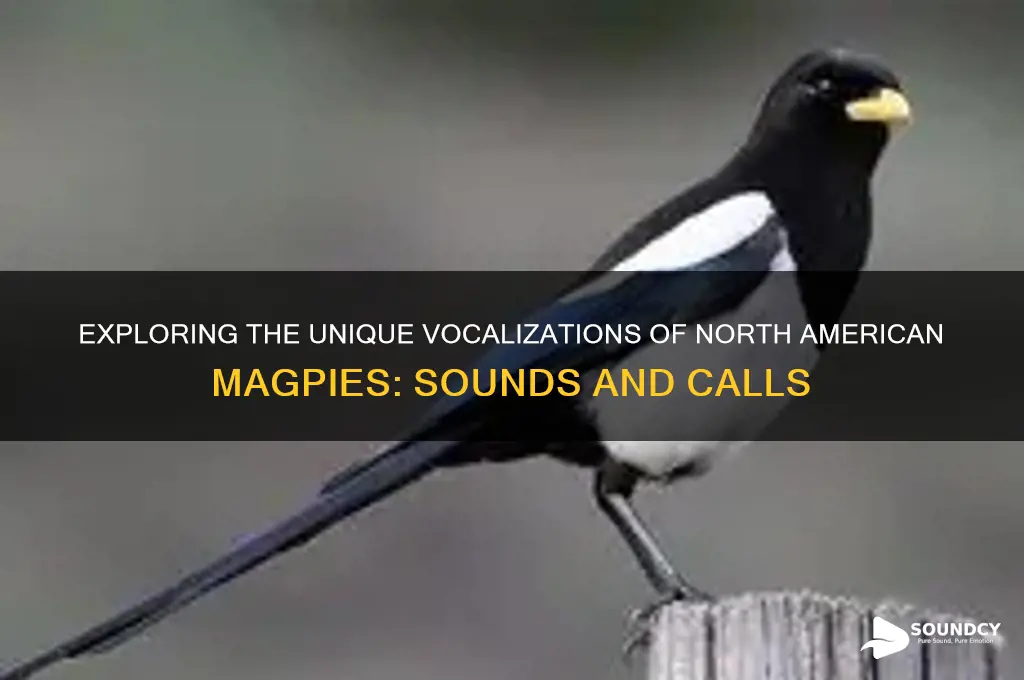
Yellow-billed Magpie sounds
The Yellow-billed Magpie lives mainly in California. It looks similar to the Black-billed Magpie but has a yellow bill and a more limited range.
Its calls are also commonly described as harsh, nasal, and chattering. A Yellow-billed Magpie may give a fast rattle or a series of rough notes. The voice can resemble the Black-billed Magpie, so location is often a key clue.
If you are in California and see a magpie with a yellow bill, the sound may belong to a Yellow-billed Magpie. If you are in the northern Rocky Mountains or the Great Plains, a Black-billed Magpie is more likely.
Do not identify the species from sound alone when the ranges overlap with other corvids. Use the bird’s bill color, body pattern, habitat, and location as well.
How to tell a magpie from a crow, raven, or jay
Magpies, crows, ravens, and jays can all make loud calls. Their voices may overlap, especially when you hear them from far away.
| Bird | Common sound quality | Useful clue |
|---|---|---|
| Magpie | Harsh chatter, rattle, croak, or nasal notes | Often a quick, uneven burst of rough sounds |
| American Crow | Clear, repeated “caw” | Usually deeper and more evenly spaced |
| Common Raven | Deep croak, gronk, or hoarse call | Lower and more resonant than most magpie calls |
| Blue Jay | Loud “jeer,” shriek, whistle, or mimicry | More varied pitch and often more piercing |
| Steller’s Jay | Harsh, raspy calls and whistles | Often a stronger, more ringing quality |
These are broad comparisons, not strict rules. Birds change their calls, and sound can be altered by wind, buildings, hills, and trees.
Magpie versus crow
A crow often gives a clear, repeated “caw.” A magpie usually sounds more broken and busy. Its call may include several rough notes packed close together.
For example:
- Crow: “Caw … caw … caw”
- Magpie: “Chack-chack-chack!”
- Raven: “Gronk … croak”
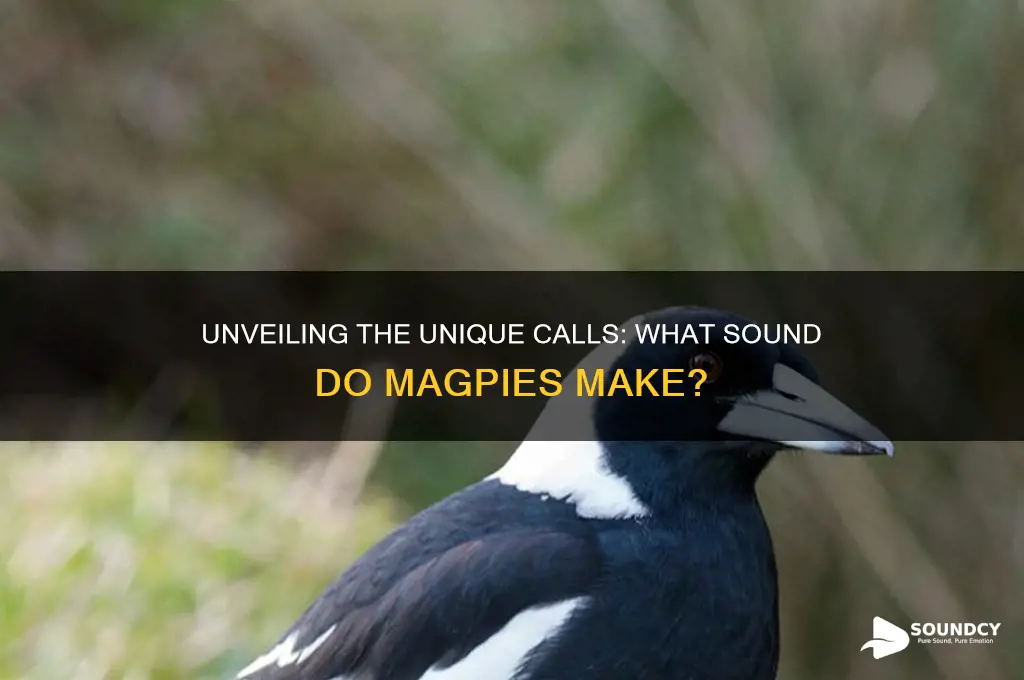
A magpie may also move while calling. Look for a long tail, strong black-and-white contrast, and flashes of blue or green in the wings and tail.
Magpie versus blue jay
A Blue Jay often sounds louder and more varied than a magpie. It may give whistles, screams, rattles, and calls that imitate other birds.
A magpie’s common call is often more nasal and repetitive. A Blue Jay may sound more like a sharp whistle or shriek, while a magpie often sounds like dry chatter.

What does a magpie sound like at different times?
The same bird may sound different from one moment to the next. Context is one of the best ways to understand a magpie call.
When a magpie is alarmed
An alarmed magpie may call rapidly and repeatedly. It may face the threat, raise its tail, spread its wings, or move from branch to branch.
You may hear this behavior when:
- A hawk or owl enters the area
- A cat approaches a nest
- A person walks near young birds
- A rival bird enters the territory
Alarm calls often sound louder and more urgent than normal contact calls.
When magpies are feeding
Magpies may become noisy around food. Several birds may call, hop, chase one another, or gather on the ground.
Their calls may signal the location of food or warn others to keep away. A bird feeding alone may stay quiet, especially if it feels exposed.
During nesting season
Magpies may call more often near a nest or nesting area. Adults may give alarm calls when people, pets, or predators approach.
Young magpies also make begging sounds. These can be thin, high-pitched, repetitive, or buzzy. A nestling or fledgling may call to an adult for food even when the adult is out of sight.
When magpies are in a group
A group can produce a noisy mix of calls. One bird may begin, and others may answer. The result may sound like a rapid exchange of rattles and chatter.
This group noise does not always mean the birds are fighting. It may reflect social contact, feeding, movement, or a shared response to danger.

How to identify a magpie by sound
Sound alone can suggest a magpie, but the strongest identification combines sound with place, appearance, and behavior.
Use this quick process:
-
Listen for the texture.
Is the call rough, dry, nasal, or rattling rather than smooth? -
Listen for the rhythm.
Does the bird give a rapid burst of short notes? -
Check the location.
Black-billed Magpies are most likely in the western and north-central United States. Yellow-billed Magpies are mainly in California. -
Look for the tail.
Magpies have a long, noticeable tail that may be nearly as striking as the voice. -
Check the color pattern.
Black-billed Magpies have black-and-white plumage with blue or green gloss in good light. Yellow-billed Magpies have a yellow bill. -
Compare nearby birds.
If the call is a clean “caw,” consider an American Crow. If it is a deep, low croak, consider a Common Raven. -
Record the sound if possible.
A short recording can help you compare the call with trusted field guides and bird-recording libraries.
The sound may seem louder than expected because magpies often call from exposed branches, utility poles, fences, or rooftops. Hard surfaces can also reflect the sound and make it seem as if more than one bird is calling.
Can magpies mimic human speech?
Magpies can copy or imitate some sounds, but they are not usually known for human speech in the same way that captive parrots are.
As members of the crow family, magpies have flexible vocal behavior. Some may imitate other birds, animals, or environmental sounds. However, a rough call should not be assumed to be imitation.
A sound that resembles speech may come from:
- A bird copying a nearby sound
- A young bird begging
- A call distorted by distance or echo
- Another species, such as a jay or starling
- A human-made sound near the bird
The safest identification method is to pair the recording with a visual sighting and a known range.

Why is a magpie calling near my house?
A magpie may call near a home because it has found food, noticed a threat, joined other magpies, or is defending a nesting area.
Common reasons include:
- Pet food or uncovered garbage is available
- A bird bath or water source is nearby
- A predator is in the yard
- The bird sees a dog, cat, or person as a threat
- Another magpie is nearby
- A nest or fledgling is close
- The bird is moving through its normal territory
Repeated calling does not always mean the bird is in distress. Watch the bird’s behavior before deciding what to do.
If magpies are gathering because of food, secure garbage, bring pet food indoors, and clean up scraps. Do not approach a nest or young bird. Keep cats indoors and dogs on a leash near active nesting areas.
Magpies are wild birds. Do not feed them by hand, handle them, or attempt to keep one as a pet.
Do magpies sing?
Magpies do sing, but their song is usually quieter and less musical than the songs of many common backyard birds.
A magpie’s softer vocal display may include murmurs, warbles, whistles, and low chattering sounds. It may occur during courtship, pair bonding, or close contact between family members.
The loud, rough call is the sound most people notice. The softer vocalizations are more likely to be heard when the birds are close, relaxed, or partly hidden.
This difference explains why descriptions of magpie sound can seem inconsistent. One person may describe a magpie as harsh and noisy, while another may report soft whistles or warbles. Both descriptions can be accurate.

Common mistakes when identifying a magpie call
Several mistakes can lead to a wrong identification.
Mistaking any harsh bird call for a magpie
Many birds make raspy or harsh sounds. Blue Jays, Steller’s Jays, crows, ravens, grackles, and some hawks may sound rough.
Use location and appearance to support the identification.
Assuming every magpie sounds the same
Species, age, sex, season, and situation can affect the sound. A warning call may be much louder than a contact call.
Ignoring distance and echoes
A call across a valley may sound deeper. A call near a wall may echo. Wind can also blur short notes into one long rattle.
Relying only on written spellings
Words such as “chack,” “yak,” and “croak” help describe a call, but they are not exact audio labels. Compare a recording when possible.
Confusing a magpie with a jay
Jays often have more dramatic pitch changes. Magpies tend to produce rough, fast chatter, but the distinction is not perfect. A clear view of the bird remains valuable.
Where to hear a real magpie call
For reliable examples, use established bird references and sound archives rather than short, unlabeled social media clips.
Useful sources include:
- Cornell Lab of Ornithology’s All About Birds: species pages often include call descriptions, recordings, range maps, and identification details.
- The Macaulay Library: a large archive of bird sound and video recordings maintained by the Cornell Lab.
- The National Audubon Society: species information and bird-identification resources.
- The Cornell Lab Merlin Bird ID app: useful for exploring bird sounds, though automated results should be treated as suggestions rather than proof.
- The xeno-canto sound archive: a community-supported collection of bird recordings from around the world.
Search for the exact species, such as Black-billed Magpie sound or Yellow-billed Magpie call. Check the recording location because regional species differences matter.
Key takeaways
- A magpie usually sounds like harsh, rapid chatter.
- Black-billed Magpies often give rough “chack” or “yak” notes, rattles, croaks, and nasal calls.
- Yellow-billed Magpies have similar vocal qualities but are mainly found in California.
- Alarm calls are often louder and faster than contact calls.
- Magpies can also make soft warbles, murmurs, and whistles.
- Use the bird’s location, bill color, long tail, and plumage to confirm what you hear.
- A recording from Cornell’s Macaulay Library or another trusted archive is more useful than a written sound spelling alone.
Frequently asked questions
Is a magpie sound pleasant or harsh?
Most people find the common magpie call harsh, scratchy, or noisy. Magpies also make quieter sounds that may seem softer and more musical.
Do magpies make a “caw” sound?
They can make sounds that resemble a caw, but a typical magpie call is more chattering, nasal, and rattling than the clear “caw” of an American Crow.
Are magpies noisy birds?
Magpies can be noisy, especially when they are alarmed, defending a nest, gathering around food, or communicating in a group. They are not calling loudly all the time.
What does a baby magpie sound like?
A young magpie may make thin, repetitive begging calls. These sounds can be higher and more buzzy than an adult’s harsh chatter.
How can I stop magpies from calling near my home?
Remove food sources such as unsecured trash and outdoor pet food. Keep pets away from nests, and avoid approaching the birds. If a magpie is calling at a predator, the noise may stop when the threat leaves.
Conclusion
A magpie in the United States most often sounds like a quick burst of harsh chatter, dry rattles, or nasal “chack” notes. The Black-billed Magpie is the species many people hear in the western states, while the Yellow-billed Magpie is mainly associated with California.
To identify one with confidence, combine the sound with the bird’s range, long tail, bill color, and black-and-white plumage. Listen for the situation, too: alarm, feeding, nesting, and social calls can all sound different.