

In the United States, the bird often called a “red-breasted grosbeak” is usually the Rose-breasted Grosbeak (Pheucticus ludovicianus). Its song is a rich, sweet warble that often sounds like a softer, more musical version of an American Robin. The song includes clear whistles, rising and falling notes, and short pauses.
The bird also gives sharp call notes. These may sound like a quick “chink,” “pik,” or metallic chip. If you hear a beautiful, robin-like song near a woodland edge, especially in the eastern or central United States, a Rose-breasted Grosbeak may be the source.

Quick Answer: What Does a Rose-breasted Grosbeak Sound Like?
A Rose-breasted Grosbeak sounds like a clear, rich, warbling song made of whistles and soft musical phrases. Each song can vary, but it often has these traits:
- A full, smooth tone
- Clear notes that rise and fall
- Short pauses between phrases
- A sound similar to an American Robin
- A softer and more flowing quality than a robin’s song
- Repeated phrases that may last several seconds
The song is not a simple repeated whistle. It is more like a small stream of notes flowing together. Some phrases sound bright and cheerful, while others can seem slightly mournful.
The bird’s common call is different. It is short, sharp, and often metallic. A listener may hear a fast “chink” or “pik” instead of the longer song.
Simple sound guide
| Sound | What it may resemble | Main use |
|---|---|---|
| Song | A rich American Robin song with smoother whistles | Attracting a mate and defending territory |
| Contact call | A short chip or metallic “chink” | Staying in touch with other birds |
| Alarm call | A sharper, more urgent note | Warning of danger |
| Flight call | A brief, distinct chip | Calling while moving or flying |
The exact sound can change with the bird, season, location, and situation. Young birds and females may also produce less familiar songs.

What the Rose-breasted Grosbeak Song Sounds Like
The Rose-breasted Grosbeak song is a series of clear whistles and warbling phrases. The notes often blend together, so the song may seem to change direction as it moves from high to low tones.
A typical song may sound like this in loose human terms:
“Cheer-up, cheer-a-lee, sweet-sweet, what-a-beauty.”
This spelling is only an imitation. Bird sounds do not fit neatly into human words, and different birds may sing very different phrases.
The song often has three useful features:
-
A strong, flute-like tone
The notes are usually clean and musical rather than buzzy or harsh. -
A rising and falling pattern
The melody may climb, drop, and then shift into another phrase. -
Variable phrases
The bird does not always repeat one exact tune. It may change the order, length, or pitch of its notes.
The song can carry well through a forest. It may seem close at first, even when the bird is high in a tree or hidden by leaves.
Does it sound like an American Robin?
Yes, the comparison is useful, but the two songs are not identical.
Both birds produce long, musical songs with changing phrases. A Rose-breasted Grosbeak often sounds richer, smoother, and more flute-like. An American Robin may sound more familiar and slightly more conversational, with clearer pauses between phrases.
The comparison is not a strict rule. Robins vary greatly, and environmental noise can make the two birds harder to separate.
Does it sound like a wood thrush?
A Rose-breasted Grosbeak can also remind listeners of a Wood Thrush, but the Wood Thrush usually has a more haunting, echoing quality. Wood Thrush songs often include distinct flute notes that seem to overlap or resonate.
The grosbeak’s song is generally more like a flowing whistle or warble. If the sound has a strong echo inside each note, a Wood Thrush may be a better match.

Rose-breasted Grosbeak Calls Versus Its Song
The easiest way to avoid confusion is to separate the bird’s song from its calls.
A song is usually longer and more complex. Male Rose-breasted Grosbeaks use it during the breeding season to attract mates and mark territory. The song may continue for several seconds and include many connected notes.
A call is shorter. It may consist of one note or a brief group of notes. The bird can use calls during flight, while feeding, when contacting another bird, or when reacting to danger.
Common Rose-breasted Grosbeak calls
The most familiar call is a short, sharp note often described as:
- “Chink”
- “Chee”
- “Pik”
- A metallic chip
The call may sound harder and more abrupt than the song. It can also seem nasal or slightly buzzy, depending on the distance and recording quality.
When the bird is alarmed, its notes may become faster or more urgent. A single call is not always enough for a firm identification. Look for a group of clues: the sound, habitat, time of year, and visible features.

When and Where You May Hear One in the United States
Rose-breasted Grosbeaks breed across much of the northern and eastern United States. Their range includes parts of the Northeast, Great Lakes region, Upper Midwest, Appalachian Mountains, and northern plains. They also occur in parts of western mountain regions during migration or the breeding season.
Many birds spend the winter in Mexico, Central America, and the Caribbean. In the United States, listeners often hear them during spring migration and the breeding season. Fall migration can also bring them through gardens, parks, and woodland edges.
You are most likely to hear one in:
- Deciduous forests
- Forest edges
- Second-growth woodland
- Parks with mature trees
- Rural yards with shrubs and feeders
- Areas near streams or woodland clearings
The best time to listen is often early morning. Birds tend to sing more when the air is calm and background noise is low. After rain, the song may be easier to hear because fewer insects and machines compete with it.
The bird may sing from a high branch. Do not assume the sound comes from a low shrub simply because it seems nearby. Dense leaves can make distance and direction hard to judge.

Male and Female Rose-breasted Grosbeaks Can Both Sing
Male Rose-breasted Grosbeaks are the singers most people notice, but females can also sing. This fact matters because a bird that sings does not have to be a brightly colored male.
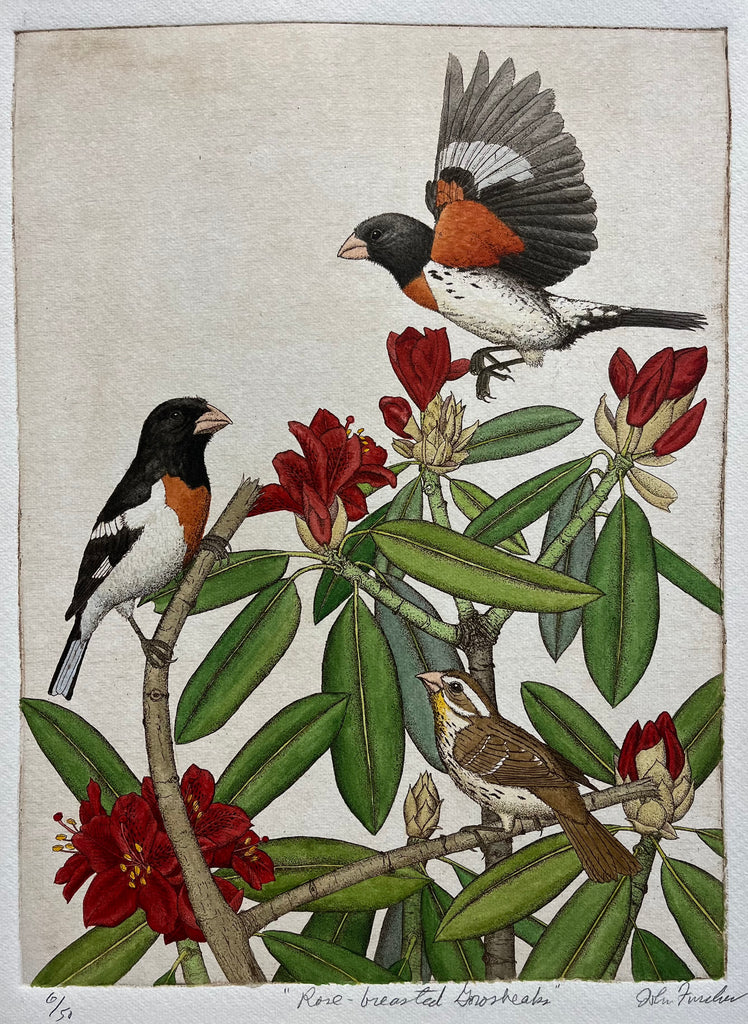
The male has a black-and-white body with a vivid red or rose-colored patch on the chest. The female is more brown and streaked, with a pale eyebrow and a less dramatic pattern.
Both sexes may produce songs or song-like sounds, especially during the breeding season. Their voices can be difficult to separate by ear alone. Visual clues can help, but a hidden bird may need a recording or careful observation for confirmation.
The bird’s age can also affect its appearance and sound. Juveniles may show less clear adult plumage and may not produce the full song associated with an adult male.

How to Identify a Rose-breasted Grosbeak by Sound
Use several clues instead of relying on one phrase. A practical identification process looks like this:
-
Listen to the song’s shape.
Is it a long, smooth warble with clear whistles and changing pitch? -
Check the habitat.
Is the bird in a forest, woodland edge, park, or leafy yard? -
Note the season.
Spring and summer are strong possibilities in much of the United States, while migration can bring the bird to other areas. -
Watch for movement.
Look high in trees, especially near open branches or the edge of a forest. -
Check the visual pattern.
A male may show a red chest patch. A female may look brown, streaked, and sparrow-like. -
Compare a recording.
Use a trusted field guide or the Cornell Lab of Ornithology’s Rose-breasted Grosbeak sound recordings.
A sound-identification app can help, but treat its result as a clue rather than proof. Wind, traffic, overlapping birds, and poor recordings can produce errors.
A useful comparison with similar birds
| Bird | Typical sound clue | How it differs |
|---|---|---|
| Rose-breasted Grosbeak | Rich, smooth warble with clear whistles | Full song with a strong, flowing quality |
| American Robin | Cheerful phrases with clear pauses | Often sounds more familiar and conversational |
| Wood Thrush | Echoing flute notes | More haunting and resonant |
| Purple Finch | Sweet, fast warble | Usually shorter and more hurried |
| Northern Cardinal | Clear whistles and repeated phrases | Often more distinct, with recognizable paired notes |
| Black-headed Grosbeak | Melodic song with varied whistles | More likely in western parts of the United States |
These comparisons are general. Individual birds vary, and habitat can change how a song sounds.

How to Listen for the Bird More Clearly
You do not need special equipment to hear a Rose-breasted Grosbeak, but a few simple habits can help.
Stand still for a minute after you hear the first phrase. The bird may stop singing when you move. Scan the highest branches near the sound, then check nearby trees and shrubs.
If you use binoculars, avoid staring at one small area. Move slowly across the canopy. The bird may be partly hidden or may shift to another branch between phrases.
For a recording, keep the phone or microphone pointed toward the sound. Record several seconds before and after the song. A longer clip gives you more useful evidence than a single short note.
Do not play loud recordings to attract the bird. Playback can disturb birds, especially during nesting. If you use a reference recording, keep the volume low and stop when you have enough information to compare the sound.
Common Mistakes When Identifying the Sound
The most common mistake is assuming every musical forest song comes from a thrush. Rose-breasted Grosbeaks, robins, finches, cardinals, and thrushes can all produce rich songs that overlap in broad character.
Another mistake is focusing on a written phrase such as “cheer-up.” Bird-song words are rough memory aids. The same bird may sound different from one recording to the next, and one listener’s “cheer-up” may be another listener’s “whistle-whistle.”
Background noise can also change the apparent pitch. Traffic may hide low notes, while wind can make a clear song sound broken or rough.
Finally, do not identify the bird from sound alone when the recording is short or distant. A good identification combines sound with location, season, habitat, and appearance.

Key Takeaways
- The “red-breasted grosbeak” is usually the Rose-breasted Grosbeak in the United States.
- Its song is a rich, musical warble with clear whistles and rising and falling phrases.
- It may sound somewhat like an American Robin, but often has a smoother, more flute-like quality.
- Its call is shorter and sharper, often resembling a metallic “chink” or “pik.”
- Both male and female Rose-breasted Grosbeaks can produce song-like sounds.
- Use habitat, season, visual traits, and a trusted recording to confirm an identification.
Frequently Asked Questions
Is there a bird called a red-breasted grosbeak?
The name “red-breasted grosbeak” is commonly used by mistake for the Rose-breasted Grosbeak. The official common name used in major North American field references is Rose-breasted Grosbeak.
What does a Rose-breasted Grosbeak sound like at night?
Rose-breasted Grosbeaks are mainly heard during the day. Migration can sometimes produce calls at night, but nocturnal sounds may be brief and harder to identify. A long, musical song heard after dark is less typical.
Do female Rose-breasted Grosbeaks sing?
Yes. Males are more often noticed singing, but females can also sing. A singing bird is not always a male.
How can I tell a Rose-breasted Grosbeak from a robin?
Both may produce rich, changing songs. A Rose-breasted Grosbeak often sounds smoother and more flute-like, while an American Robin frequently uses clearer, more separated phrases. Habitat and visual features can help confirm the difference.
What should I do if a sound-identification app says it is a Rose-breasted Grosbeak?
Listen again and check the result against the bird’s range, habitat, season, and appearance. Use the app as one piece of evidence. A clean recording with several song phrases is more useful than a short clip with wind or traffic.
Conclusion
A Rose-breasted Grosbeak sounds like a rich, flowing song of whistles and warbled phrases. The closest everyday comparison is often a smoother, more musical American Robin, though the bird’s voice can vary from one individual to another.
If you hear that song in a leafy yard, woodland edge, or eastern U.S. forest, listen for the metallic “chink” call and look high in the trees. Those clues, combined with the bird’s season and appearance, can turn a pleasant sound into a confident identification.
2 thoughts on “What Does A Red-Breasted Grosbeak Sound Like: Song Guide”