
Introduction
For birders in the United States, the magnificent bird-of-paradise is a rare sight. This small, colorful bird does not live wild in the continental U.S. Its natural home is the mountain forests of New Guinea. Most Americans will encounter it through a major zoo, a museum display, wildlife footage, or a bird book.
The name can also cause confusion. The magnificent bird-of-paradise is Diphyllodes magnificus. It is not the same bird as the superb bird-of-paradise, Lophorina superba, which is famous for turning its blue breast shield into a dark oval during courtship.
This guide explains how to identify the magnificent bird-of-paradise, where it lives, how it breeds, what it eats, and what its conservation status means.

What Is the Magnificent Bird-of-Paradise?
The magnificent bird-of-paradise is a small member of the bird-of-paradise family, Paradisaeidae. Its scientific name is Diphyllodes magnificus.
Birds in this family are known for bright feathers, unusual shapes, and complex courtship displays. In many species, males have more striking feathers than females. The males use those feathers to attract mates, while the females often have brown or olive plumage that helps them blend into forest shade.
The magnificent bird-of-paradise is sometimes listed under older or alternate common names, including:
- Magnificent bird-of-paradise
- Magnificent riflebird in some older references
- Diphyllodes magnificus
- A member of the genus Diphyllodes
The common name is not the same as the scientific name for the greater bird-of-paradise, Paradisaea apoda, or the king bird-of-paradise, Cicinnurus regius. These are separate species with different body shapes and displays.
The species is recognized by major bird references, including the Cornell Lab of Ornithology Birds of the World and the IOC World Bird List. Taxonomic treatment can change as researchers study regional forms, so older field guides may use different groupings or names.

How to Identify a Magnificent Bird-of-Paradise
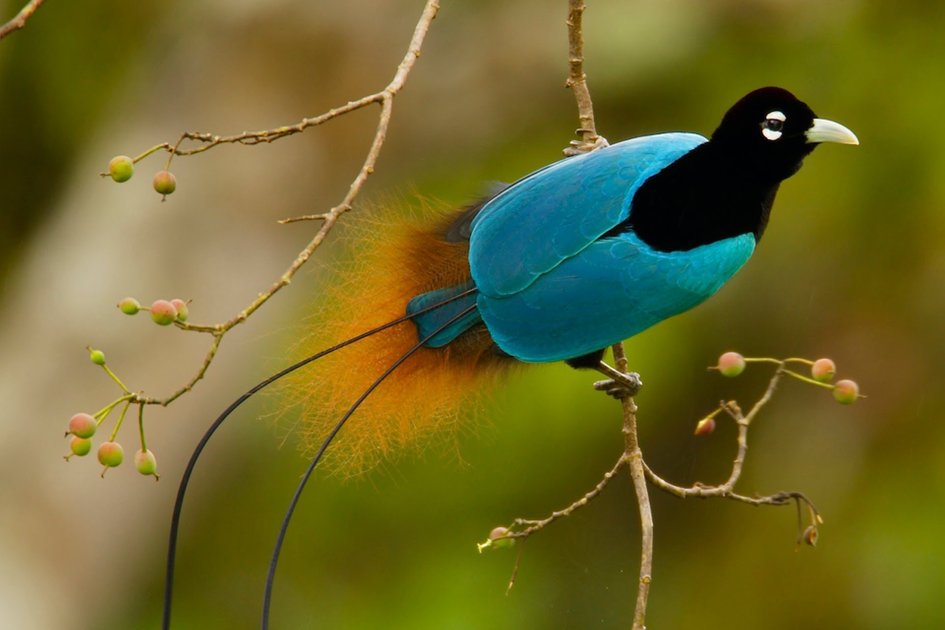
The male is easier to identify than the female because his plumage is bright and highly shaped. He has a dark body, a colorful breast area, a yellow or golden mantle, and long, curved flank feathers that can form a bold ornament during display.
Male identification
Look for these main traits:
- A compact body with a short, strong bill
- Dark blue, green, or purple tones on the head and breast
- A bright yellow or golden cape across the upper back
- Red or orange ornamental feathers along the sides
- Long, curved flank plumes
- A short tail compared with many other birds-of-paradise
- A strong contrast between dark body feathers and bright display feathers
Lighting can change the bird’s appearance. Iridescent feathers may look black, blue, green, or violet depending on the angle of the sun. This is a useful clue when viewing photographs or birds in a shaded forest.
Female identification
The female is less colorful. She is usually brown, olive, or buff, with darker markings across the body. Her plain plumage provides camouflage while she searches for food and raises young.
The female’s appearance is important because many people expect every bird-of-paradise to look bright. In this species, the difference between male and female is a clear example of sexual dimorphism, which means the sexes have different physical traits.
Magnificent versus superb bird-of-paradise
These two birds are often mixed up because both live in New Guinea and both have dramatic male courtship displays.
| Feature | Magnificent bird-of-paradise | Superb bird-of-paradise |
|---|---|---|
| Scientific name | Diphyllodes magnificus | Lophorina superba |
| Main display feature | Golden mantle and curved flank plumes | Dark, shield-like breast and head display |
| Body shape | Small, compact, colorful | More compact with a broad display shield |
| Common confusion | Bright cape and side feathers | Oval black-and-blue courtship shape |
| Natural region | New Guinea | New Guinea |
The safest way to identify a bird from a photo is to check the shape of the display feathers, not color alone. Iridescent plumage may look different in each image.
Where Does the Magnificent Bird-of-Paradise Live?
The magnificent bird-of-paradise lives on the island of New Guinea, which is divided politically between Papua New Guinea and the Indonesian provinces of Papua. It is a tropical species of the Australasian region.
It uses forest habitats that provide fruit, insects, cover, and display sites. Depending on the regional form, it may occur in:
- Lowland rainforest
- Hill forest
- Montane forest
- Forest edges
- Secondary forest in some areas
Many records place the species in forested areas from low elevations into the mountains. Exact elevation limits vary by subspecies and location, so a single range should not be applied to every population.
New Guinea has some of the largest remaining areas of tropical forest in the Asia-Pacific region. However, forests face pressure from logging, mining, agriculture, roads, and local habitat change. A bird may remain locally common while still losing suitable habitat across parts of its range.
The magnificent bird-of-paradise is not native to the United States. It should not be treated as a North American bird, even when it appears in an American zoo or bird collection.

What Does the Magnificent Bird-of-Paradise Eat?
The magnificent bird-of-paradise eats a mix of fruit and small animal prey. Its diet may include:
- Soft fruits
- Berries
- Insects
- Spiders
- Other small arthropods
Fruit gives the bird energy, while insects and other small prey provide protein. The bird’s diet may change with season and local food supply.
By eating fruit, the species may help move seeds through the forest. This does not mean every individual plant depends on this one bird. Seed dispersal is part of a wider network that includes many birds, mammals, and other animals.
A bird in a managed collection may receive a carefully planned diet that does not match its wild diet exactly. Zoo diets often use a mix of fruit, insects, formulated food, and supplements under veterinary care. Feeding a wild bird fruit in an American yard will not attract this species because it does not occur naturally in U.S. neighborhoods.

How Does Its Courtship Display Work?
The male magnificent bird-of-paradise uses bright feathers and body movement to attract a female. Courtship displays can include posture, feather spreading, wing or body movement, and calls.
The golden mantle and long flank feathers are central visual features. When the male raises or arranges these feathers, his body can look much larger and more complex than it does while resting.
The display serves more than one purpose:
- It helps the male stand out in dense forest.
- It shows the female the color, shape, and condition of his feathers.
- It gives the female a chance to inspect the male at close range.
- It may help females compare several males.
The female does not simply respond to the brightest color. Courtship can involve position, movement, sound, feather condition, and the quality of the display site. The male’s success may also depend on whether the female can approach safely and see the display clearly.
Like many birds-of-paradise, the magnificent bird-of-paradise is a good example of sexual selection. This is the process in which traits that improve mating success become more common, even when those traits do not directly help survival.
A long feather or bright patch can make a bird more visible to predators. Yet if females prefer that feature, males with it may still leave more offspring. Over many generations, this can produce the extreme ornaments seen in birds-of-paradise.

Nesting and Reproduction
The female is expected to carry most of the work of nesting and raising the young, as is common among many birds-of-paradise. The male’s main role is courtship and mating rather than parental care.
A typical breeding process includes:
- Choosing a suitable nest site
- Building a small nest from plant fibers
- Laying a small clutch of eggs
- Incubating the eggs
- Feeding and protecting the young after hatching
Published details can vary by region because the species is difficult to study in dense rainforest. Researchers may also describe different subspecies or populations separately.
The female’s brown plumage is useful during nesting. A colorful female would be easier for predators to spot while she sits on the nest or moves through low vegetation. Her less noticeable appearance shows how male display feathers and female nesting safety can lead to very different body designs within one species.
Do not assume that a male’s elaborate feathers mean the species forms a permanent pair bond. In many birds-of-paradise, mating behavior is more flexible than the long-term pair systems seen in some familiar North American birds.

Conservation Status and Main Threats
The magnificent bird-of-paradise is generally listed as Least Concern by the IUCN Red List. That category means the species does not currently meet the IUCN thresholds for a threatened category at the global level.
Least Concern does not mean the bird faces no risks. It means the available evidence does not place the species in the higher-risk categories of Vulnerable, Endangered, or Critically Endangered.
Potential threats include:
- Loss of mature forest
- Logging and forest fragmentation
- Mining and road construction
- Conversion of forest to farms or plantations
- Local hunting in some areas
- Climate-related changes to food and habitat
The size and condition of each regional population may differ. A global status can also hide local declines. Conservation planning must therefore protect forest at the landscape level, not only preserve a few isolated display or nesting sites.
The most useful actions for people in the United States are indirect but meaningful:
- Support credible rainforest conservation groups.
- Choose wood and paper from responsible sources.
- Avoid buying wildlife products made from protected birds.
- Follow all rules at zoos and aviaries.
- Share accurate information about New Guinea’s forest species.
Never buy feathers, skins, or stuffed specimens advertised as genuine magnificent bird-of-paradise material. Laws can vary, and possession or trade may be illegal under U.S. wildlife regulations.

Can You See a Magnificent Bird-of-Paradise in the United States?
You may be able to see one in the United States, but only in a zoo, aviary, museum collection, or other licensed setting that keeps the species. It is not a wild U.S. bird.
Availability changes. A facility may list a species online but keep it off public display during breeding, veterinary care, or exhibit changes. Before traveling, check the facility’s current animal list and contact its bird department if the species is not clearly listed.
When viewing a magnificent bird-of-paradise, follow these practices:
- Stay on marked paths.
- Do not tap on glass or barriers.
- Avoid flash photography unless the facility permits it.
- Keep noise low during displays.
- Never feed the bird.
- Follow staff instructions during breeding behavior.
A zoo display can help visitors understand the bird’s colors and courtship anatomy. It cannot reproduce the full conditions of a New Guinea rainforest. Captive viewing should therefore support, not replace, interest in wild habitat protection.

Common Misconceptions
It is not a bird from the Caribbean
The name “bird-of-paradise” can sound like it refers to tropical islands near the United States. The magnificent bird-of-paradise is from New Guinea, north of Australia.
It is not the same as a bird-of-paradise flower
The bird is an animal. The bird-of-paradise flower usually refers to plants in the genus Strelitzia, especially Strelitzia reginae. The plant name comes from the flower’s shape, which resembles a bird’s head.
A bright male is not always displaying
A male may show bright feathers while moving, feeding, or reacting to another bird. A full courtship display involves a pattern of posture and movement, not just a moment when a feather catches the light.
A plain female is not a different species
The brown female may look unrelated to the colorful male. In many cases, however, the two are the same species. Sex, age, lighting, and regional variation can all affect appearance.
“Magnificent” does not mean largest
The common name describes the bird’s striking appearance. It does not mean this species is the largest bird-of-paradise or the most closely related to every other species with a similar name.

Frequently Asked Questions
Is the magnificent bird-of-paradise endangered?
The species is generally assessed as Least Concern by the IUCN. Local populations may still face habitat loss, hunting, or other pressures.
What is the scientific name of the magnificent bird-of-paradise?
Its scientific name is Diphyllodes magnificus.
Where is the magnificent bird-of-paradise found?
It is found in New Guinea, including areas under the administration of Papua New Guinea and Indonesia. It lives mainly in tropical forest and may occur across lowland, hill, and mountain habitats.
What does the male magnificent bird-of-paradise look like?
The male has dark iridescent plumage, a bright yellow or golden mantle, and colorful curved flank feathers. The exact color can change with light and viewing angle.
What does the female magnificent bird-of-paradise look like?
The female is mainly brown, olive, or buff with darker markings. Her subdued color helps her blend into forest vegetation.
Is the magnificent bird-of-paradise the same as the superb bird-of-paradise?
No. The magnificent bird-of-paradise is Diphyllodes magnificus. The superb bird-of-paradise is Lophorina superba. Their male displays use different feather structures.
Can I keep one as a pet in the United States?
A private person should not assume this species can be legally owned or responsibly kept. Wildlife laws, permits, import rules, and animal-care requirements may apply. These birds also need specialized care and are not suitable pets for a typical household.
Conclusion
The magnificent bird-of-paradise, Diphyllodes magnificus, is a New Guinea forest bird known for its golden mantle, iridescent colors, and curved display feathers. Its courtship shows how sexual selection can shape extraordinary plumage, while the plain female reflects the demands of nesting and survival.
For U.S. readers, the best way to see this species is through a reputable zoo, museum, or trusted wildlife resource. To help protect it, support forest conservation and avoid illegal wildlife products. When checking an identification, confirm the scientific name because the magnificent bird-of-paradise is often confused with the superb bird-of-paradise and other members of the same family.